
Lamu Old Town, a coral-stone Swahili harbour town
Published on 09/08/2026 at 15:59 | Editorial responsibility: Rafael Müller, Editor-in-Chief AD HOC NEWS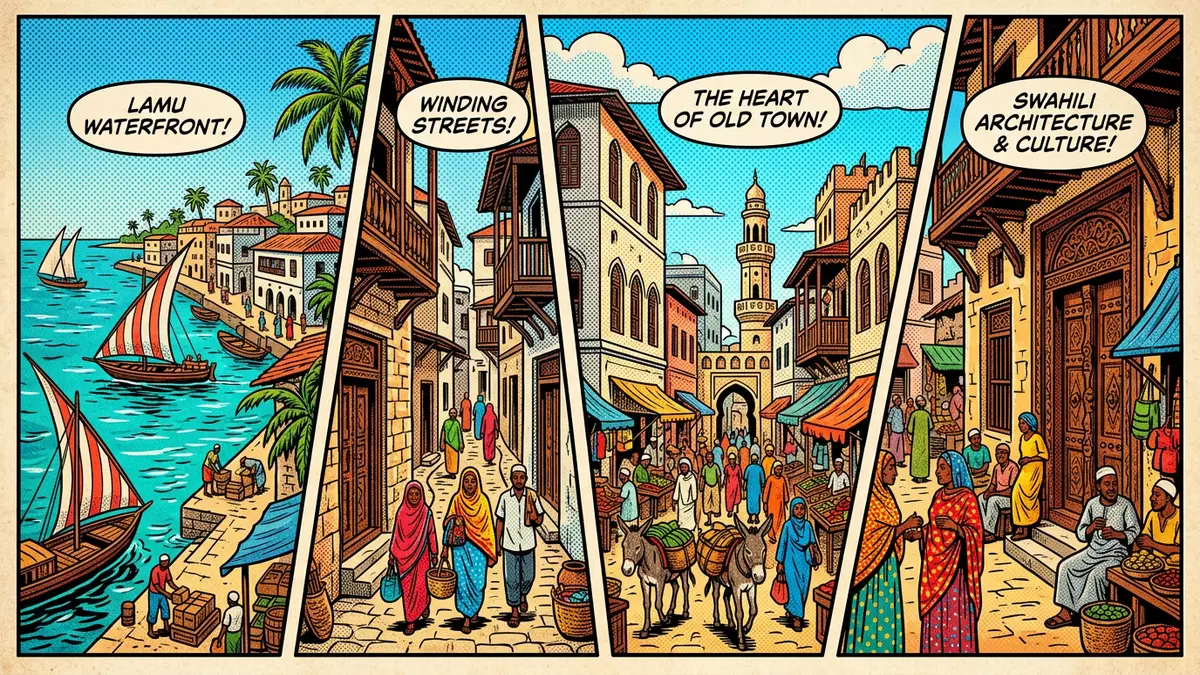
Lamu Old Town on Lamu Island, off Kenya’s northern coast, is a compact Swahili harbour town where coral-stone houses, carved timber doors and Islamic learning have shaped urban life for centuries. The settlement forms part of the Lamu Archipelago in the Indian Ocean and was inscribed as a World Heritage Site in 2001 as an outstanding example of a Swahili coastal town that has retained its traditional functions.World Heritage Site in 2001
Coral stone, mangrove timber and the Swahili streetscape
Lamu Old Town occupies a small area on the eastern side of Lamu Island, facing a sheltered channel across the water towards Manda Island and the wider Indian Ocean. The town’s building fabric is defined by coral stone walls and mangrove timber beams, a construction tradition that gives the streets pale textured surfaces and dark timber details in doorways and verandas.built in coral stone and mangrove timber Many houses rise over several storeys with mostly blank ground-floor façades, punctuated by heavy wooden entrance doors, while upper levels carry small windows and sheltered verandas overlooking the lanes.
Within this dense streetscape, domestic architecture carries the strongest visual identity of Lamu Old Town. Houses are arranged along narrow streets and around inner courtyards, with shaded verandas and elaborately carved doors marking the transition from public lane to private interior.inner courtyards and carved doors The timber doors themselves are substantial pieces of carpentry, built from thick planks and carved in geometric and floral patterns that form a layer of ornament against otherwise restrained walls. Together with simple plastered façades and the rhythm of small window openings above, these features create a streetscape in which detail appears in concentrated points rather than across entire fronts.
A Swahili harbour town shaped by Indian Ocean trade
Lamu Old Town represents more than seven centuries of continuous urban settlement on the northern Kenyan coast, with its origins in the medieval period and its development tied to Indian Ocean trade routes linking East Africa to Arabia, Persia and India.oldest Swahili settlement on the East African coast Over this long period the town functioned as a coastal centre for merchants, scholars and sailors, forming part of a wider network of Swahili city-states along the shore. The harbour-facing edge of the town opens onto waters used by dhows and small boats, with simple landing points and waterfront buildings marking the connection between sea routes and the inland lanes.
Across the centuries the town’s culture has drawn on Bantu, Arab, Persian, Indian and later European influences, visible in its language, religious traditions and architecture.diverse cultural influences Coral stone and mangrove timber form the structural core, while decorative carving and spatial organisation reflect Islamic and Swahili ideas about privacy, shade and social life. Within the compact town are mosques, religious schools and meeting spaces interwoven with houses and small commercial premises, so that religious observance and everyday routines share the same fabric of lanes and courtyards.centre for Islamic and Swahili cultures
Layout, movement and daily life in the lanes
The urban plan of Lamu Old Town is characterised by narrow streets and passageways that bend between houses, creating a fine-grained network of routes scaled to pedestrian and animal movement rather than large vehicles.a compact Swahili settlement In places the lanes broaden into small open spaces and waterfront edges, but much of the town retains the feeling of corridors defined by continuous walls and projecting verandas. The modest width of the streets and their irregular alignment reflect incremental growth over centuries as houses were added in relation to one another and to the harbour.
Within this setting, movement in Lamu Old Town is closely tied to the scale of the streets. Walking and the use of donkeys for transport fit the dimensions of the lanes and support a townscape in which buildings, people and animals share limited space. Religious occasions, domestic routines and commercial activities unfold in close proximity, with mosques, madrassas, houses and small shops opening directly onto the same passages. The overall effect is a living coastal town that has retained its historic building fabric while continuing to serve as a centre of Swahili and Islamic culture on Kenya’s northern shore.inscribed as a cultural World Heritage site
Visiting Lamu Old Town: what travellers from Western Europe should know
- Lamu Old Town lies on Lamu Island in the Lamu Archipelago off Kenya’s northern coast, reached via connections through mainland Kenya and onward boat services from nearby landing points.
- The town’s lanes are narrow and largely arranged for walking and donkey transport, with uneven stone surfaces and occasional steps between different levels.
- Lamu Old Town faces a sheltered channel towards Manda Island, and parts of the waterfront offer views of dhows and small boats crossing shallow Indian Ocean waters.
- The official language is Swahili and the currency is the Kenyan shilling.
- Entry requirements depend on your nationality; UK travellers can check the FCDO travel advice at gov.uk/foreign-travel-advice, Irish travellers the Department of Foreign Affairs at ireland.ie.
Searching for Lamu Old Town on social platforms
These links open searches for Lamu Old Town on each platform.Frequently asked questions about Lamu Old Town
Where is Lamu Old Town and what kind of place is it?
Lamu Old Town lies on Lamu Island in the Lamu Archipelago on Kenya’s northern Indian Ocean coast, and is a historic Swahili harbour settlement.
What should visitors expect when walking through Lamu Old Town?
Visitors encounter narrow coral-stone streets lined with multi-storey houses, inner courtyards, shaded verandas and carved timber doors opening directly onto the lanes.
What makes Lamu Old Town distinctive among coastal towns in East Africa?
Lamu Old Town is recognised as the oldest and best-preserved Swahili settlement on the East African coast, with coral-stone and timber architecture supporting more than seven centuries of urban life.


