
Lamu Old Town, a coral-stone Swahili harbour on Kenya’s coast
Published on 09/05/2026 at 14:43 | Editorial responsibility: Rafael Müller, Editor-in-Chief AD HOC NEWS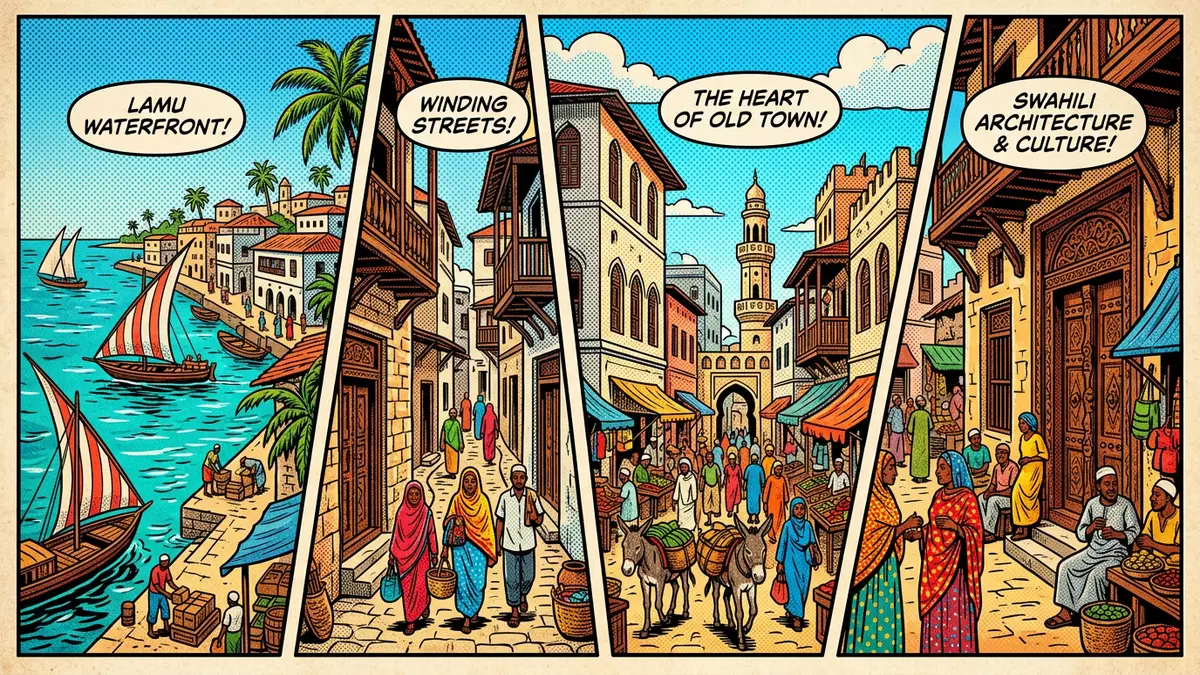
Lamu Old Town on Lamu Island is a compact Swahili harbour settlement of coral-stone houses and narrow streets facing a sheltered channel of the Indian Ocean. Its townscape reflects more than seven centuries of continuous urban life, shaped by trade, scholarship and religion along Kenya’s northern coast.
A medieval Swahili town on Lamu Island
Lamu Old Town lies on Lamu Island in the Lamu Archipelago off the north coast of Kenya, some distance north of Mombasa along the East African shoreline.located on an island by the same name The old town occupies a strip of land along the island’s eastern shore, with its buildings oriented towards the narrow channel that separates Lamu from neighbouring Manda Island.buffer zone covering Indian Ocean waters and the Manda Island skyline
The settlement is part of a wider archipelago and forms the historic core of Lamu, which is considered one of Kenya’s oldest continually inhabited towns, with urban life dating back to the twelfth century.dates to the twelfth century and cradle of Swahili culture Its position along Indian Ocean trade routes made it an important coastal seaport in East Africa, connecting the Swahili coast with Arabia, Persia, India and, later, Europe.
Coral stone, mangrove timber and carved doors
The fabric of Lamu Old Town is built largely from coral stone and mangrove timber, materials drawn from the surrounding coast and creeks.built in coral stone and mangrove timber Many houses rise above narrow lanes with enclosed inner courtyards, shaded verandas and elaborately carved wooden doors that mark the main entrances from the street.features such as inner courtyards, verandahs and elaborately carved wooden doors The simplicity of the overall structural forms contrasts with the fine detail of the doors and plasterwork, where geometric and calligraphic motifs appear in relief.
The architecture and urban structure of the town are described as a clear expression of cultural influences from Arabia, India and Europe, all filtered through Swahili building techniques over several centuries.architecture and urban structure demonstrate cultural influences from Europe, Arabia and India Within the old town stand public buildings such as Lamu Fort, the Lamu Museum housed in a former warehouse and the historic German Post Office, interspersed with mosques and residential compounds.German Post Office, Lamu Museum and Lamu Fort Together they form a streetscape in which everyday domestic life, religious practice and maritime trade have long been intertwined.
A World Heritage harbour of scholarship and faith
Lamu Old Town was inscribed on the UNESCO World Heritage List in 2001 as a cultural site under criteria (ii), (iv) and (vi).inscribed on the World Heritage List in 2001 The inscription recognises the town as the oldest and best-preserved Swahili settlement in East Africa, with a layout and building fabric that have retained their integrity over centuries of use.oldest and best preserved Swahili settlement in East Africa
Lamu’s role as a trading port brought merchants and scholars whose presence gave the town a strong religious and educational character within the region.paramount trading role and attraction for scholars and teachers Important Islamic and Swahili cultural celebrations have continued there since the nineteenth century, and Lamu Old Town has become significant for the study of Islamic and Swahili cultures. The town’s living traditions, combined with its architectural coherence, make it a place where historical layers remain visible in everyday life.
Visiting Lamu Old Town: what travellers from Western Europe should know
- Lamu Old Town lies on Lamu Island off Kenya’s north coast, reached by local boat services across the channel from the mainland jetty at Mokowe and by regional flights serving Lamu.
- The streets in the old town are narrow and primarily laid out for walking and donkey transport, with uneven stone surfaces and stepped passages between harbourfront and inland quarters.
- The settlement sits at sea level beside the Indian Ocean, with lanes running close to the waterfront and some paths exposed to tidal spray during periods of strong wind and high water.
- The official language is Swahili alongside English, and the currency is the Kenyan shilling.
- Entry requirements depend on your nationality; UK travellers can check the FCDO travel advice at gov.uk/foreign-travel-advice, Irish travellers the Department of Foreign Affairs at ireland.ie.
Searching for Lamu Old Town on social platforms
These links open searches for Lamu Old Town on each platform.
Frequently asked questions about Lamu Old Town
Where is Lamu Old Town?
Lamu Old Town is on Lamu Island in the Lamu Archipelago off Kenya’s northern coast, facing a sheltered Indian Ocean channel opposite Manda Island.
What should visitors expect in Lamu Old Town?
Visitors encounter a dense Swahili townscape of coral-stone houses, mosques and public buildings along narrow lanes and a waterfront where boats serve the harbour.
What makes Lamu Old Town distinctive?
Lamu Old Town is recognised as a UNESCO World Heritage site for its long-lived Swahili urban fabric, carved wooden doors and enduring role in Islamic and Swahili scholarship.


