
Lalibela’s rock-hewn churches carved into living stone
Published on 09/15/2026 at 22:52 | Editorial responsibility: Rafael Müller, Editor-in-Chief AD HOC NEWS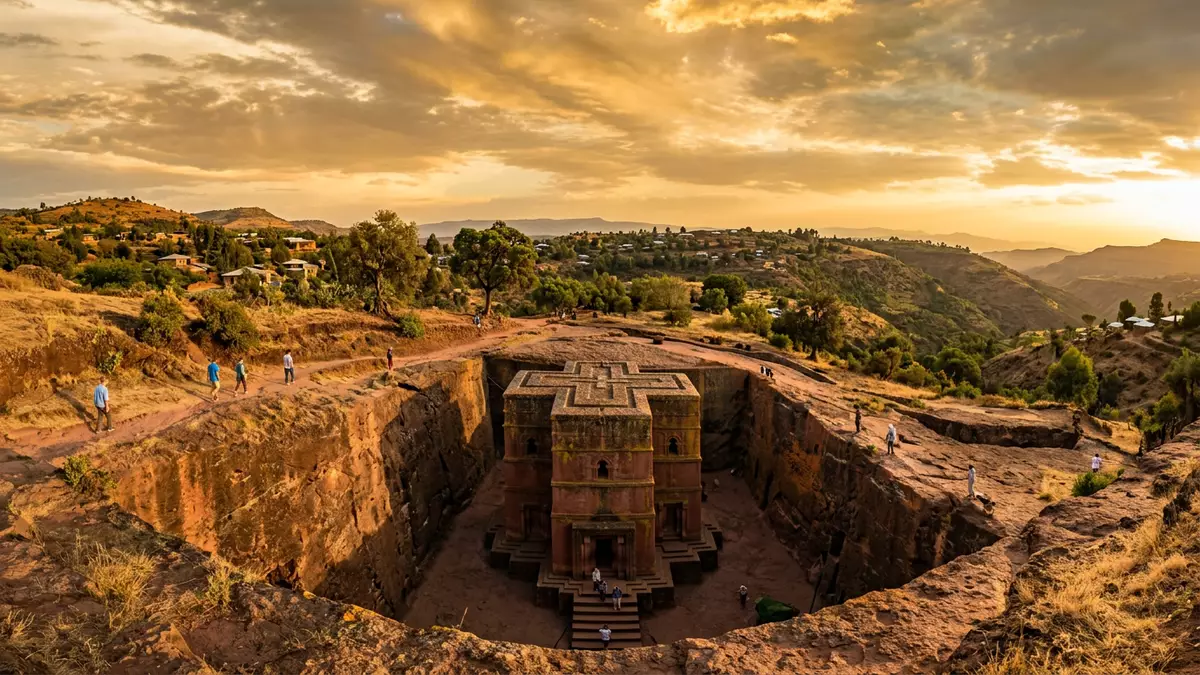
Lalibela in northern Ethiopia is defined by a group of rock-hewn churches carved directly into the highland plateau, turning living stone into an entire sacred townscape. The complex is traditionally dated to the late twelfth and early thirteenth centuries and is closely associated with King Gebre Meskel Lalibela of the Zagwe dynasty.
A sacred city cut from volcanic rock
The rock-hewn churches of Lalibela form one of Ethiopia’s most remarkable concentrations of religious architecture, with eleven monolithic churches carved from a single mass of volcanic rock within the Ethiopian Highlands. The complex stands in the Lasta district in the Amhara Region, where the plateau rises to about 2,500 m (8,200 ft) above sea level.highland setting at 2,500 m The churches are recognised as a UNESCO World Heritage Site and were inscribed on the World Heritage List in 1978 as a cultural property.World Heritage inscription in 1978
The stone from which the churches are carved is predominantly red volcanic scoria underlain by darker basalt, giving the walls and façades a distinctive colour contrast between warm-toned upper surfaces and cooler, shadowed foundations.red volcanic scoria and basalt Trenches were cut down through the plateau to isolate blocks of living rock, which were then carved externally and internally from the top downward, transforming the isolated masses into freestanding churches with façades, windows and interior spaces entirely shaped from the original stone.carved from living rock
Groups of churches and their layout
The eleven churches are conventionally described in several groups, separated by trenches and a seasonal watercourse often referred to as a symbolic river. To the north of this channel stand churches such as Biete Medhane Alem, Biete Maryam, Biete Maskal, Biete Denagel and the combined complex of Biete Golgotha Mikael.northern group of churches To the south lie churches including Biete Amanuel and Biete Qeddus Mercoreus, while a further group contains Biete Gabriel Rafael and Biete Abba Libanos.
Among the most recognisable is Biete Giyorgis (House of Saint George), a church carved as a freestanding block of rock reached by a sunken passage. This church sits slightly apart from the main clusters yet remains connected through a network of trenches and paths that thread through the site.Biete Giyorgis as a freestanding monolith Within each church, interior spaces range from simple halls with pillars carved from the same rock to more intricate layouts that echo the spatial organisation of traditional Ethiopian Orthodox churches.
Medieval Ethiopia and the “New Jerusalem” idea
The Lalibela complex belongs to the flourishing period of the Zagwe dynasty in the late twelfth and early thirteenth centuries, when Roha, later renamed Lalibela, served as an important political and religious centre.Zagwe dynasty context The site is closely associated with King Gebre Meskel Lalibela, whose name the town now bears and who is widely linked with the commissioning of the rock-hewn churches.King Gebre Meskel Lalibela The churches are laid out with Biblical references, and elements such as the naming of the watercourse as a “Jordan” reflect this scriptural geography.
Lalibela is recognised as a major centre of Ethiopian Orthodox Christianity, and its churches have served as places of worship, monastic life and pilgrimage for many centuries.major pilgrimage site for Ethiopian Orthodox Christians The religious function remains central to daily life around the churches, with liturgical chants, processional routes and spaces for prayer woven into the carved passages and courtyards. Architecturally, the complex represents one of the most ambitious programmes of rock-cut construction in medieval Africa, combining structural ingenuity with theological symbolism in the way the churches are grouped and oriented.
Visiting Lalibela: what travellers from Western Europe should know
- Lalibela lies in the Lasta district of Ethiopia’s Amhara Region, north of Addis Ababa, and is reached by domestic flights to the local airport or by road from regional centres.
- The churches and their connecting passages are carved below the plateau surface, so visiting involves descending into rock-cut trenches and climbing stairways between different levels.
- Many approaches to individual churches follow narrow paths cut into the rock, with uneven surfaces that require steady footing, particularly around the sunken courts.
- The complex stands at high altitude in the Ethiopian Highlands, where the air is thinner than in most Western European cities and the terrain around the site includes slopes and escarpments.
- The official language is Amharic and the currency is the Ethiopian birr.
Searching for Lalibela on social platforms
These links open searches for Lalibela on each platform.Frequently asked questions about Lalibela
Where is Lalibela?
Lalibela is a highland town in the Lasta district of the Amhara Region in northern Ethiopia, set within the Ethiopian Highlands at about 2,500 m (8,200 ft).
What can a visitor expect at the rock-hewn churches?
A visitor encounters a cluster of eleven Ethiopian Orthodox churches carved from a single mass of volcanic rock, reached by sunken passageways, rock-cut courts and stairways.
What makes the Lalibela churches distinctive among religious sites?
The churches are entirely carved from living volcanic rock, grouped with Biblical references such as a symbolic river, and have been recognised as a UNESCO World Heritage Site since 1978.


