
Lal Qila in Delhi, a Mughal palace fortress of red sandstone
Published on 09/05/2026 at 20:14 | Editorial responsibility: Rafael Müller, Editor-in-Chief AD HOC NEWS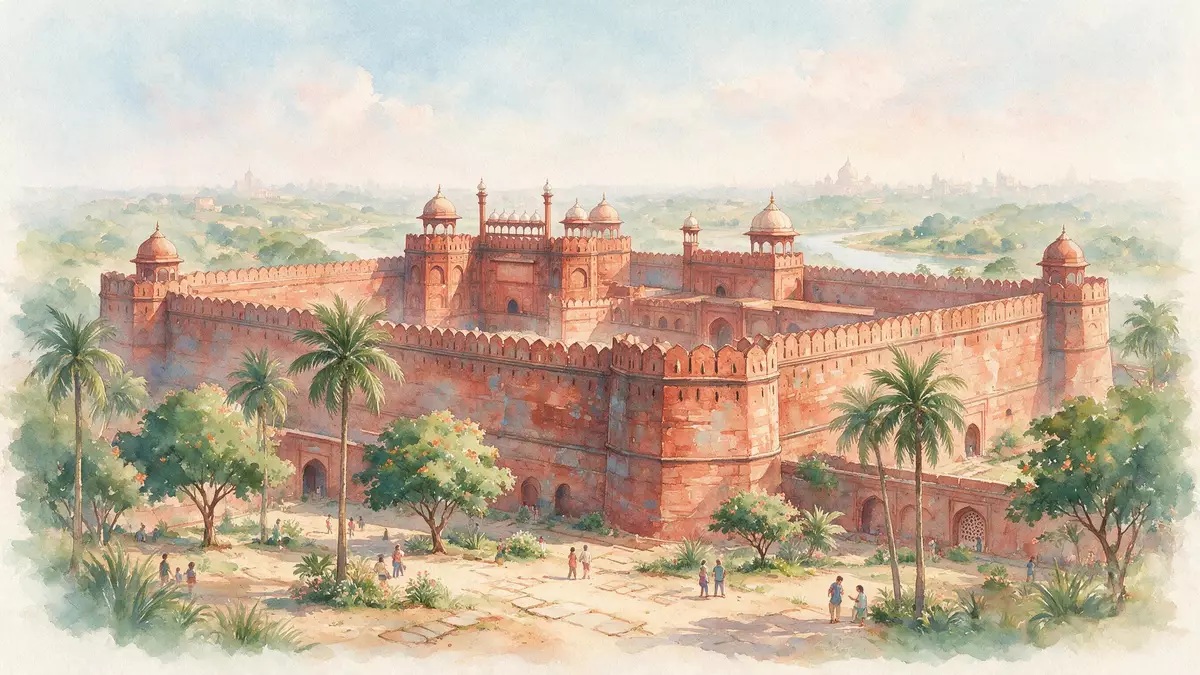
Lal Qila in Delhi, better known internationally as the Red Fort, is a monumental Mughal palace fortress built in the seventeenth century as the heart of Shah Jahan’s new imperial capital. Rising above the streets of Old Delhi, its high red sandstone walls and ceremonial gateways frame a sequence of gardens and marble pavilions that once housed the Mughal court.
Shah Jahan’s fortified palace for Shahjahanabad
The story of Lal Qila begins with the Mughal emperor Shah Jahan, who ruled from 1628 and decided in the late 1630s to shift his capital from Agra to Delhi, founding the planned city of Shahjahanabad along the Yamuna river.the Red Fort Construction of the fort complex started in 1639 and it was completed in the 1640s, providing a walled palace for the emperor and his court.palace fort of Shahjahanabad Inside the enclosure, separate zones served different courtly functions, from public audiences to private gardens.
Lal Qila served as the main residence of the Mughal emperors from the completion of the complex until the mid-nineteenth century, when imperial rule from the fort ended in the aftermath of the 1857 uprising.residence of Mughal emperors from 1648 to 1857 The fort later housed British colonial administration for a period, and in the twentieth century it became closely associated with India’s independence, adding later layers of meaning on top of its Mughal origins.seat of Mughal power
Architecture in red sandstone and white marble
From outside, Lal Qila is defined by its long curtain walls and bastions built in red sandstone, which give the fort its name and set it apart from the surrounding city fabric.towering red sandstone walls These ramparts enclose an irregular polygonal plan aligned with the river, with monumental gateways opening towards the city and towards the riverfront. Beyond the main gate, a processional route leads through arcaded spaces to the inner courts.
Within the enclosure, the material palette shifts from red sandstone to pale, carved marble, reflecting the Mughal taste of Shah Jahan’s reign. Audience halls, throne pavilions and private palaces display a refined Indo-Islamic architectural style that blends Persian, Timurid and Indian elements in their arches, columns and ornamental panels.Indo-Islamic architecture Many structures once faced formal gardens laid out on geometric lines, linking built spaces and planting in a continuous sequence.
UNESCO World Heritage fort and layered history
Lal Qila is recognised as the core of the Red Fort Complex, which has been inscribed as a UNESCO World Heritage Site, underlining its importance as an example of Mughal palace architecture and urban planning.Red Fort Complex UNESCO inscription The complex includes the main fort and the nearby Salimgarh Fort, reflecting the way successive defences shaped the riverfront edge of Shahjahanabad.
The fort has seen significant historical events, including invasions and political trials in the eighteenth and twentieth centuries, and parts of the original Mughal fabric were lost or altered during British occupation.only a part of the original buildings remain Even with these changes, walking through Lal Qila still reveals a sequence of surviving pavilions, halls and garden traces that convey its former role as an imperial residence and its continuing symbolic weight in India’s political life.enduring symbol of sovereignty
Visiting Lal Qila: what travellers from Western Europe should know
- Lal Qila stands in Old Delhi on the eastern side of the historic city, close to the Yamuna river and the Chandni Chowk area, with approach roads leading to its main gate.
- The fort’s interior involves substantial walking along stone and brick surfaces, with changes of level between gateways, courtyards and gardens that include stepped approaches.
- The official language is Hindi and the currency is the Indian rupee.
- Entry requirements depend on your nationality; UK travellers can check the FCDO travel advice at gov.uk/foreign-travel-advice, Irish travellers the Department of Foreign Affairs at ireland.ie.
Searching for Lal Qila on social platforms
These links open searches for Lal Qila on each platform.
Frequently asked questions about Lal Qila
Where is Lal Qila located in Delhi?
Lal Qila stands on the eastern edge of Old Delhi, close to the Yamuna river and the historic Chandni Chowk district.
What should visitors expect inside the fort?
Visitors enter through monumental gateways into a sequence of stone streets, courtyards, halls and garden areas, with surviving Mughal pavilions in sandstone and marble.
What makes Lal Qila distinctive among Mughal sites?
Lal Qila combines extensive red sandstone fortifications with an inner palace of finely carved marble pavilions and gardens, forming the core of a UNESCO-listed fort complex.


