
Lake Tekapo’s turquoise lake and star-filled Mackenzie skies
Published on 09/15/2026 at 11:30 | Editorial responsibility: Rafael Müller, Editor-in-Chief AD HOC NEWS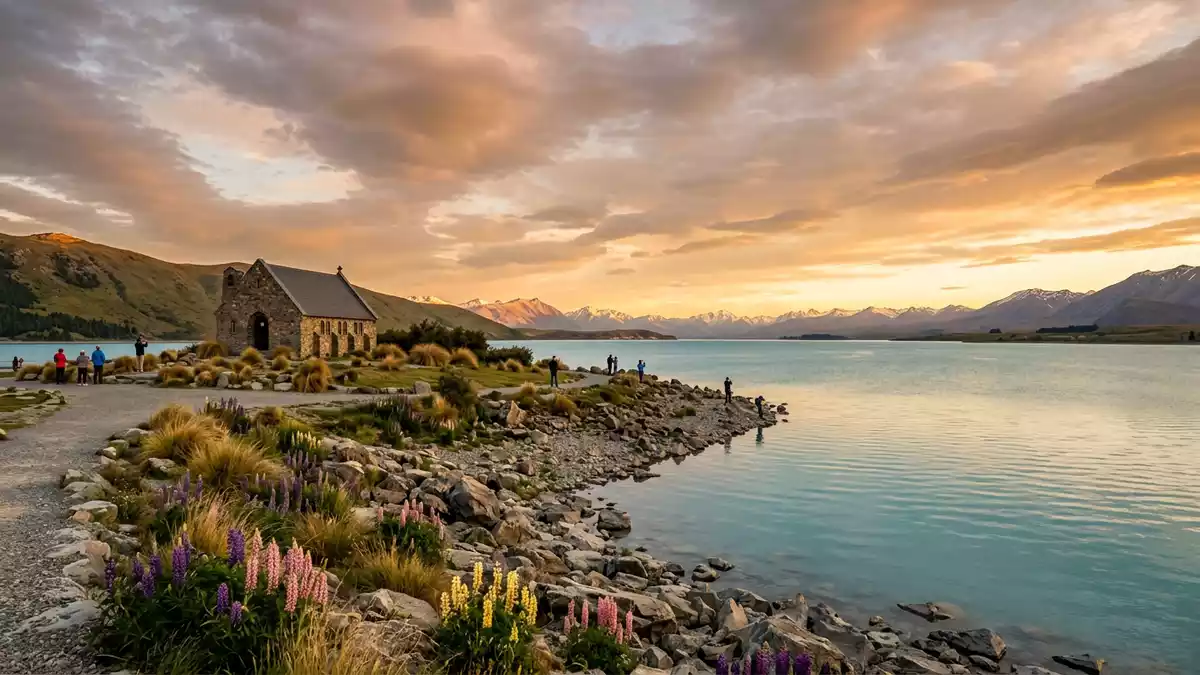
Lake Tekapo in New Zealand’s Mackenzie Basin is defined by two striking elements that visitors notice immediately: the lake’s distinctive turquoise colour and the clarity of the night sky over the surrounding hills. Set among broad tussock grasslands and framed by distant ranges, this highland lake has become a focal point for those interested in dramatic alpine landscapes and astronomy.
A highland glacial lake in the Mackenzie Basin
Lake Tekapo is a glacial lake in the Mackenzie District of the Canterbury region on New Zealand’s South Island, occupying a valley enclosed by moraines at the northern edge of the Mackenzie Basin.Lake Tekapo area description The lake lies at an elevation of about 710 m (2,330 ft) above sea level, giving the settlement on its southern shore an alpine character despite its relatively modest altitude.elevated at 710 metres
The lake is fed at its northern end by braided rivers such as the Godley and Macaulay, which descend from the Southern Alps and carry finely ground rock particles in suspension.fed by Godley and Macaulay rivers These glacial meltwaters refract light in a way that produces Lake Tekapo’s distinctive turquoise hue, which contrasts with the golden tussock grass of the surrounding basin.remarkable turquoise colour Along the shoreline, low gravel beaches and gently sloping ground make the boundary between water and land feel broad and open, with long views northwards toward the Southern Alps.
Mt John and the internationally recognised dark sky
On the western side of Lake Tekapo rises Mt John, a glacially smoothed rock mass described as a roche moutonée, which forms a distinctive low summit above the lake.Mt John roche moutonée The hill provides an elevated platform with broad views over the Mackenzie Basin and the chain of nearby lakes such as Lake Alexandrina. The approach from the lakeside to Mt John passes through open tussock and scattered shrubs, with the lake surface below forming a constant reference point.
Mt John is home to the University of Canterbury’s astronomical observatory, which benefits from the region’s low population density, high number of clear nights and relatively stable atmosphere.Mount John University Observatory The wider Mackenzie region, including Lake Tekapo, has been recognised as part of the Aoraki Mackenzie International Dark Sky Reserve, a designation that reflects the quality of night-time conditions for stargazing and professional observation.Aoraki Mackenzie International Dark Sky Reserve After nightfall, the lack of strong artificial lighting allows stars, the Milky Way and, at certain times, southern constellations to be seen with clarity from the lakeside and surrounding slopes.
The Church of the Good Shepherd on the lakeshore
Near the township on the southern shore stands the Church of the Good Shepherd, a small stone church built in 1935 as a memorial to the pioneers of the Mackenzie Country.opened in 1935 The building sits close to the water’s edge on Pioneer Drive, with its simple rectangular form aligned toward the lake and the distant mountains beyond.location on Pioneer Drive Constructed from local stone with a steeply pitched roof, it contrasts with the expansive landscape that surrounds it.
The Church of the Good Shepherd functions as a place of Christian worship for local residents and visitors, and its interior is relatively modest, focusing attention on the view framed beyond the altar.place of worship for local residents Outside, a low wall and paths lead around the building, connecting the church grounds with the lake shore and nearby boulder-strewn areas. The juxtaposition of the stone church, the turquoise water and the surrounding ranges has made this stretch of shore one of the most recognisable scenes in the Mackenzie Basin.
Visiting Lake Tekapo: what travellers from Western Europe should know
- Lake Tekapo lies in the Mackenzie District in the centre of New Zealand’s South Island, with the township on the southern shore linked to regional roads that connect to other centres in Canterbury.
- The lakeside terrain around the township combines gently sloping ground, gravelly beaches and low rocky outcrops; some paths near the Church of the Good Shepherd and towards Mt John include short, uneven sections.
- In winter conditions, snow can settle around the basin and on nearby hills, while summer visits reveal the contrast between blue water and dry golden tussock on the surrounding slopes.
- New Zealand’s official languages are English, te reo M?ori and New Zealand Sign Language, and the national currency is the New Zealand dollar.
- Entry requirements depend on your nationality; UK travellers can check the FCDO travel advice at gov.uk/foreign-travel-advice, Irish travellers the Department of Foreign Affairs at ireland.ie.
Searching for Lake Tekapo on social platforms
These links open searches for Lake Tekapo on each platform.
Frequently asked questions about Lake Tekapo
Where is Lake Tekapo located?
Lake Tekapo is in the Mackenzie District of the Canterbury region on New Zealand’s South Island, set within the Mackenzie Basin and reached via regional roads.
What can visitors expect on a visit to Lake Tekapo?
Visitors encounter a turquoise glacial lake, open tussock landscapes, views towards the Southern Alps and accessible lakeside paths near the township and the Church of the Good Shepherd.
What makes Lake Tekapo distinctive compared with other New Zealand lakes?
Lake Tekapo combines its glacial turquoise colour and highland basin setting with recognised dark skies over Mt John Observatory and the presence of the lakeside Church of the Good Shepherd.


