
Lake Tana Monasteries, Ethiopia’s painted islands of faith
Published on 08/28/2026 at 20:33 | Editorial responsibility: Rafael Müller, Editor-in-Chief AD HOC NEWS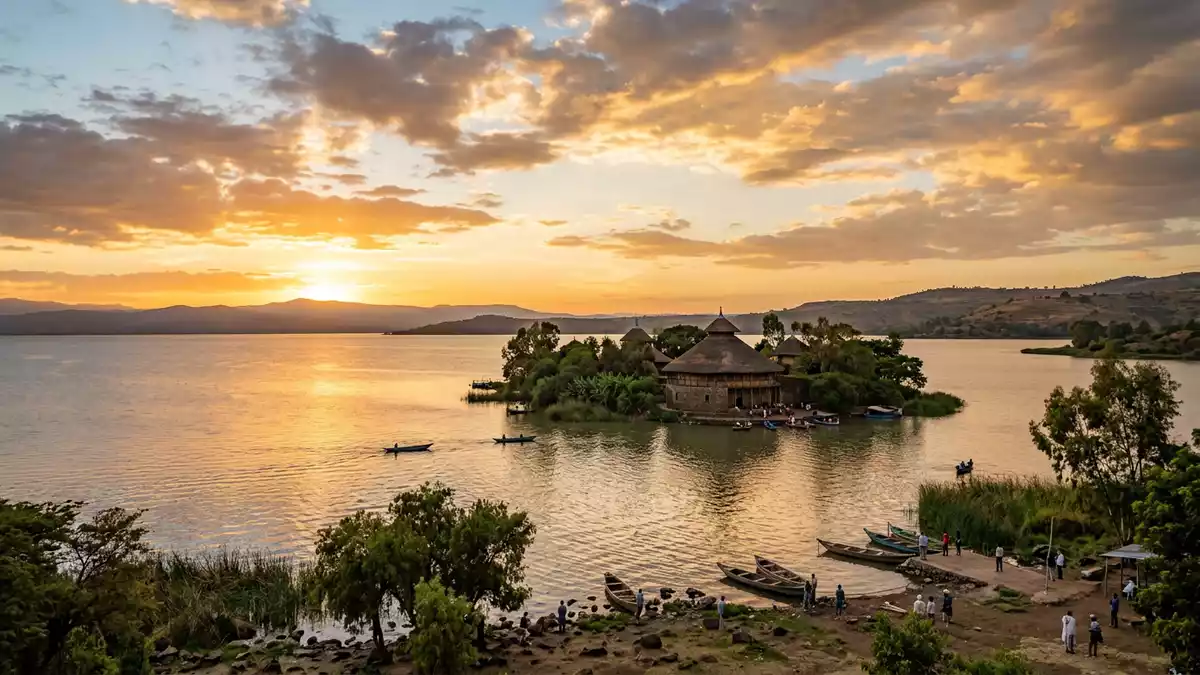
On the broad blue expanse of Lake Tana near Bahir Dar, the Lake Tana Monasteries form a scattered archipelago of churches and monastic compounds that preserve centuries of Ethiopian Orthodox Christian culture. Many of these monasteries were founded between the fourteenth and eighteenth centuries, and their island setting makes them feel distinct from the city on the southern shore.
Lake Tana, sacred islands and a medieval monastic landscape
Lake Tana is the largest lake in Ethiopia and the headwater of the Blue Nile, and its islands and peninsulas shelter monasteries that have become closely associated with the country’s religious history.the largest lake in Ethiopia The lake lies in the Amhara region, with Bahir Dar on its southern shore functioning as the main urban centre and starting point for journeys out to the monastic sites.Bahir Dar on the southern shore
Across Lake Tana there are numerous islands and peninsulas bearing monasteries and churches, many of which were established during a period of monastic revival under medieval rulers such as Emperor Amde Tsion in the fourteenth century.monastic revival under Amde Tsion These foundations created a distinct religious landscape in which monastic communities lived in relative isolation, keeping manuscripts, liturgical objects and relics connected to successive Ethiopian emperors.
Island monasteries: emperors, manuscripts and painted churches
Several island monasteries on Lake Tana are closely linked to royal patronage and imperial burials, making them important sites for understanding Ethiopian state history alongside religious tradition.bodies of important Ethiopian emperors On Dek Island, Narga Selassie was built in the eighteenth century under Empress Mentewab of Gondar and is known for church paintings associated with the Gondarine style, set within a wooded compound that overlooks the central part of the lake.Narga Selassie on Dek Island
Other island monasteries carry different strands of tradition. Tana Cherkos, on the eastern side of Lake Tana, is linked by long-standing stories to the Ark of the Covenant, and its site retains sacrificial stones associated with Jewish rites.Tana Cherkos and sacrificial stones Kebran Gabriel, one of the closest island monasteries to Bahir Dar, is traditionally dated to the fourteenth century and is described as housing a large library of crosses and manuscripts, although access rules there are more restrictive than at some other sites.Kebran Gabriel library of crosses
Zege Peninsula and the painted church of Ura Kidane Mihret
South of the main island groups, the Zege Peninsula projects into Lake Tana and carries its own concentration of monasteries in a landscape of coffee groves and forest.six monastic churches on Zege Among these, Ura Kidane Mihret is particularly noted for its circular church, rich interior murals and collection of church regalia, all sheltered within a monastic enclosure that visitors reach by walking inland from the small landing place on the lakeshore.Ura Kidane Mihret church and regalia
The Zege Peninsula also contains monasteries such as Azwa Mariam, whose church is associated with fourteenth-century foundations and stands within a wooded compound where monastic life continues alongside the reception of visitors from Bahir Dar.Azwa Mariam on Zege Together, the peninsula monasteries and the island churches form one coherent Lake Tana Monasteries region, in which painted interiors, manuscripts and relics sit within simple structures built from local materials such as mud-plastered walls and thatched roofs.
Art, architecture and religious life around Lake Tana
The churches of Lake Tana Monasteries typically follow Ethiopian Orthodox architectural patterns, with circular or polygonal plans organised around a central sanctuary and ringed by one or more ambulatory spaces where murals and icons are displayed on the inner walls.circular church with conical roof Many interiors are covered with vivid paintings that depict saints, biblical scenes and episodes from Ethiopian religious history, using strong colours that stand out against the timber and plaster surfaces.
Because these monasteries developed as centres of learning and manuscript production, visitors encounter not only architecture and painting but also a tradition of conserving written texts and liturgical objects within the monastic compounds.invaluable historical artefacts Lake Tana’s monastic communities continue to follow Ethiopian Orthodox practices, with services, processions and periods of quiet study and prayer taking place within spaces that visitors see only in part, reinforcing the sense that the monasteries remain living religious institutions rather than historical monuments alone.
Visiting Lake Tana Monasteries: what travellers from Western Europe should know
- Lake Tana Monasteries are reached from Bahir Dar on the southern shore of Lake Tana, with boat journeys across the water giving access to islands such as Dek and peninsulas such as Zege.
- Approaches to the monasteries usually involve walking on unpaved paths, with short but sometimes uneven stretches through forest or village terrain between landing places and church compounds.
- Some monasteries, including Kebran Gabriel on its island near Bahir Dar, apply restrictions on access to certain areas, and rules for women and men can differ between sites.
- The official language is Amharic and the currency is the Ethiopian birr.
- Entry requirements depend on your nationality; UK travellers can check the FCDO travel advice at gov.uk/foreign-travel-advice, Irish travellers the Department of Foreign Affairs at ireland.ie.
Searching for Lake Tana Monasteries on social platforms
These links open searches for Lake Tana Monasteries on each platform.
Frequently asked questions about Lake Tana Monasteries
Where are Lake Tana Monasteries located?
Lake Tana Monasteries are found on islands and peninsulas within Lake Tana in the Amhara region of Ethiopia, with Bahir Dar on the southern shore serving as the main access point.
What should visitors expect on a trip to the monasteries?
Visitors travel across the lake by boat and then walk on paths to reach church compounds, where they encounter traditional Ethiopian Orthodox architecture, painted interiors and relics preserved within monastic communities.
What makes Lake Tana Monasteries distinctive among Ethiopian religious sites?
The combination of island geography, medieval foundations linked to emperors and royal patrons, and richly painted churches such as Ura Kidane Mihret on the Zege Peninsula gives Lake Tana Monasteries a distinctive character within Ethiopia’s Orthodox heritage.


