
Lake Nakuru National Park and the mirror of the Rift Valley
Published on 08/16/2026 at 14:22 | Editorial responsibility: Rafael Müller, Editor-in-Chief AD HOC NEWS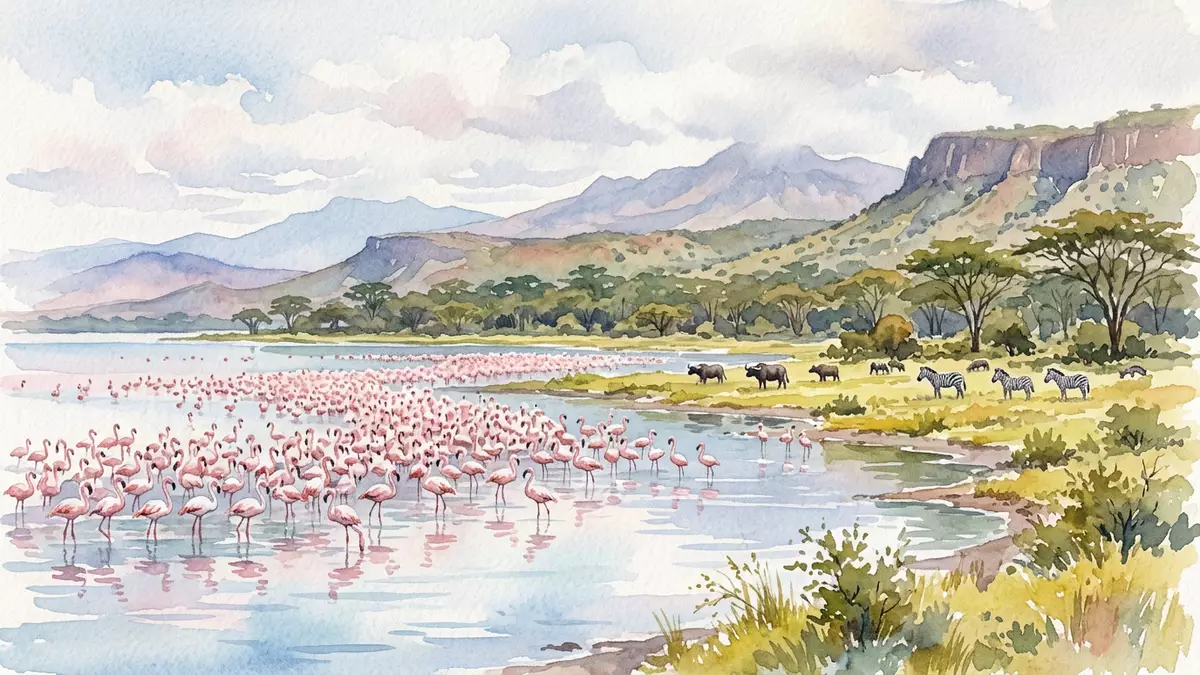
Lake Nakuru National Park in central Kenya gathers a shallow alkaline lake, wooded escarpments and busy grasslands into a compact sanctuary on the floor of the Great Rift Valley. Created as a protected area in 1961 around Lake Nakuru near the growing town of Nakuru, it has become one of Kenya’s flagship conservation landscapes, framed by volcanic hills and highland ridges.Lake Nakuru National Park was created in 1961
A soda lake ringed by escarpments
The geographical heart of Lake Nakuru National Park is Lake Nakuru itself, a very shallow soda lake whose strongly alkaline waters support dense blooms of algae.The lake is described as very shallow and strongly alkaline The lake lies to the south of Nakuru town in the central stretch of the Great Rift Valley, at elevations around 1,740 to 1,800 m (5,708 to 5,906 ft) above sea level, and its surface area shifts with rainfall and inflow from the wider catchment.Lake Nakuru National Park occupies a central position in the Great Rift Valley
Around the lake, the national park covers about 188 km² (73 sq mi), rising from the lakeshore through belts of acacia woodland to forested escarpments that reach above 2,000 m (6,562 ft).The park encompasses 188 square kilometres The steep slopes of the Mau escarpment and other ridges give the park a natural amphitheatre form, enclosing the lake within a ring of hills and framing long views across the water towards the surrounding highlands.Forest escarpments and volcanic hills surround the lake
Birdlife, rhinos and fenced protection
Lake Nakuru National Park is widely recognised for its birdlife, with hundreds of bird species recorded in and around the lake, including large numbers of pelicans and the famous gatherings of lesser flamingos that feed along the alkaline shallows.Lake Nakuru is known for vast numbers of flamingos feeding on algae The combination of open water, shoreline mudflats, grassland and woodland creates overlapping habitats that support raptors, waterbirds and forest species within a relatively small area.
On land, the park functions as a closely managed wildlife sanctuary, and it is regarded as an important stronghold for rhinoceros conservation within Kenya’s protected area network.Lake Nakuru National Park is described as a high-density wildlife sanctuary and rhino stronghold Black and white rhinos, various antelope species, buffalo and predators such as lions and leopards share the grasslands and woodlands, while Rothschild’s giraffes move through the acacia stands.The park hosts rhinos, Rothschild’s giraffe and a range of mammals
From bird sanctuary to World Heritage lake system
The protection story at Lake Nakuru began with its gazettement as a bird sanctuary in 1960, reflecting the international attention drawn by the spectacular flamingo concentrations along its shores.Lake Nakuru was gazetted as a bird sanctuary in 1960 and later declared a national park It was elevated to national park status later in the 1960s, and has since been managed by the Kenya Wildlife Service as one of the country’s premium conservation areas.Kenya Wildlife Service manages Lake Nakuru National Park as a flagship park
Beyond national protection, Lake Nakuru forms part of the Kenya Lake System in the Great Rift Valley, which is recognised on the World Heritage List for its ecological significance and concentration of birdlife, wetland habitats and endangered species.The park is part of the UNESCO-listed Kenya Lake System in the Rift Valley It is also identified as a Key Biodiversity Area and a Ramsar wetland of international importance, tying its alkaline waters and surrounding woodland into a wider network of conservation designations across eastern Africa.Lake Nakuru National Park is recognised as a Key Biodiversity Area
Visiting Lake Nakuru National Park: what travellers from Western Europe should know
- Lake Nakuru National Park lies south of Nakuru in Kenya’s central Rift Valley, reached by road along the main Nairobi–Nakuru highway on the A104 and through gates such as Lanet, Main Gate and Nderit.
- The park landscape rises from the lakeshore across grasslands into wooded escarpments, with game-viewing tracks that climb to higher viewpoints; visitors encounter uneven terrain and changes in altitude between about 1,740 and over 2,000 m (5,708–6,562 ft).
- The lake and surrounding grasslands sit in a highland climate, and rainfall patterns influence lake levels and the extent of shoreline mudflats that can be seen on a visit.
- English and Swahili are widely used in Nakuru County, and the national currency is the Kenyan shilling.
- Entry requirements depend on your nationality; UK travellers can check the FCDO travel advice at gov.uk/foreign-travel-advice, Irish travellers the Department of Foreign Affairs at ireland.ie.
Searching for Lake Nakuru National Park on social platforms
These links open searches for Lake Nakuru National Park on each platform.Frequently asked questions about Lake Nakuru National Park
Where is Lake Nakuru National Park?
Lake Nakuru National Park surrounds Lake Nakuru in Nakuru County in central Kenya, on the floor of the Great Rift Valley south of Nakuru town.
What can visitors expect on a visit?
Visitors encounter a compact park where lake shores, grassland and woodland lie close together, with opportunities to see flamingos, other birdlife, rhinos and varied savannah mammals against a backdrop of escarpments.
What makes Lake Nakuru National Park distinctive?
The park’s distinction lies in the close pairing of a shallow alkaline lake with highland escarpments, combined with its long-standing role as a bird sanctuary and rhino conservation area within the UNESCO-listed Kenya Lake System.


