Lake Nakuru National Park and its flamingo-filled Rift Valley basin
Published on 08/24/2026 at 14:12 | Editorial responsibility: Rafael Müller, Editor-in-Chief AD HOC NEWS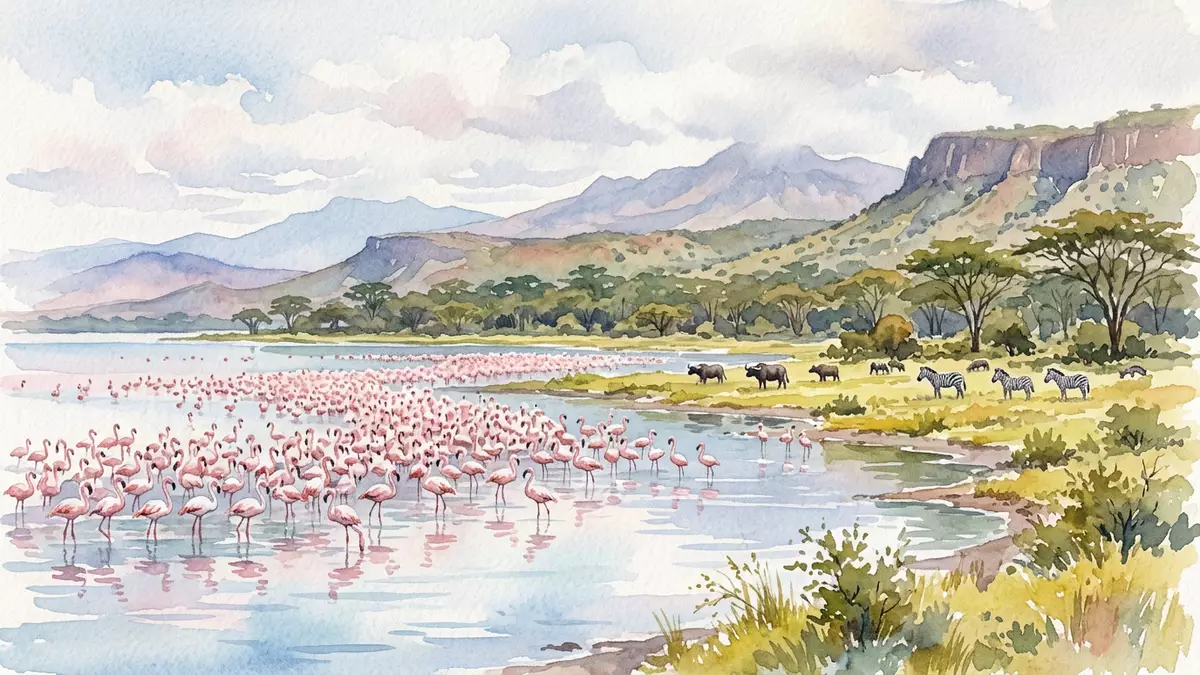
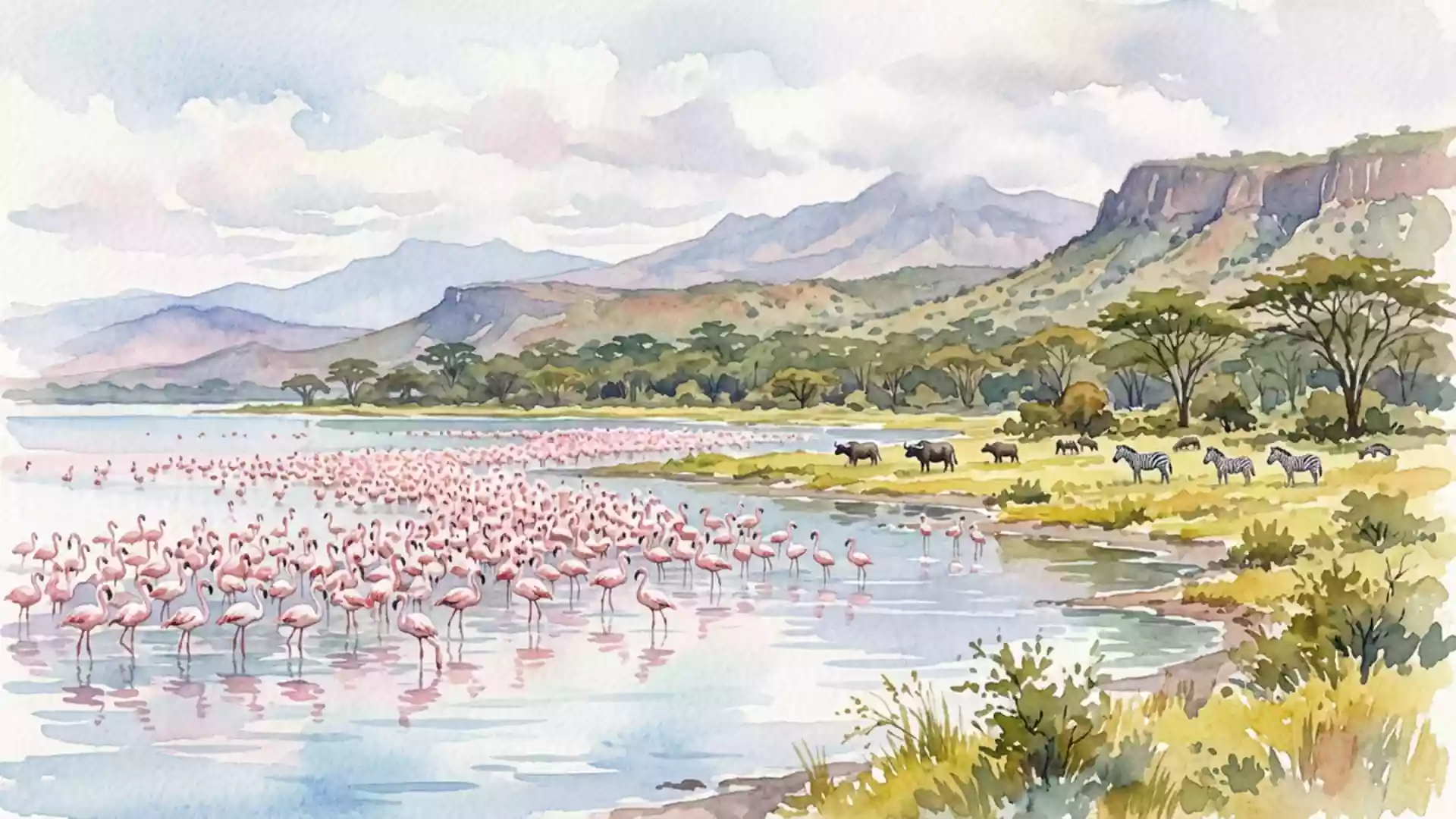
Lake Nakuru National Park in Kenya’s Great Rift Valley is built around a shallow alkaline lake where dense birdlife meets steep escarpments and open grassland. South of Nakuru town, this protected basin combines water, woodland and savanna in a compact area, making the relationship between lake and surrounding slopes the defining experience of a visit.
A shallow Rift Valley lake at the centre of the park
The core of Lake Nakuru National Park is Lake Nakuru itself, a strongly alkaline lake lying within the Kenyan section of the Great Rift Valley south of the city of Nakuru. The park surrounds the water, protecting both the lake and the mosaic of grassland and woodland that rises towards the valley rims.Lake Nakuru The lake is characteristically shallow, with water levels and surface area changing with rainfall and inflow, so broad mudflats and exposed shoreline can appear and disappear over time.shallow alkaline lake
Geographically, the park sits at elevations of roughly 1,750 m to just over 2,000 m (5,740 to 6,560 ft) above sea level, giving it a plateau climate compared with the hotter lowlands elsewhere in Kenya.elevation range It forms part of a wider catchment bounded by features such as the Menengai crater and the Mau escarpment, whose slopes feed several rivers into the lake. The Njoro, Makalia and Enderit rivers drain into Lake Nakuru, reinforcing the impression of the park as a bowl-shaped basin collecting water and wildlife from its surrounding heights.Njoro, Makalia and Enderit rivers
From bird sanctuary to national park and World Heritage landscape
Lake Nakuru’s protection history began with its value for birds. Nakuru was first officially gazetted as a bird sanctuary in 1960, reflecting the extraordinary numbers and diversity of waterbirds using the lake as a feeding and resting ground.gazetted as a bird sanctuary in 1960 In 1968, the area was upgraded to national park status, extending formal protection from the water body to the surrounding woodlands and grasslands that support grazing mammals and forest species.upgraded to National Park status in 1968
The park covers about 188 km² (73 sq mi), a relatively compact size by East African standards, which intensifies the feeling that different habitats are closely interwoven.park area 188 km² Lake Nakuru National Park is recognised as part of the Kenya Lake System World Heritage Site and as a Ramsar wetland of international importance, underscoring its global status for migratory birds and specialised wetland ecology.Kenya Lake System World Heritage Site Management lies with the Kenya Wildlife Service, which treats it as one of the country’s flagship conservation parks, particularly for rhinoceros and wetland birds.
Birdlife, rhinoceros and acacia woodland in a compact basin
The park is best known for the dense birdlife gathering around the lake margins. Lesser and greater flamingos, pelicans and a broad range of other waterbirds feed in the shallow alkaline waters and fringe wetlands, creating shifting bands of colour along the shoreline.flamingos, pelicans and other waterbirds Over 400 bird species have been recorded in the wider Lake Nakuru area, with the park forming a crucial stop on the African–Eurasian migratory flyway for several globally threatened species.over 400 bird species
On land, Lake Nakuru National Park functions as an important sanctuary for both white and black rhinoceros, with fenced boundaries and patrolled grasslands designed to protect these large herbivores.sanctuaries for white and black rhinoceros The endangered Rothschild’s giraffe has also been reintroduced, joining resident populations of buffalo, waterbuck, zebra and various antelope species in the park’s wooded grasslands and acacia forests.Rothschild’s giraffes and other mammals Predators such as lions and leopards patrol the fringes of these herds, while steep rocky hillsides and cliffs provide habitat for baboons, rock hyrax and specialised plant communities including Euphorbia forest.
Terrain, viewpoints and the feel of the landscape
One of the striking aspects of Lake Nakuru National Park is how quickly the terrain rises away from the lake shore. Short distances can take a traveller from open lakeside grassland to rocky outcrops and forested escarpments, with viewpoints looking back across the water and the enclosing basin. These vantage points reveal the full sweep of the Rift Valley setting, from the shining lake surface to the darker greens of acacia woodland and the ridges marking the catchment boundary.park within the Rift Valley
The vegetation reflects this variety in relief and soils. Around the lake are areas of marsh and open grassland, grading into belts of acacia woodland where giraffes browse and rhinos move between glades. On the steeper slopes, thicker forest and Euphorbia stands cling to rocky ground, while grazed clearings and bushy grassland provide space for zebra, impala and other ungulates.acacia and Euphorbia woodland The park’s compact size means that on a single circuit, the contrast between waterbirds on the mudflats and mammals under scattered trees is immediately visible, with steep valley walls framing almost every view.
Visiting Lake Nakuru National Park: what travellers from Western Europe should know
- Lake Nakuru National Park lies south of Nakuru in Kenya’s Rift Valley region, reached by road transport from Nairobi and regional centres through Nakuru County.
- The terrain around the lake includes flat lakeside tracks and steeper drives up escarpments, with some viewpoints accessed by short walks over uneven, rocky ground.
- The park’s elevation around 1,750 m (5,740 ft) above sea level gives it a plateau climate, and conditions can differ from lower-lying parts of Kenya.
- The official language is Swahili and English, and the currency is the Kenyan shilling.
- Entry requirements depend on your nationality; UK travellers can check the FCDO travel advice at gov.uk/foreign-travel-advice, Irish travellers the Department of Foreign Affairs at ireland.ie.
Searching for Lake Nakuru National Park on social platforms
These links open searches for Lake Nakuru National Park on each platform.
Frequently asked questions about Lake Nakuru National Park
Where is Lake Nakuru National Park located?
Lake Nakuru National Park lies in Nakuru County in Kenya’s Great Rift Valley, surrounding Lake Nakuru south of Nakuru town in central Kenya.
What can visitors expect on a visit to Lake Nakuru National Park?
Visitors encounter a shallow alkaline lake edged by wetlands, acacia woodland and grassland, with prominent birdlife, rhinoceros, giraffes and other mammals framed by valley escarpments.
What makes Lake Nakuru National Park distinctive among Kenyan parks?
Its compact basin setting brings together alkaline lake ecology, dense waterbird concentrations and fenced rhinoceros sanctuary landscapes within a relatively small, easily traversed Rift Valley park.