
Lake Nakuru National Park and its alkaline lake
Published on 09/23/2026 at 20:43 | Editorial responsibility: Rafael Müller, Editor-in-Chief AD HOC NEWS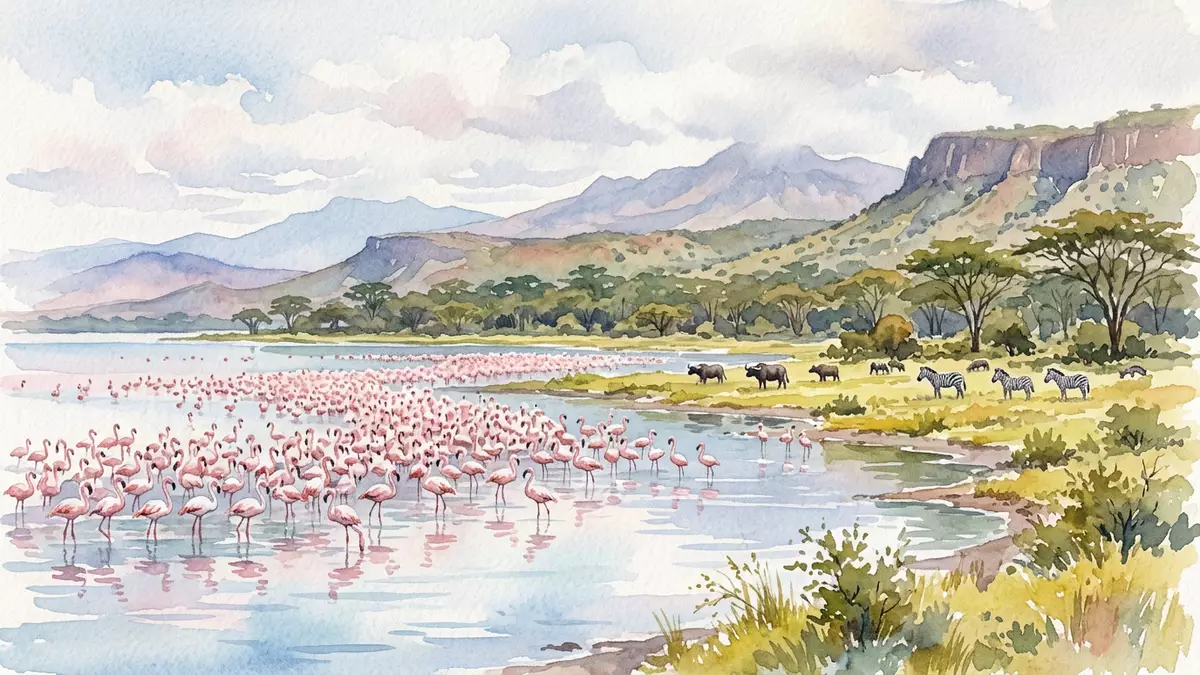
Lake Nakuru National Park surrounds a shallow alkaline lake on the floor of Kenya’s Great Rift Valley. The water, shoreline, grasslands, forests and escarpments form a compact landscape where lesser flamingos share the wider habitat with black rhinos, white rhinos and many other species.
Established in 1961, the park lies beside Nakuru in central Kenya. Its defining feature is the visible meeting of water and wildlife: a soda lake at the centre, with wooded slopes, open plains and rocky viewpoints around it.
Lake Nakuru’s alkaline waters and Rift Valley setting
Lake Nakuru is a very shallow, highly alkaline lake. Four seasonal rivers and the perennial Ngosur River feed the wetland, which includes sedge swamps, flooded grasslands, dry grasslands, floodplain forests and scrubland. Ramsar’s Lake Nakuru record gives the wetland an area of 18,800 hectares and records its designation on 5 June 1990.
The lake sits within a broader mosaic of yellow acacia woodland, bushy grassland and rocky ground. Hills named Enasoit Hill, Honeymoon Hill and Lion Hill rise around the basin, while Baboon Cliff and Out of Africa Hill provide elevated views across the water and surrounding habitats.
Flamingos, pelicans and birds of the lake
The lake’s alkaline character supports algae and aquatic invertebrates, creating feeding habitat for lesser flamingos. Their presence links the open water with the park’s wider bird life, which includes pelicans, fish eagles, secretary birds, herons, egrets, hamerkops and grebes.
Lake Nakuru lies within the Great Rift Valley, a major route for resident and migratory birds. The park’s habitats extend beyond the shoreline, with woodland, marsh, grassland and escarpment providing different places for feeding and nesting. Kenya Wildlife Service’s park description lists about 450 bird species, alongside approximately 550 plant species.
From bird sanctuary to rhino conservation area
Lake Nakuru began as a bird sanctuary in 1961 and became a national park around the lake. Its conservation role includes endangered black rhinos and white rhinos, with the park recognised as Kenya’s first rhino sanctuary.
Acacia woodland shelters impalas, waterbucks and bushbucks. Rocky outcrops support rock hyraxes, while lions, leopards, spotted hyenas, striped hyenas, servals, jackals, civets, genets and mongooses occur among the park’s carnivores and smaller predators. Giraffes, zebras, buffaloes, olive baboons, vervet monkeys and colobus monkeys add further layers to the landscape. The park forms part of the UNESCO Kenya Lake System in the Great Rift Valley, together with Lakes Bogoria and Elementaita.
Visiting Lake Nakuru National Park: what travellers from Western Europe should know
- Lake Nakuru National Park lies beside Nakuru, north-west of Nairobi. The Nairobi–Nakuru highway reaches the park through Lanet Gate, Nderit Gate and the Main Gate.
- The park is a vehicle-based wildlife landscape, with roads crossing woodland, grassland and lake margins. Rocky viewpoints include Baboon Cliff, Lion Hill and Out of Africa Hill.
- Makalia Waterfall lies within the park, among picnic and camping areas. Seasonal rivers, marshes and the alkaline lake form distinct parts of the terrain.
- The official language is English and Swahili, and the currency is the Kenyan shilling.
- Entry requirements depend on your nationality; UK travellers can check the FCDO travel advice at gov.uk/foreign-travel-advice, Irish travellers the Department of Foreign Affairs at ireland.ie.
Searching for Lake Nakuru National Park on social platforms
These links open searches for Lake Nakuru National Park on each platform.
Frequently asked questions about Lake Nakuru National Park
Where is Lake Nakuru National Park?
Lake Nakuru National Park lies beside Nakuru in central Kenya, on the floor of the Great Rift Valley. The park surrounds Lake Nakuru and extends across woodland, grassland, wetlands and escarpments.
What can visitors expect to see?
The park combines lake and land habitats. Wildlife includes flamingos, pelicans, rhinos, giraffes, zebras, buffaloes, lions, leopards, antelopes and several primate species.
What makes the park distinctive?
Its shallow alkaline lake sits at the centre of a protected landscape that joins wetland, woodland, grassland and rocky hills. The park also combines major bird habitat with black rhino and white rhino conservation.


