
Lake Nakuru National Park and its alkaline lake basin
Published on 09/22/2026 at 10:47 | Editorial responsibility: Rafael Müller, Editor-in-Chief AD HOC NEWS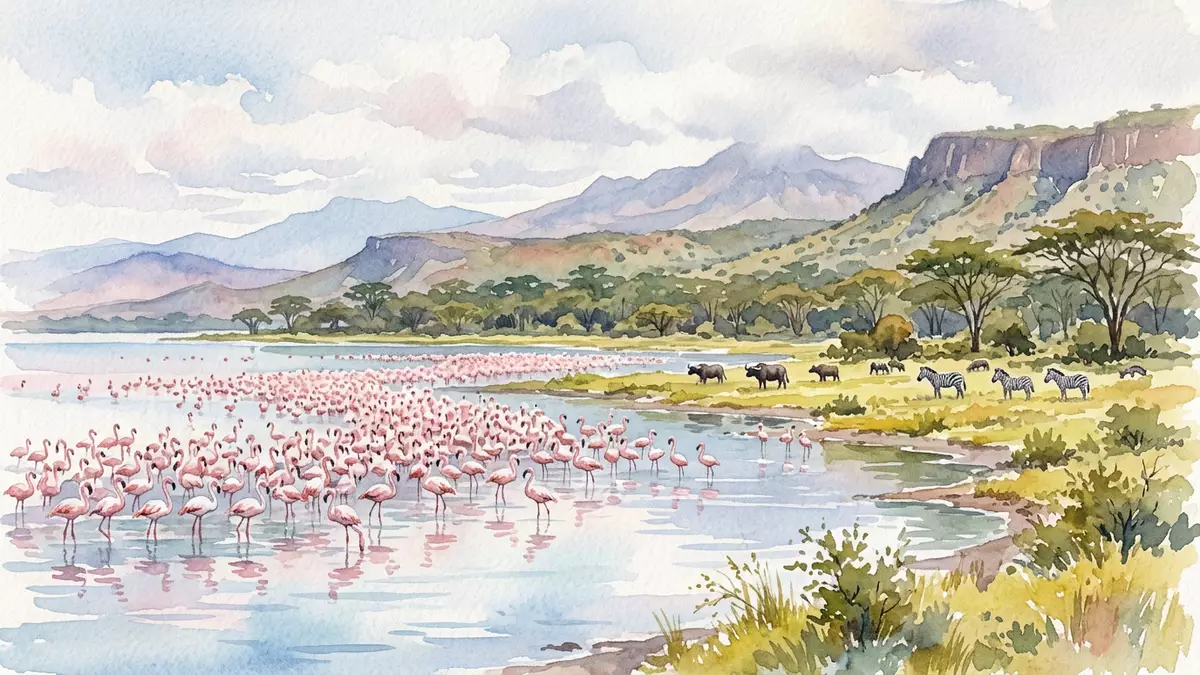
Lake Nakuru National Park surrounds a shallow alkaline lake in Kenya’s Great Rift Valley, south of Nakuru. The visible character of the park comes from the meeting of water, open grassland, wooded slopes and bird-rich shoreline. Gazetted as a national park in 1961, the protected area covers about 188 km².
Lake Nakuru’s alkaline basin in the Great Rift Valley
Lake Nakuru lies in a Rift Valley basin framed by escarpments, ridges and volcanic terrain. The lake is shallow and highly alkaline, with surrounding forests, grasslands, sedge swamps and scrubland. Seasonal rivers and the perennial Ngosur River feed the wetland.
The lake forms part of the Kenya Lake System in the Great Rift Valley, a UNESCO World Heritage property inscribed in 2011. The property also includes Lake Bogoria and Lake Elementaita, linking three shallow alkaline lakes with their surrounding territories.
Flamingos, pelicans and the park’s wetland life
The shoreline is associated with lesser flamingos, whose feeding grounds lie in the shallow alkaline water and adjoining wetland. Great white pelicans, African darters, egrets and other waterbirds use the lake and its margins. The Ramsar designation records Lake Nakuru as an internationally important wetland.
The Ramsar wetland covers 18,800 hectares and was designated on 5 June 1990. Its habitats include floodplain forest, seasonally flooded grassland, dry grassland and sedge swamp, creating several ecological zones around the lake.
Rhino sanctuary within a compact national park
Lake Nakuru National Park also protects black and white rhinoceroses. The park’s fenced landscape contains open grazing areas, woodland and lakeshore habitats, while Rothschild’s giraffe is another notable mammal associated with the reserve.
Its conservation history began with bird protection before expanding towards broader wildlife management. The rhino sanctuary was established in the 1980s, adding large mammals to the park’s central conservation role. The Kenya Wildlife Service park is reached from the Nairobi–Nakuru highway through named gates serving different sides of the protected area.
Visiting Lake Nakuru National Park: what travellers from Western Europe should know
- Lake Nakuru National Park lies in Nakuru County, south of Nakuru city, within Kenya’s Great Rift Valley. The main gate is close to Nakuru and the A104 highway connects the park with Nairobi.
- The park occupies elevated Rift Valley terrain, ranging from roughly 1,750 m to just over 2,000 m above sea level. The landscape includes a lake basin, escarpments, woodland and open grassland.
- Road access uses the Main Gate, Lanet Gate and Nderit Gate. Their positions serve the northern, eastern and southern approaches to the park.
- The official language is English and Swahili, and the currency is the Kenyan shilling.
- Entry requirements depend on your nationality; UK travellers can check the FCDO travel advice at gov.uk/foreign-travel-advice, Irish travellers the Department of Foreign Affairs at ireland.ie.
Searching for Lake Nakuru National Park on social platforms
These links open searches for Lake Nakuru National Park on each platform.
Frequently asked questions about Lake Nakuru National Park
Where is Lake Nakuru National Park?
Lake Nakuru National Park is in Nakuru County, Kenya, south of Nakuru city. It lies within the Great Rift Valley and surrounds Lake Nakuru.
What can visitors expect to see?
The protected area combines an alkaline lake, wetland habitats, woodland and grassland. Wildlife includes lesser flamingos, pelicans, black rhinoceroses, white rhinoceroses and Rothschild’s giraffes.
What makes the park distinctive?
Its identity comes from the close combination of a shallow alkaline lake, internationally recognised wetland habitats and a rhino sanctuary. The landscape belongs to the Kenya Lake System in the Great Rift Valley.


