
Lake Louise’s turquoise basin in the Canadian Rockies
Published on 08/21/2026 at 06:58 | Editorial responsibility: Rafael Müller, Editor-in-Chief AD HOC NEWS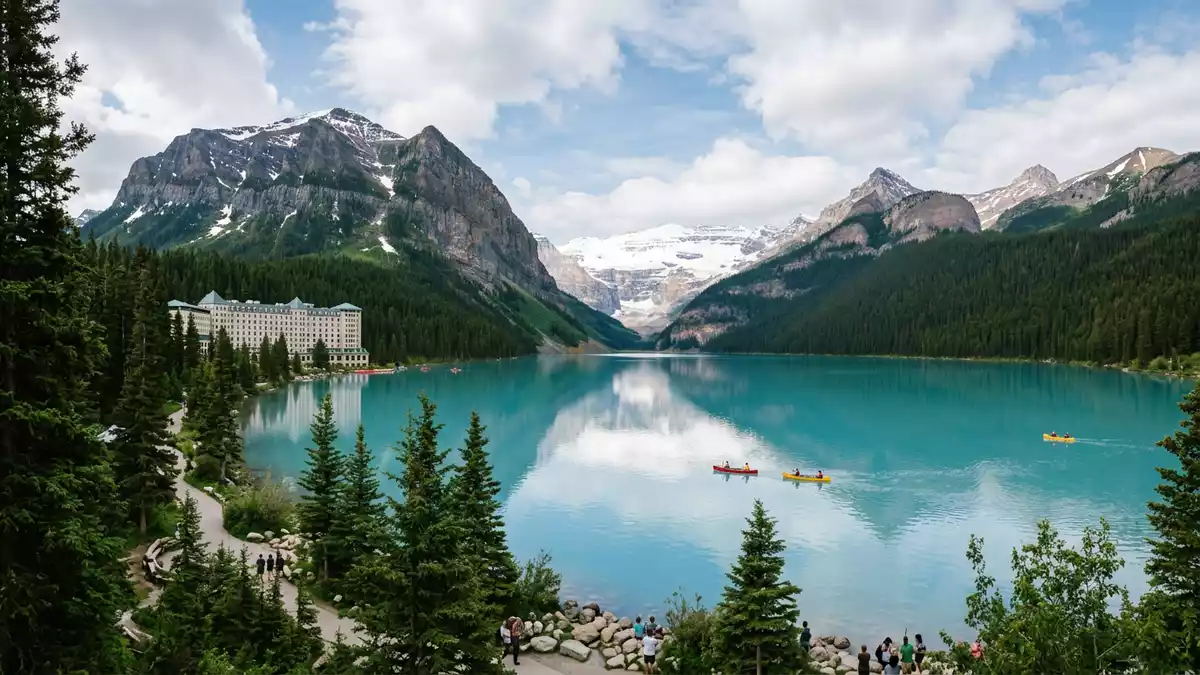
Lake Louise in Alberta is a compact glacial basin where vivid turquoise water, steep Rocky Mountain walls and the ice of Victoria Glacier form a single, tightly framed scene within Banff National Park in western Canada.
A turquoise glacial lake beneath Victoria Glacier
Lake Louise lies in the Canadian Rockies within Banff National Park in the province of Alberta, a protected landscape recognised as part of a wider Canadian mountain parks inscription.Banff National Park in Alberta The lake takes its name from Princess Louise Caroline Alberta, a daughter of Queen Victoria, whose titles also gave the province of Alberta its name.Princess Louise Caroline Alberta A small settlement known as Lake Louise stands close by on the Bow River, acting as a base for the lake, the surrounding valley and the wider park landscape.the Bow River in Banff National Park
The basin itself lies at an elevation of about 1,731 m (5,680 ft), fed at its western end by meltwater from Victoria Glacier that spills through a short delta into the lake.an elevation of 1,731 metres From this ice-clad backdrop the water stretches northeast for roughly 2 km (1.2 mi), narrowing and then spilling out through Louise Creek towards the Bow River, which carries the glacial water further east across the prairies.Louise Creek towards the Bow River Soundings have recorded depths of more than 70 m (230 ft), so the water column drops away sharply from the shoreline into a compact but relatively deep basin.depths of more than 70 metres
Colour, composition and the human edge
The surface colour that draws travellers to Lake Louise comes from rock flour suspended in the water, fine glacial silt that scatters light into an opaque turquoise band against the darker forests and the pale ice.tiny particles of glacial silt The lake is long and narrow rather than round, framed by steep valley walls that rise on either side, so the colour reads not as an isolated patch of water but as a flat strip laid between dark rock and sky.a long, narrow form tucked into the valley floor At the western end, Victoria Glacier fills the head of the valley, its ice hanging above the basin and linking the water visually to the higher snowfields.
On the eastern shore sits Fairmont Chateau Lake Louise, a grand hotel whose origins lie with the Canadian Pacific Railway in the late nineteenth century and which has grown through successive wings since the early 1900s.first opened by the Canadian Pacific Railway Behind the hotel, the small community of Lake Louise spreads along the valley floor, and the Bow River runs beyond it, tying the glacial basin into a wider transport corridor that crosses the Rockies.an unincorporated place on the Bow River The contrast between the formal hotel frontage and the raw cliff walls across the water is part of the area’s character, with manicured paths giving way quickly to forest and rock.
History, names and surrounding peaks
Long before its renaming for Princess Louise, the lake was known to the Stoney Nakoda people as Ho-run-num-nay, a name that translates as “Lake of the Little Fishes”, and the basin lay within their traditional lands.Ho-run-num-nay, Lake of the Little Fishes In the 1880s, Canadian Pacific Railway employees including Thomas Wilson followed avalanche noise up the valley and encountered the lake, bringing it into the rail company’s orbit and, with that, into wider Canadian and international awareness.Thomas Wilson encountered the lake in 1882 The hotel that eventually became Chateau Lake Louise first took shape as a simple chalet in the 1890s, evolving over the twentieth century into a multi-winged complex above the shoreline.
The peaks around the basin form part of the central Canadian Rockies and include Mount Victoria to the west and Mount Lefroy to the south-west, both linked to the early history of Canadian mountaineering.glacial Lake Louise in Alberta The combination of a relatively compact lake, enclosing rock walls and a visible glacier makes the setting legible even to first-time visitors, who see at a glance how ice, meltwater and valley floor sit in sequence from one end of the basin to the other.a glacially carved basin in the Canadian Rockies
Visiting Lake Louise: what travellers from Western Europe should know
- Lake Louise lies in western Alberta inside Banff National Park, along the Trans-Canada Highway west of the town of Banff, with the small community of Lake Louise close to the lakeshore.
- The lakeshore area is at an elevation of around 1,731 m (5,680 ft), and paths near the water run on compacted ground with some gentle gradients rather than long staircases.
- The surrounding terrain rises steeply from the valley floor, and trails leading away from the lakeshore gain height quickly as they head towards viewpoints and passes above the basin.
- English and French are official languages in Canada, and the currency is the Canadian dollar.
- Entry requirements depend on your nationality; UK travellers can check the FCDO travel advice at gov.uk/foreign-travel-advice, Irish travellers the Department of Foreign Affairs at ireland.ie.
Searching for Lake Louise on social platforms
These links open searches for Lake Louise on each platform.
Frequently asked questions about Lake Louise
Where is Lake Louise?
Lake Louise is in Banff National Park in western Alberta in Canada, close to the small community of the same name and the Bow River.
What can visitors expect at Lake Louise?
Visitors see a long turquoise glacial lake beneath Victoria Glacier, steep Rocky Mountain walls, a formal hotel frontage on one shore and forested paths along the water.
What makes Lake Louise distinctive?
The combination of a compact, deep basin, turquoise glacial water, a visible glacier at one end and an historic lakeside hotel on the other gives Lake Louise its distinctive character.


