
Lake Louise and its turquoise glacial basin in Alberta
Published on 09/17/2026 at 07:08 | Editorial responsibility: Rafael Müller, Editor-in-Chief AD HOC NEWS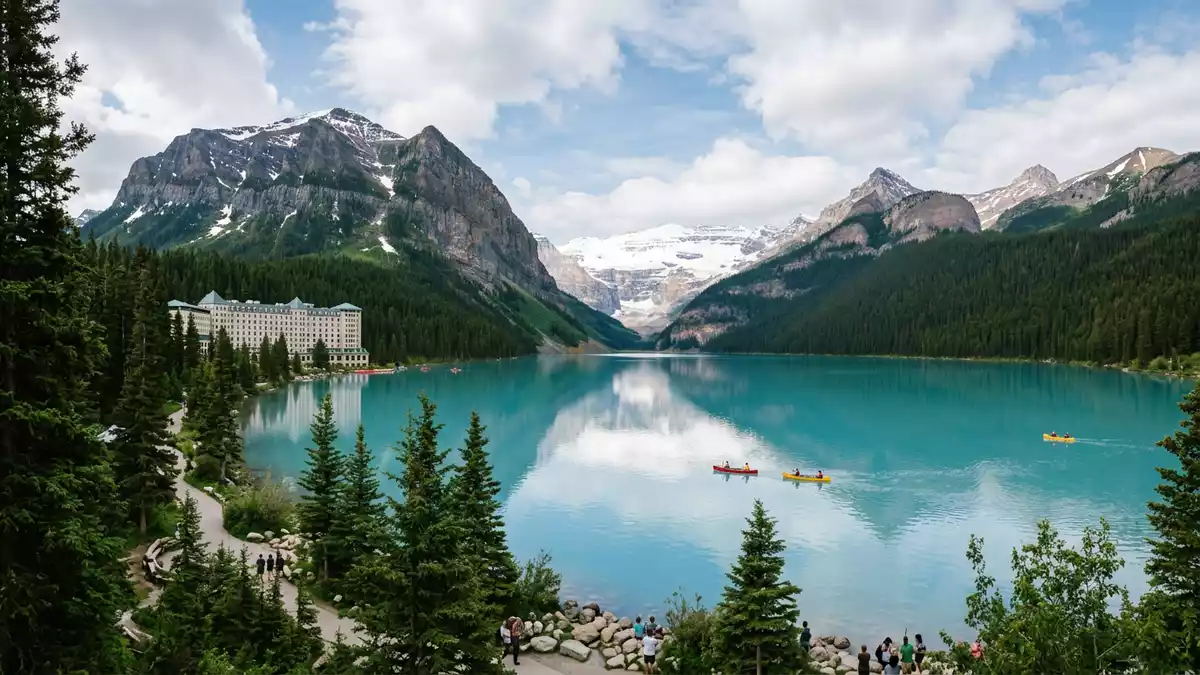
Lake Louise in Alberta is a compact glacial lake in the Canadian Rockies whose vivid turquoise surface lies beneath steep mountain walls and the ice of Victoria Glacier, creating a sharply framed basin that defines one of Banff National Park’s most recognisable views. The lake has formed within Banff National Park in western Canada since the late nineteenth century, with its waters draining eastward into the Bow River through a short outflow known as Louise Creek.
A turquoise glacial basin in the Canadian Rockies
Lake Louise is a glacially carved basin in the Canadian Rockies, lying within Banff National Park in the province of Alberta in western Canada, a short distance from the small community of Lake Louise on the Bow River and close to the line of the Trans-Canada Highway. Banff National Park in Alberta contains both the lake and the hamlet, placing them in a subalpine landscape where dense coniferous forest rises towards bare rock and permanent ice.
The basin holding the lake stretches for about 2 km (1.2 mi) from the western end beneath Victoria Glacier towards its outflow at the eastern shore, and reaches around 0.5 km (0.3 mi) at its broadest point, giving it a long, relatively narrow form tucked into the valley floor. Soundings in the lake have recorded depths of more than 70 m (230 ft), marking it as a relatively deep glacial basin compared with its surface footprint.
Water, colour and the surrounding peaks
The waters of Lake Louise stand at an elevation of around 1,730 m (5,680 ft) above sea level, placing the lake in a belt where valley forest gives way to alpine meadows, rock faces and the lower reaches of glaciers. The lake’s turquoise colour arises from fine particles of glacial silt suspended in the water, which scatter light and leave the surface with a dense, opaque hue rather than the clear tones of many lower-elevation lakes.
At the western end of Lake Louise, Victoria Glacier descends from Mount Victoria into the headwall above the water, and peaks such as Mount Temple and Fairview Mountain frame the basin, giving a composition in which the lake sits at the foot of high rock faces and glacial ice. Victoria Glacier and Mount Victoria are part of the visual identity of the place, with the glacier occupying the upper frame of the basin while the water and its shoreline form the foreground.
From Louise Creek to the Bow River and the wider landscape
At the eastern end of Lake Louise, a short outflow carries the same turquoise water away from the basin as Louise Creek, flowing for about 3 km (1.9 mi) before meeting the Bow River, where the silt gradually settles and the colour shifts to the tones more typical of a mountain stream. The Bow River then runs eastward through the Rocky Mountains towards the prairie, linking Lake Louise with a wider watershed that spans much of southern Alberta.
The lake lies near the small community bearing the same name, which sits on the Bow River a few kilometres downstream at an elevation recorded around 1,600 m (5,249 ft), and the area forms one of the main access points to the western part of Banff National Park. The hamlet of Lake Louise grew from an outpost of the Canadian Pacific Railway in the 1880s, and the setting around the lake has long been tied to rail and highway routes crossing the Rockies.
Visiting Lake Louise: what travellers from Western Europe should know
- Lake Louise lies in Banff National Park in Alberta, in the Canadian Rockies west of Calgary, with road access along the Trans-Canada Highway and a short local approach from the community of Lake Louise.
- The lakeshore sits at around 1,730 m (5,680 ft) above sea level and is bordered by steep valley sides, so walks along the water remain on relatively gentle ground while routes towards viewpoints and neighbouring valleys climb more sharply.
- Lake Louise is in Canada, where the official languages are English and French and the currency is the Canadian dollar.
Searching for Lake Louise on social platforms
These links open searches for Lake Louise on each platform.
Frequently asked questions about Lake Louise
Where is Lake Louise?
Lake Louise is a glacial lake in Banff National Park in the Canadian Rockies in the province of Alberta, a short distance from the hamlet bearing the same name.
What should visitors expect at Lake Louise?
Visitors encounter a long, narrow glacial basin with turquoise water, steep mountain walls and distant glaciers, with paths along the lakeshore and steeper terrain rising towards surrounding peaks.
What makes Lake Louise distinctive?
The combination of a deep turquoise lake at around 1,730 m (5,680 ft), framed by Victoria Glacier, Mount Victoria and other high peaks within Canada’s oldest national park, gives Lake Louise a recognisable character.


