
Lake Louise and its turquoise glacial basin in Alberta
Published on 09/10/2026 at 18:53 | Editorial responsibility: Rafael Müller, Editor-in-Chief AD HOC NEWS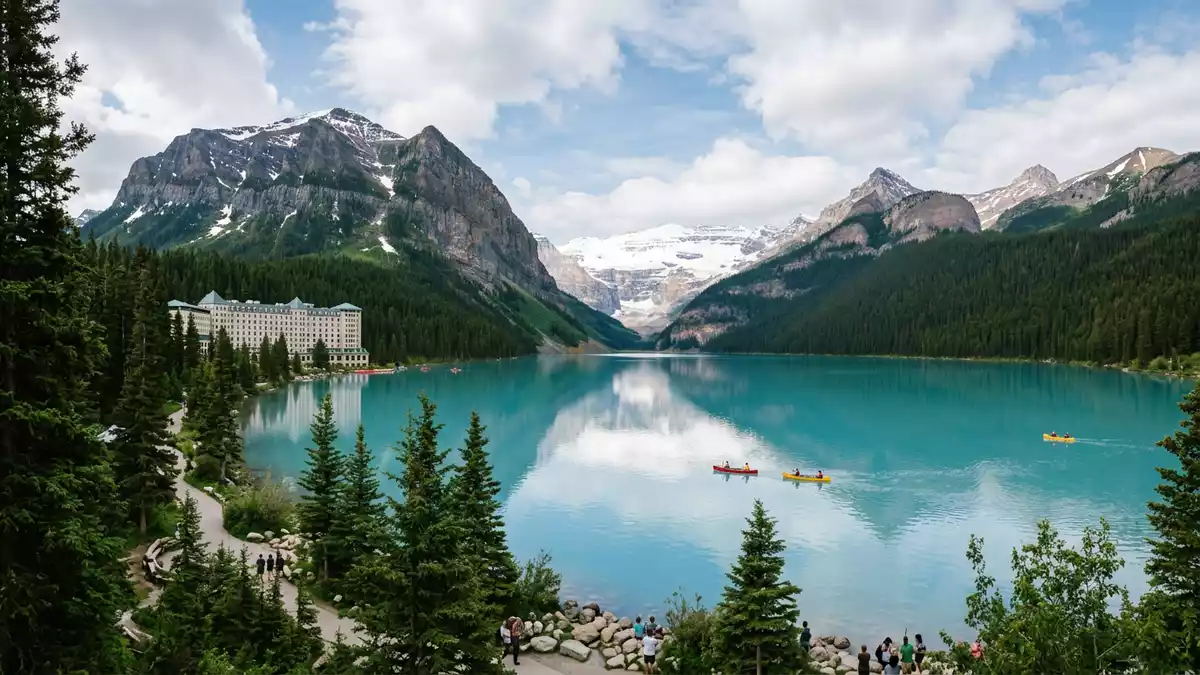
Lake Louise in Alberta is a compact glacial lake whose vivid turquoise surface sits beneath steep Rocky Mountain walls and the ice of Victoria Glacier, forming one of the most recognisable compositions in Banff National Park.Banff National Park has contained the lake since the 1890s, and the water drains eastward into the Bow River through a short outflow known as Louise Creek.
A glacial basin in the Canadian Rockies
Lake Louise is a glacially carved basin in the Canadian Rockies, lying within Banff National Park in the province of Alberta in western Canada.Lake Louise is a glacial lake The lake stretches for about 2 km (1.2 mi) from the western end beneath Victoria Glacier towards its outflow, and reaches around 0.5 km (0.3 mi) at its broadest point, giving it a long, narrow form tucked into the valley floor.Lake Louise covers 0.8 square kilometres
The water in Lake Louise often appears an intense turquoise colour, created by fine particles of glacial silt suspended in the meltwater flowing down from Victoria Glacier and other icefields above the western shore.rock flour carried into the lake Soundings have recorded depths of more than 70 m (230 ft), marking it as a relatively deep glacial basin for its size.around 70 m deep
Princess Louise, the Bow River and a high mountain settlement
Both the lake and the nearby community carry the name of Princess Louise, daughter of Queen Victoria and wife of John Campbell, marquess of Lorne, who served as governor general of Canada between 1878 and 1883.Princess Louise, daughter of Queen Victoria The settlement began in the 1880s as a construction camp on the Canadian Pacific Railway and was later renamed for the lake, reflecting the intimate link between the railway line, the Bow River valley and the glacial basin upstream.a Canadian Pacific Railway outpost
The community of Lake Louise lies on the Bow River a short distance northeast of the water, at around 1,600 m (5,200 ft) above sea level, and is regarded as one of the highest permanent settlements in Canada.Lake Louise sits at an elevation of 1,600 m The lake itself lies higher still, at about 1,731 m (5,680 ft), where a narrow valley concentrates the views towards Victoria Glacier and the dark faces of Mount Lefroy and Mount Victoria that tower over the western shore.elevation 1,731 m
Paths, peaks and the human presence around the lake
The lakeshore at Lake Louise has level paths close to the water, offering a sequence of perspectives along the elongated basin, while steeper trails rise into the surrounding mountains and forests towards higher viewpoints.hiking around Lake Louise On the eastern side of the lake stands a large hotel complex, Fairmont Chateau Lake Louise, whose historic main building looks straight down the length of the water towards the glacier, anchoring human architecture against the backdrop of rock and ice.Fairmont Chateau Lake Louise
Across the valley, the Lake Louise Ski Resort spreads over several mountain faces, using the same landscape of peaks and forests for winter sport.Lake Louise ski area Together, the lake, village and ski area illustrate how a glacial basin and a transport corridor through the Rockies have become a combined centre for mountain scenery and outdoor activity, while remaining embedded within the protected setting of Banff National Park.Lake Louise in Banff National Park
Visiting Lake Louise: what travellers from Western Europe should know
- Lake Louise lies within Banff National Park in the Canadian province of Alberta, close to the small community of the same name on the Bow River and near the Trans-Canada Highway.
- Paths along the lakeshore offer level walking, while trails leading towards viewpoints and into the surrounding mountains climb steadily and can involve sustained uphill sections.
- Lake Louise is reached most directly from Calgary, whose international airport connects with the Trans-Canada Highway running west into the Rockies towards Banff and the lake.
- The official languages of Canada are English and French, and the currency is the Canadian dollar.
- Entry requirements depend on your nationality; UK travellers can check the FCDO travel advice at gov.uk/foreign-travel-advice, Irish travellers the Department of Foreign Affairs at ireland.ie.
Searching for Lake Louise on social platforms
These links open searches for Lake Louise on each platform.Frequently asked questions about Lake Louise
Where is Lake Louise and what kind of place is it?
Lake Louise is a small glacial lake in Banff National Park in Alberta, in the Canadian Rockies, a short distance southwest of the community that shares its name.
What should visitors expect when they reach the lakeshore?
Visitors find a relatively small glacial lake with a turquoise surface, level paths near the water and steeper trails that lead into the surrounding mountains.
What makes Lake Louise distinctive among mountain lakes?
Lake Louise combines an elongated, deep glacial basin and vivid turquoise water with clear views towards Victoria Glacier and steep Rocky Mountain walls at its western end.


