
Laguna de Bacalar and its seven shades of blue
Published on 09/12/2026 at 18:58 | Editorial responsibility: Rafael Müller, Editor-in-Chief AD HOC NEWS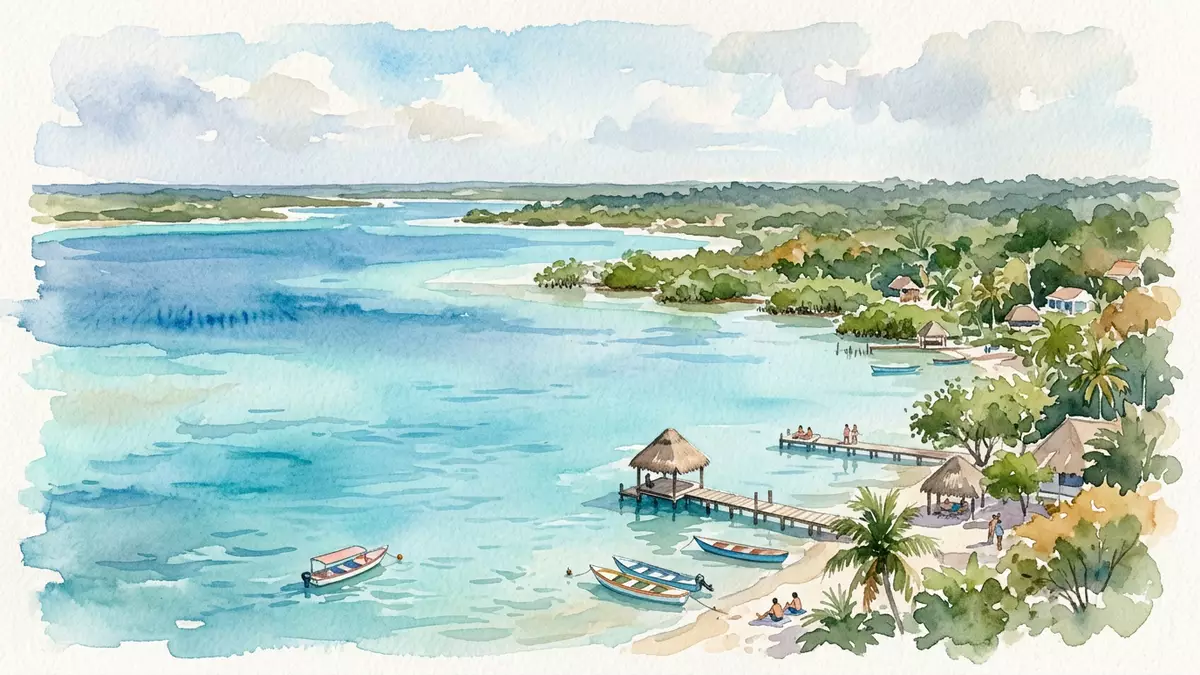
Laguna de Bacalar in Bacalar, in the Mexican state of Quintana Roo, is a long freshwater lagoon known for a striking spectrum of blue tones across its surface.Lake Bacalar The lagoon forms part of a wider karst landscape of limestones and cenotes, and research has described it as a major freshwater microbialite habitat in south-eastern Mexico.karstic freshwater system
A ribbon of freshwater in southern Quintana Roo
Laguna de Bacalar is a long, narrow body of freshwater in southern Quintana Roo, near Mexico’s border with Belize.Laguna de Bacalar location The lagoon runs for about 42 km (26 mi) in length and reaches up to around 2 km (1.2 mi) in width, forming a ribbon of clear water aligned roughly north–south between Bacalar and the surrounding low-lying terrain.lake characteristics On its western shore sits the town of Bacalar, a small settlement whose history as one of the oldest towns in Quintana Roo links the lagoon to centuries of movement along the Caribbean coast.village of Bacalar
The lagoon’s basin lies within a karst platform composed largely of limestones and loams, and its freshwater character is tied to groundwater exchange through cenotes and underground channels.limestone bottom and cenotes In places along the shore shallow sandy shelves continue far out into the lagoon, while specific sinkholes such as Cenote Azul reach depths of around 90 m (295 ft), adding a sharp vertical dimension to the otherwise gently shelved floor.Cenote Azul depth This alternation between shoals and deep pockets is central to how the lagoon reads in the landscape, and it shapes the transitions between pale water near the shore and darker bands further out.
Seven colours, stromatolites and cenotes
The name “Lagoon of Seven Colours” reflects an observable phenomenon across Laguna de Bacalar: the water surface shifts from near-transparent turquoise over the shallows to deep indigo in the channels and cenotes.Lagoon of Seven Colors The contrast between these tones is reinforced by the lagoon’s white sandy bottom in many areas, which brightens the blues where the floor lies close to the surface.white sandy bottom Local names such as Laguna de los Siete Colores underline the way these colour bands have become part of how Bacalar is understood and described.
The lagoon is also known for living stromatolites, layered microbial structures that grow in the shallow nearshore zones and have drawn scientific attention as one of the most significant freshwater microbialite communities documented in Mexico.stromatolites in Bacalar Around parts of the shoreline these stromatolites rise from the bed into rounded forms visible from the water, reinforcing the sense that the lagoon’s underwater life and its surface appearance are tightly connected.freshwater microbialite habitat Nearby cenotes such as Cenote Negro, Cenote Cocalitos and Cenote Esmeralda sit within the lagoon’s reach, each adding its own depth profile to the overall system and extending the gradient between bright shallows and shadowed depths.named cenotes and Canal de los Piratas
Karst waters and a historical route
Laguna de Bacalar’s waters have long formed part of a wider route between the interior of the Yucatán Peninsula and the Caribbean coast, and the lagoon’s length made it a natural corridor for transport by water.passage for pirates and traders Historical accounts describe channels such as the Canal de los Piratas connecting the lagoon to surrounding waterways, and the town of Bacalar stands as a reminder of colonial and earlier Maya presence along this inland stretch of water.Maya and pirate lore The combination of freshwater, access routes and defensible ground helps explain why a settlement of this size took root here, though the lagoon’s present role centres on its landscape qualities rather than its strategic function.
Geologically, Laguna de Bacalar has been documented as a karstic freshwater system whose hydrology is controlled by its position near the Rio Hondo fault zone and its connections to groundwater through cenotes.tectonic setting linked to the Rio Hondo fault zone Limestones in the basin and the surrounding platform influence both the clarity of the water and the distribution of stromatolites along the margins, where microbial communities build layered structures that extend above the lagoon floor.three-billion-year-old underwater lifeforms Seen from the shore, this geological context is legible in the pale, almost chalk-like shelves at the edge of the lagoon and the way the water drops abruptly into darker channels further out.
Visiting Laguna de Bacalar: what travellers from Western Europe should know
- Laguna de Bacalar lies beside the town of Bacalar in southern Quintana Roo, north of Chetumal and not far from the border with Belize; the lagoon is reached via Bacalar and the highways that link this part of Mexico with the rest of the peninsula.
- The shoreline around Bacalar includes stretches of shallow water over sandy shelves, wooden jetties extending into the lagoon and access points where the transition from shore to water involves descending steps or short ramps.
- The wider setting is low-lying and humid, with the lagoon at low altitude; walking routes along the shore can involve uneven ground and occasional narrow paths close to the water.
- The official language is Spanish and the currency is the Mexican peso.
- Entry requirements depend on your nationality; UK travellers can check the FCDO travel advice at gov.uk/foreign-travel-advice, Irish travellers the Department of Foreign Affairs at ireland.ie.
Searching for Laguna de Bacalar on social platforms
These links open searches for Laguna de Bacalar on each platform.Frequently asked questions about Laguna de Bacalar
Where is Laguna de Bacalar?
Laguna de Bacalar is a long freshwater lagoon beside the town of Bacalar in southern Quintana Roo, in south-eastern Mexico near the border with Belize.
What can travellers expect on a visit?
Travellers encounter clear freshwater over pale sandy shelves, wooden jetties reaching into the lagoon and views along a narrow ribbon of water that shifts through several blue tones.
What makes Laguna de Bacalar distinctive?
The lagoon’s seven observable shades of blue, its stromatolites in shallow nearshore zones and its setting in a karst landscape of limestones and cenotes combine into a distinctive freshwater environment.


