
Laguna de Bacalar and its seven shades of blue
Published on 09/08/2026 at 20:36 | Editorial responsibility: Rafael Müller, Editor-in-Chief AD HOC NEWS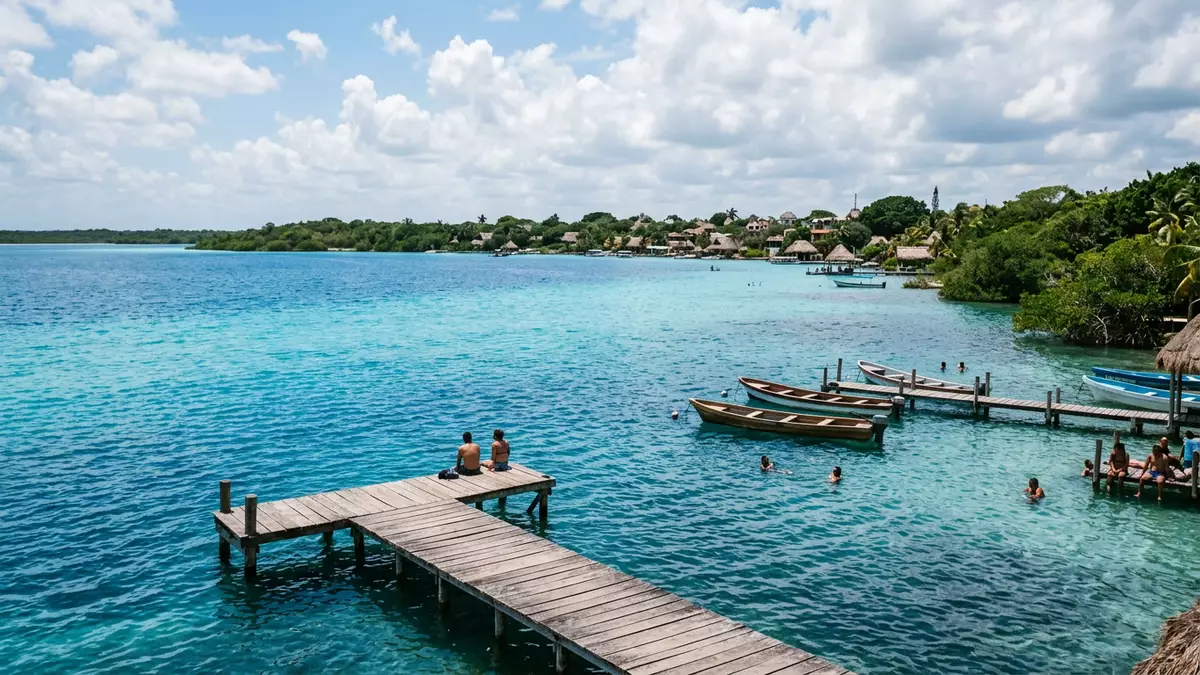
Laguna de Bacalar in southern Mexico is a long freshwater lagoon beside the small town of Bacalar, known for a striking band of blues that runs the length of its shallow limestone basin. Set in the state of Quintana Roo near the border with Belize, it offers an inland waterscape where colour, geology and history meet in a single ribbon of water.
A freshwater ribbon in southern Quintana Roo
Laguna de Bacalar lies in the south of Quintana Roo, an eastern Mexican state on the Yucatán Peninsula, close to the frontier with Belize and near the city of Chetumal.south of the state The lagoon runs alongside the town of Bacalar, which lends it its name, and stretches roughly north–south in a long, narrow band separated from the Caribbean Sea by low, forested land.near Mexico's border with Belize
Measured along its length, Laguna de Bacalar extends for around 42 km (26 mi), with a width that rarely exceeds about 2 km (1.2 mi), making it one of the larger freshwater bodies in Mexico.about 26 miles long The lagoon sits almost at sea level and is fed by underground water emerging through cenotes, so the water is fresh rather than saline and forms a long inland lake parallel to the Caribbean coastline.freshwater lagoon stretching 42 kilometres
Seven colours over limestone shallows
The name “Lagoon of Seven Colours” reflects a visual effect that has made Laguna de Bacalar widely recognised: bands of blues appear across the surface, changing from pale turquoise over sandy shallows to dark indigo in deeper channels.Lagoon of Seven Colors The lagoon floor is largely limestone and sand, with sinkholes such as Cenote Azul forming abrupt depth changes that add dramatic colour contrasts where the bottom drops away.Cenote Azul sinkhole
Near the shore, broad shallows give the water a translucent quality, while towards the central parts the colours darken over deeper basins connected by natural channels. Local usage has fixed the Spanish name “Laguna de los Siete Colores” for this gradient, and visitors on the water can see clear transitions between several blue bands during a single outing.continuous gradient of blues The freshwater character and the lack of direct contact with the open sea also mean there is no marine sargassum in the lagoon, so the water surface remains clear of seaweed typical of nearby coasts.no salt and no sargassum
Bacalar, canals and stromatolites
The town of Bacalar sits on the western shore of the lagoon and is classed in Mexico as a Pueblo Mágico, reflecting both its lakeside setting and its historical background in Maya and colonial periods.anchored by the Pueblo Mágico Along this shore, piers, small balnearios and simple waterfront structures reach out over the shallows, giving direct access to the lagoon from the settlement and framing views towards the far side.
Across the water, several named features have become part of the identity of Laguna de Bacalar. The Canal de los Piratas, or Pirates’ Channel, is a natural waterway connecting one part of the lagoon system, associated with historic navigation and now a recognised route on the lagoon.Pirates’ Canal In the shallows, living stromatolites grow as rounded rock-like structures formed by microbial communities, representing one of the lagoon’s most distinctive natural elements and linking the waterscape to ancient geological processes.living stromatolites
Visiting Laguna de Bacalar: what travellers from Western Europe should know
- Laguna de Bacalar lies beside the town of Bacalar in the Mexican state of Quintana Roo, in the far south near the border with Belize; Chetumal is the nearest city.
- The shore around Bacalar consists of low limestone and sandy banks with jetties and simple waterfront structures, and access to the water often involves steps or ladders from piers into shallow areas.
- The lagoon is at low elevation and the terrain around it is largely flat, but reaching the water from accommodation or the town usually involves walking short distances along unpaved or lightly paved paths.
- The official language is Spanish and the currency is the Mexican peso; cards and cash are both in use in Bacalar and around the lagoon.
- Entry requirements depend on your nationality; UK travellers can check the FCDO travel advice at gov.uk/foreign-travel-advice, Irish travellers the Department of Foreign Affairs at ireland.ie.
Searching for Laguna de Bacalar on social platforms
These links open searches for Laguna de Bacalar on each platform.
Frequently asked questions about Laguna de Bacalar
Where is Laguna de Bacalar located?
Laguna de Bacalar is in the south of the Mexican state of Quintana Roo, beside the town of Bacalar and close to the border with Belize.
What can visitors expect on a visit to Laguna de Bacalar?
Visitors find a long, narrow freshwater lagoon with clear blue water over limestone shallows, simple jetties and waterfront structures, and low, flat terrain around the shore.
What makes Laguna de Bacalar distinctive among Mexican lakes?
The lagoon is known for its seven visible shades of blue, its elongated shape and shallow limestone floor, and natural features such as stromatolites and the Pirates’ Channel.


