
Lagoa das Sete Cidades and its twin-blue crater
Published on 08/27/2026 at 08:51 | Editorial responsibility: Rafael Müller, Editor-in-Chief AD HOC NEWS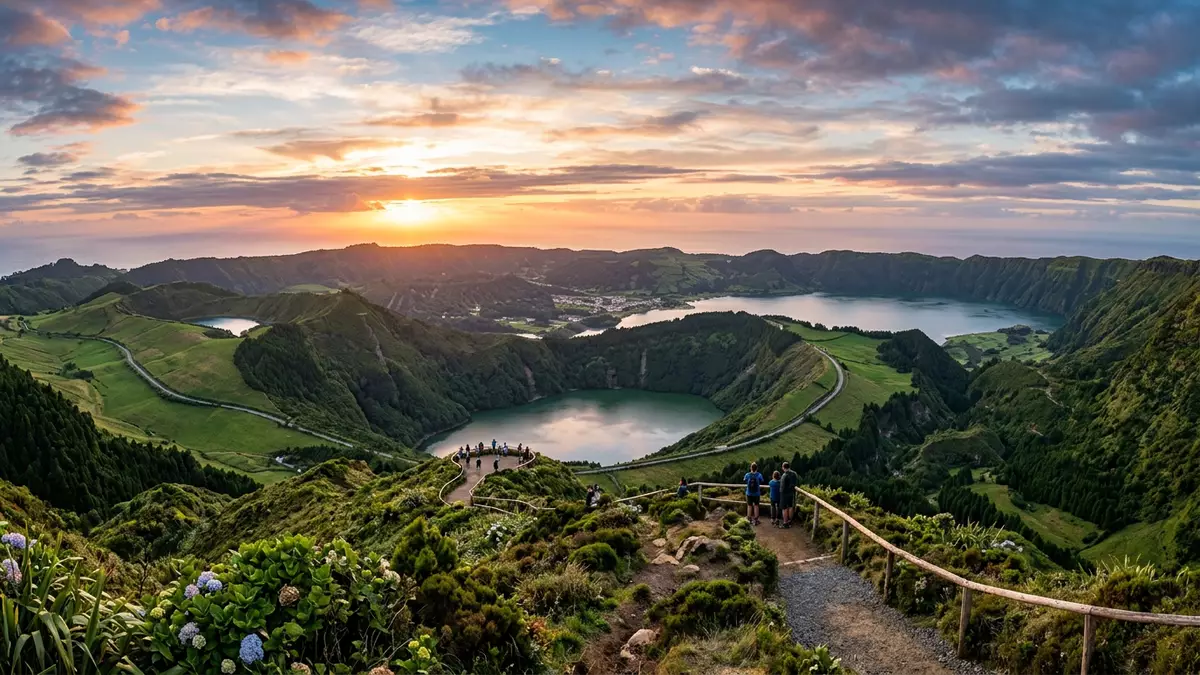
Lagoa das Sete Cidades lies in the caldera of the Sete Cidades Volcano on São Miguel, in the Azores, and forms part of the protected landscape area at the island’s west end. The lake is usually seen as two bodies of water, Lagoa Azul and Lagoa Verde, in a single crater setting.
A crater lake on São Miguel
The lake sits within a large collapse caldera on the Sete Cidades massif. The protected area is linked to the Azores’ volcanic terrain, endemic plants and birdlife, and it covers a broad swathe of the island’s western sideprotected landscape area.
The basin reaches an average diameter of 5.3 kilometres and a depth of about 630 metres. The lake itself is the largest in the Azores, and it is commonly described as a twin lake because of its blue and green waterslargest lake in the Azores.
Blue water, green water
Sete Cidades is best understood from its visible contrast: one side is known as Lagoa Azul, the other as Lagoa Verde. A narrow connection separates the two water bodies, with a bridge crossing between themnarrow strait.
The crater landscape includes steep slopes, layered volcanic ground and several smaller lakes inside the wider caldera. The area also includes the lakes of Santiago and Rasa, together with the Serra Devassa ridge to the south-eastlakes of Santiago and Rasa.
Protected landscape and volcanic setting
The Sete Cidades Volcano formed a huge collapse caldera, probably around 36,000 years ago, and later eruptions occurred inside it. The landscape now combines water, volcanic slopes and protected habitats, which gives the site its distinct physical character36 thousand years ago.
Sete Cidades is also linked to the wider geography of São Miguel and the municipality of Ponta Delgada. The lake complex stands within a region where volcanic landforms, vegetation and freshwater bodies sit tightly togetherPonta Delgada.
Visiting Lagoa das Sete Cidades: what travellers from Western Europe should know
- Sete Cidades lies at the western end of São Miguel, within the municipality of Ponta Delgada. Roads lead into the caldera, and the area is reached from the island’s western side.
- The ground around the lake is volcanic and uneven in places. The surrounding landscape includes slopes, crater walls and a bridge across the narrow link between the two waters.
- The site contains several named water bodies, not just the two best-known lagoons. Santiago and Rasa lie inside the wider caldera, alongside the blue and green lakes.
- The area is a protected landscape and a Ramsar site, with natural values linked to endemic flora and bird species. That status reflects the importance of the lake basin and its wider volcanic setting.
Searching for Lagoa das Sete Cidades on social platforms
These links open searches for Lagoa das Sete Cidades on each platform.
Frequently asked questions about Lagoa das Sete Cidades
Where is Lagoa das Sete Cidades?
It is on São Miguel in the Azores, within the municipality of Ponta Delgada. The lake lies in a volcanic caldera at the western end of the island.
What does a visit involve?
The site is defined by crater walls, sloping volcanic ground and twin-coloured water. Nearby roads, viewpoints and the bridge across the narrow channel frame the main landscape.
What makes it distinctive?
The contrast between Lagoa Azul and Lagoa Verde is the clearest feature. The wider caldera setting, with additional lakes inside it, gives the place a layered volcanic form.


