
Lago Titicaca at Copacabana: high-altitude water and pilgrimage
Published on 09/08/2026 at 21:00 | Editorial responsibility: Rafael Müller, Editor-in-Chief AD HOC NEWS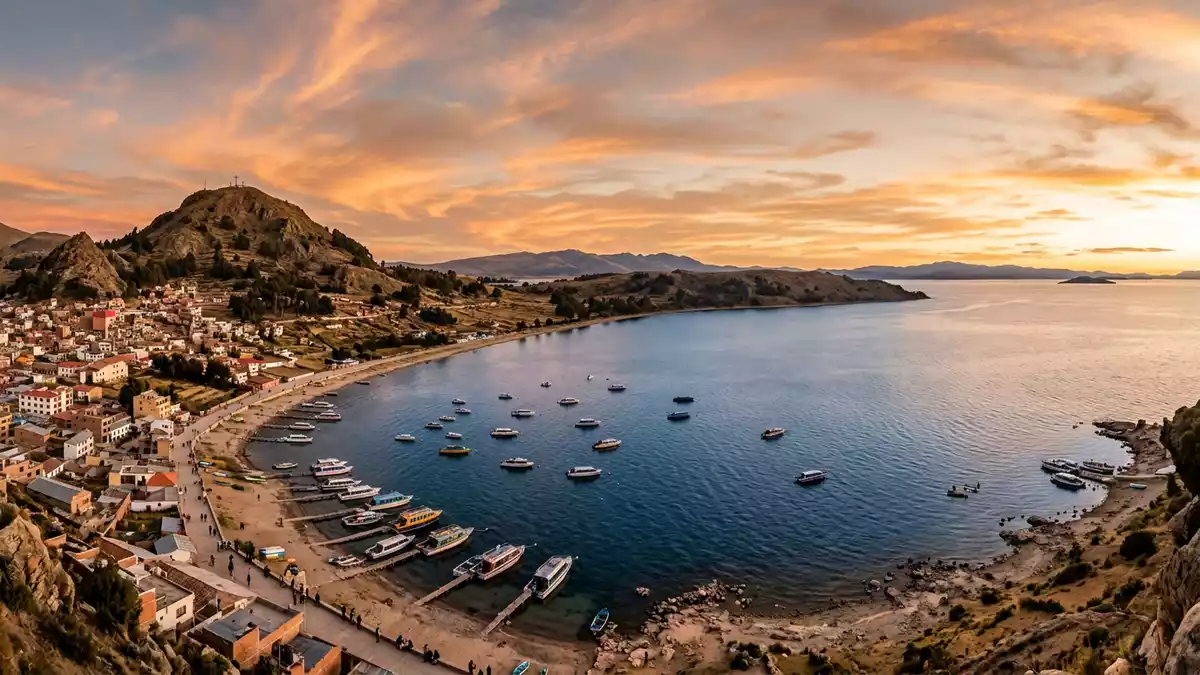
Lago Titicaca stretches across the Andean Altiplano as a high?mountain lake shared by Bolivia and Peru, and at Copacabana its shoreline meets a compact pilgrimage town built at more than 3,800 m (around 12,500 ft) above sea level. The lake is widely recorded as the highest major navigable body of water in the world, with a water surface around 3,810 m (12,500 ft) above sea level and broad reaches hemmed in by ridges of the Andes.highest lake navigable to large vessels Copacabana, in Bolivia’s La Paz Department, looks out over this water from a peninsula that has served as a sacred lakeside site since pre?Hispanic times and later as a Catholic pilgrimage centre focused on the Virgin of Copacabana.main Bolivian town on the shore
The Andean lake at 3,810 m
Lago Titicaca lies in the Andes mountains, astride the border between Peru to the west and Bolivia to the east, forming a broad sheet of water in the high plateau known as the Altiplano.large lake in the Andes on the border Its average water surface elevation around 3,810 m (12,500 ft) makes it the highest major lake navigable by sizeable vessels, a fact noted in both scientific and general references to the region.highest major body of navigable water The lake occupies several thousand square kilometres and spreads in elongated form along a roughly north–south axis, backed by snow?clad Andean ranges visible from many points on the shore.
The water of Lago Titicaca is divided into larger and smaller basins separated by the narrow strait of Tiquina on the Bolivian side, giving the lake a characteristic two?part outline that appears on maps and satellite images.semiendorheic basin with average elevation On the Bolivian shore near Copacabana, the main basin pushes into the land in the form of bays flanked by rocky hills, with small harbours and jetties marking the points where boats serve nearby islands. Among these islands, the Isla del Sol on the Bolivian side is prominent; it lies within the municipality of Copacabana and has long been tied to Andean religious traditions centred on the lake.Isla del Sol within Copacabana municipality
Copacabana: lakeside town and pilgrimage centre
Copacabana is the principal Bolivian town on the shore of Lago Titicaca, occupying a bay framed by two rocky hills and serving as both lakeside settlement and religious destination.principal Bolivian town on the shore The town stands as the capital of Manco Kapac Province in La Paz Department and lies at an elevation recorded around 3,840 m (12,600 ft), which makes its streets and waterfront part of the same high?altitude environment as the lake itself.Copacabana bay of Lake Titicaca Houses, guest establishments and small shops line the slopes rising from the water, while the central plaza is dominated by a large basilica dedicated to Our Lady of Copacabana.
Catholic devotion in Copacabana focuses on an image of the Virgin Mary under the title of Our Lady of Copacabana, recognised as patroness of Bolivia and housed in the Basilica of Our Lady of Copacabana by the town’s main square.seventeenth-century Roman Catholic shrine and basilica Construction of the basilica complex began in 1601 and continued into the nineteenth century, producing a white?walled building with domes that mix Iberian and local influences over a long period of work.constructed between 1601 and 1820 Inside stands the statue known as the Dark Virgin of Copacabana, carved in 1576 by the Inca sculptor Francisco Tito Yupanqui from dark maguey wood; this image became central to religious practice here and is associated with reported miracles that led to its acceptance and later elevation as the country’s patron saint.major shrine and patroness of Bolivia
Lake, basilica and surrounding hills
The immediate setting of Lago Titicaca at Copacabana combines water, religious architecture and slopes that rise above the town. One hill overlooking the town has been developed as a site of devotion known locally as Cerro Calvario, which carries chapels and stations recalling events from Christian tradition and provides views back across the bay and lake.Andes Mountains of South America The proximity of Cerro Calvario to the basilica and waterfront means that processions and individual pilgrims move between steep paths, the plaza with its domed church and the shore where boats depart.
From Copacabana’s waterfront, small vessels serve nearby islands including Isla del Sol and Isla de la Luna, which stand in Lago Titicaca as elongated landforms with archaeological sites and small communities.island situated in the Bolivian side of the lake On the peninsula itself, the town’s streets descend towards the bay, where the lake’s surface reflects the surrounding hills and the high plateau beyond. The combination of lake at high elevation, a basilica associated with a national patron saint and nearby island landscapes gives Copacabana a distinctive profile among settlements on Lago Titicaca.
Visiting Lago Titicaca: what travellers from Western Europe should know
- Lago Titicaca at Copacabana lies in Bolivia’s La Paz Department on a peninsula of the lake; road connections link the town with La Paz and with the border route towards Puno in Peru.
- The town and lakeshore sit above 3,800 m (12,467 ft), so streets, paths and viewpoints involve walking at high altitude, with some approaches to hilltop chapels following steep, stepped routes.
- The basilica dedicated to Our Lady of Copacabana stands beside a main plaza paved for pedestrians, with surrounding blocks mixing religious buildings, administrative offices and accommodation.
- The official language is Spanish and the currency is the Boliviano (BOB).
- Entry requirements depend on your nationality; UK travellers can check the FCDO travel advice at gov.uk/foreign-travel-advice, Irish travellers the Department of Foreign Affairs at ireland.ie.
Searching for Lago Titicaca on social platforms
These links open searches for Lago Titicaca on each platform.Frequently asked questions about Lago Titicaca
Where is Lago Titicaca in relation to Copacabana?
Lago Titicaca forms the high?altitude lake on the border of Bolivia and Peru, and Copacabana is the main Bolivian town built on one of its bays.
What can visitors expect when they reach Copacabana?
Visitors encounter a lakeside town at more than 3,800 m (12,467 ft), with a waterfront on Lago Titicaca, a central basilica and paths that rise towards surrounding hills.
What makes the Copacabana stretch of Lago Titicaca distinctive?
The Copacabana shore combines the altitude and scale of Lago Titicaca with Bolivia’s principal Marian shrine in the Basilica of Our Lady of Copacabana and nearby island landscapes.


