
Lago Titicaca and Copacabana’s high-altitude shoreline
Published on 09/17/2026 at 13:45 | Editorial responsibility: Rafael Müller, Editor-in-Chief AD HOC NEWS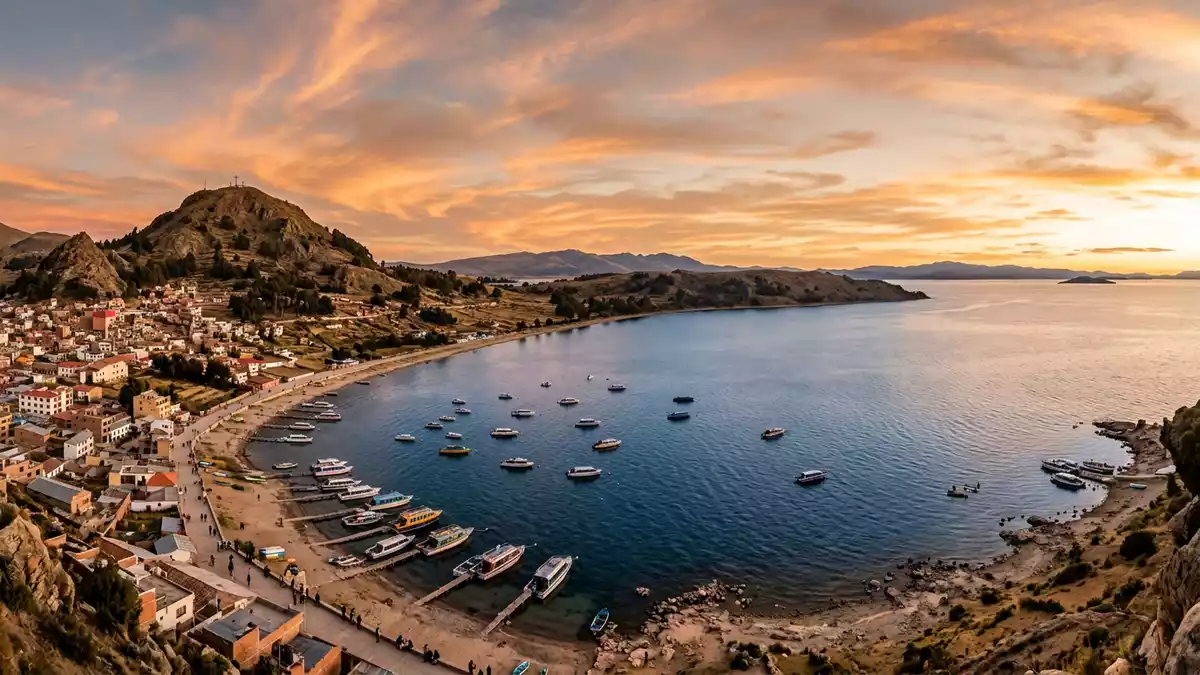
Lago Titicaca lies in the Andes on the border between Bolivia and Peru and reaches an elevation of around 3,810 m (12,500 ft) above sea level, making it the highest lake navigable to large vessels. It forms the backdrop to Copacabana in Bolivia, a lakeside town built on a peninsula that projects into its waters.
Lago Titicaca at the edge of Copacabana
Lago Titicaca is a large Andean lake shared between Bolivia and Peru, occupying a high basin known as the Altiplano and extending over several thousand square kilometres. It is widely described as the highest lake navigable to sizeable vessels, with an elevation given as about 3,810 m (12,500 ft) above sea level.highest lake navigable to large vessels The lake’s surface lies within sight of snow-capped Andean ranges, creating a contrast between open water and mountain ridges.
On its Bolivian side, Lago Titicaca reaches the shores of Copacabana, a town that occupies a peninsula between bays on the southern part of the lake.a peninsula between bays The settlement stands at a high altitude above sea level and faces the open expanse of the lake towards the border with Peru. From the waterfront, boats cross towards islands further out in the lake, and the town’s streets rise gently away from the shore between low hills.
A Marian shrine above the water
Copacabana is known within Bolivia for its Marian shrine, the Basilica of Our Lady of Copacabana, a Roman Catholic church from the seventeenth century that stands close to the lakeside. The basilica is dedicated to the Blessed Virgin Mary under the title associated with Copacabana and is regarded as a national patronal shrine.Basilica of Our Lady of Copacabana Its history reaches back to an earlier church from the sixteenth century, rebuilt during the first half of the seventeenth century.
The basilica complex occupies a prominent position in the town, with a square in front that forms a focus for religious gatherings and vehicle blessings. Copacabana has long been described as a centre of pilgrimage within Bolivia, linked to devotion to the Virgin of Copacabana whose veneration dates back to the late sixteenth century.veneration dates back to 1583 From the basilica and the nearby squares, there are views down towards Lago Titicaca, and the lake itself forms part of the wider devotional landscape.
Islands and high-altitude lake journeys
Lago Titicaca around Copacabana includes islands that carry strong archaeological and cultural associations, such as Isla del Sol and Isla de la Luna. These islands lie within the Bolivian part of the lake and are reached by boats leaving from the harbour at Copacabana.settlements on the shores Journeys across the water reveal stepped slopes, terraced fields and small communities that look back towards the high plateau on both sides of the border.
The lake itself has been navigated by vessels for generations, including steamships introduced in the nineteenth century that were transported in pieces and assembled on its shores.steamships built in England in the 1860s The combination of historic lake travel, island settlements and the religious role of Copacabana gives this part of Lago Titicaca a layered character. Visitors encounter a town with a long-standing shrine, a harbour leading to islands associated with pre-Columbian cultures and an open lake whose altitude shapes everyday life on its shores.
Visiting Lago Titicaca: what travellers from Western Europe should know
- Lago Titicaca lies in the Andes on the border between Bolivia and Peru, and Copacabana stands on a peninsula on its Bolivian shore, reached by road from La Paz.
- The town and lakefront sit at high altitude, so streets and paths rise on noticeable gradients between the harbour, the main square and the surrounding hills.
- Boats to islands such as Isla del Sol and Isla de la Luna depart from the Copacabana waterfront, using simple piers along the bay.
- Copacabana is in Bolivia, where the official language is Spanish and the currency is the boliviano.
- Entry requirements depend on your nationality; UK travellers can check the FCDO travel advice at gov.uk/foreign-travel-advice, Irish travellers the Department of Foreign Affairs at ireland.ie.
Searching for Lago Titicaca on social platforms
These links open searches for Lago Titicaca on each platform.Frequently asked questions about Lago Titicaca
Where is Lago Titicaca in relation to Copacabana?
Lago Titicaca lies in the high Andes on the border between Bolivia and Peru, and Copacabana occupies a peninsula on its Bolivian shore.
What should travellers expect on a visit to Lago Titicaca from Copacabana?
Travellers encounter a high-altitude lakeside town with a harbour, a seventeenth-century basilica and boat journeys to islands such as Isla del Sol.
What makes the Copacabana section of Lago Titicaca distinctive?
This stretch of Lago Titicaca combines an elevated Andean lakescape with a longstanding Marian pilgrimage centre and access to culturally significant islands.


