
Lago Titicaca and Copacabana: Bolivia’s high-altitude lakeside town
Published on 09/19/2026 at 20:59 | Editorial responsibility: Rafael Müller, Editor-in-Chief AD HOC NEWS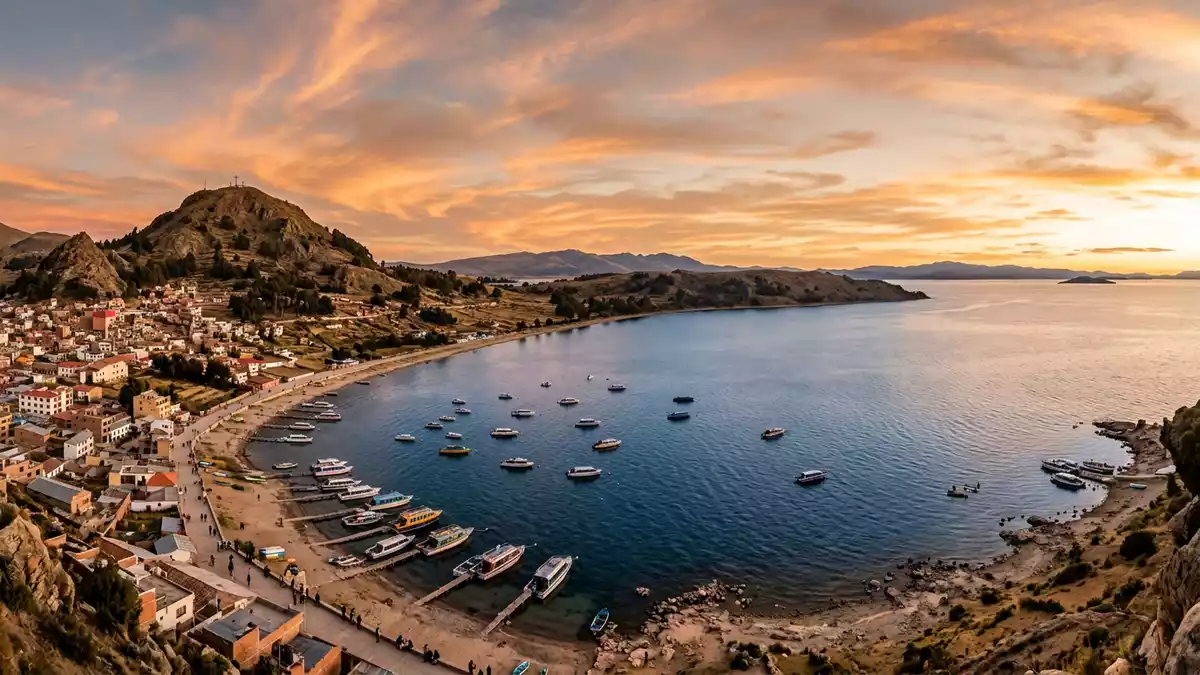
Lago Titicaca, shared between Bolivia and Peru in the Andes, forms a vast high-altitude sheet of water with the Bolivian town of Copacabana spread along one of its bays. Rising to around 3,810 m (12,500 ft) above sea level, the lake is among the world’s highest large bodies of navigable water, giving Copacabana a setting where deep blue water meets thin mountain air and strong highland light.high-altitude sheet of water
Water, altitude and a town on a peninsula
Lago Titicaca is South America’s largest freshwater lake by surface area, extending roughly northwest to southeast for about 190 km, with wide reaches that feel closer to inland sea than mountain lake.South America’s largest freshwater lake Its waters lie between Peru to the west and Bolivia to the east, and Copacabana occupies a peninsula on the Bolivian shore where hills drop sharply towards sheltered bays.a peninsula on the Bolivian shore
The town sits well above 3,800 m (12,467 ft), an altitude where even short climbs from the waterfront to the upper streets can feel demanding.well above 3,800 m From the bay, steep slopes frame views over water and towards islands rising from the lake, while the peninsular position gives Copacabana long contact with the shore compared with its compact urban area.
Copacabana, from pre-Hispanic cult site to pilgrimage town
Long before Copacabana became a colonial town, the region around Lago Titicaca formed part of the cultural heartland of the Inca and earlier civilisations, with the nearby Isla del Sol regarded as a place of origin in Andean myth.place of origin in Andean myth Copacabana later developed as a settlement linked to these traditions and to the lake, and by the late sixteenth century it had gained a reputation as a centre of Marian devotion centred on an image known as the Virgen de Copacabana.centre of Marian devotion
In the colonial period Copacabana became the capital of the Manco Kapac province in the La Paz department, anchoring religious life on the Bolivian shore of Lago Titicaca.capital of the Manco Kapac province The town’s role as a pilgrimage centre continues, with processions, blessings and celebrations focused on the basilica that dominates the central square, combining Andean traditions with Catholic ritual.
The basilica and the lakeside: architecture facing water
Copacabana’s most recognisable building is the white basilica dedicated to the Virgen de Candelaria de Copacabana, whose architecture blends Spanish colonial forms with elements often described as Moorish, including domes and decorative details more associated with Mediterranean influences than with the Andean plateau.white basilica dedicated to the Virgen The basilica complex includes courtyards where vehicles line up to receive blessings, a practice that links everyday travel with sacred protection.
From the basilica’s elevated position, streets run downhill towards the waterfront, where jetties and small harbours serve boats crossing Lago Titicaca to islands such as Isla del Sol.boats crossing Lago Titicaca The town’s grid opens into the bay, giving clear views of the surrounding hills and the expanse of water, and making the relationship between lake and settlement visible in a single walk from shrine to shore.
Visiting Lago Titicaca: what travellers from Western Europe should know
- Copacabana lies in western Bolivia on a peninsula projecting into Lago Titicaca, reached overland from La Paz or from Peruvian towns such as Puno by road and bus.
- The town and lakeside sit above 3,800 m (12,467 ft); streets rise steeply from the waterfront, and walks to viewpoints and the basilica involve noticeable gradients and stairways.
- Boat services operate from Copacabana’s waterfront to surrounding islands on Lago Titicaca, using simple piers and small craft that embark close to the main lakeside promenade.
- The official language is Spanish and the currency is the Boliviano (BOB).
- Entry requirements depend on your nationality; UK travellers can check the FCDO travel advice at gov.uk/foreign-travel-advice, Irish travellers the Department of Foreign Affairs at ireland.ie.
Searching for Lago Titicaca on social platforms
These links open searches for Lago Titicaca on each platform.Frequently asked questions about Lago Titicaca
Where is Lago Titicaca and Copacabana?
Lago Titicaca lies in the Andes on the border between Bolivia and Peru, with Copacabana as the principal Bolivian town on its southern shore.
What can visitors expect on a visit to Copacabana?
Visitors encounter a lakeside town at high altitude, with a prominent basilica, steep streets, and direct access to boat trips on Lago Titicaca and its islands.
What makes Lago Titicaca distinctive among mountain lakes?
Lago Titicaca combines great surface area with a position above 3,800 m (12,467 ft), making it one of the world’s highest large navigable lakes and a dominant feature of the Altiplano.


