
La Seu Vella turns Lleida’s hilltop into a stone cathedral
Published on 09/22/2026 at 19:51 | Editorial responsibility: Rafael Müller, Editor-in-Chief AD HOC NEWS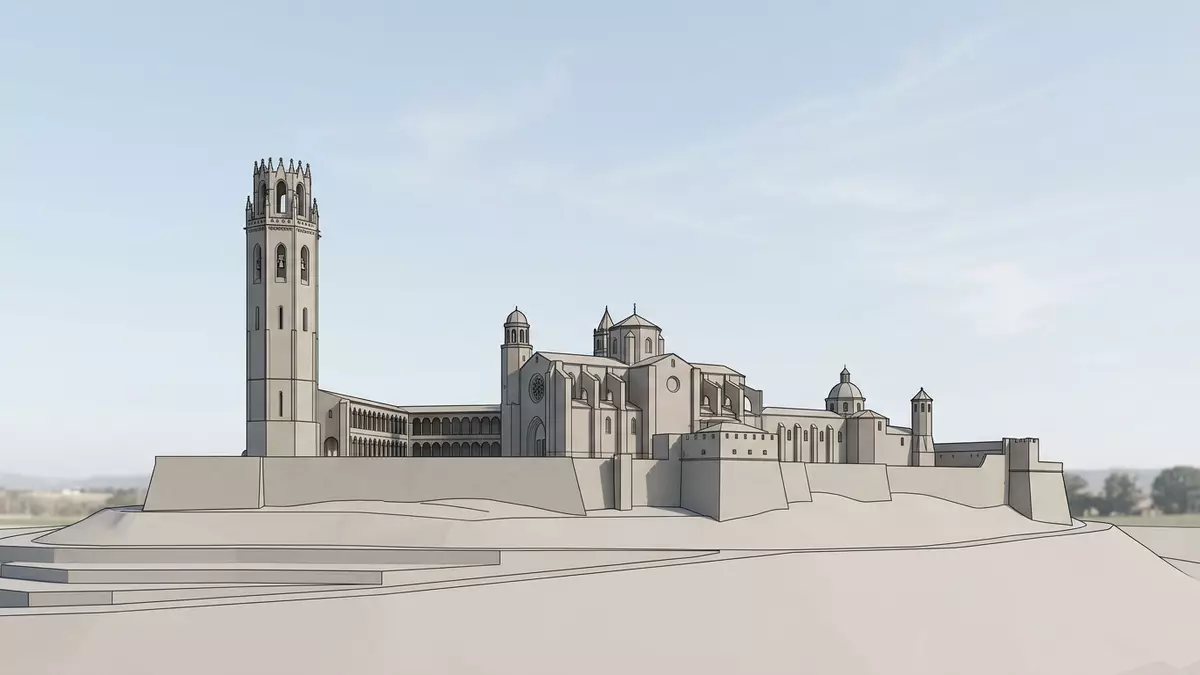
La Seu Vella rises above Lleida on the Turó de la Seu Vella, a hilltop ensemble where a cathedral, cloister, bell tower and fortifications occupy the same elevated precinct. Its defining feature is the meeting of sacred architecture and military stonework, with Romanesque walls and Gothic vaults set within a fortified skyline.
The cathedral was begun in 1203 under Pere de Coma and consecrated in 1278. Work continued into the fifteenth century, leaving La Seu Vella with a long medieval building history visible in its changing forms.
La Seu Vella and the shape of the hilltop
The monument occupies the upper part of the Turó de la Seu Vella, above Lleida and the surrounding Segrià plain. The hill contains the former cathedral, the Castell del Rei-Suda and defensive walls, creating a broad stone complex rather than an isolated church.
La Seu Vella is built from stone, with a Romanesque core and Gothic additions. Its exterior presents solid walls, sculpted portals and a prominent bell tower. The fortified setting gives the cathedral a second architectural language, in which ramparts and gateways sit beside ecclesiastical buildings.
The hilltop location is visible from across Lleida, while the monument itself opens towards the city and the plain. The relationship between church, cloister, tower and walls is central to the character of the site.
Romanesque beginnings and Gothic additions
Pere de Coma directed the initial project in 1203. The church follows a Romanesque layout with three naves, a transept and apses, while its vaulting uses Gothic ribbed forms. This combination records the transition between architectural traditions in medieval Catalonia.
The cathedral served as the church of the Diocese of Lleida from 1278 until 1707. During the thirteenth, fourteenth and fifteenth centuries, chapels, the cloister, the bell tower and the Portal of the Apostles formed part of the expanding ensemble.
The Portal of the Apostles belongs to the Gothic work associated with the cloister. Sculpted capitals and carved architectural details remain among the most notable features of the monument, giving the stone surfaces a strong decorative presence.
In 1707, La Seu Vella lost its cathedral function and became part of a military complex. The change of use altered the relationship between the building and the city, but the medieval church, cloister and tower remain legible within the fortified hill.
The cloister, tower and fortified ensemble
The cloister stands beside the church as an open court surrounded by arcaded galleries. Its scale is a defining feature of La Seu Vella, and its carved capitals provide a detailed counterpoint to the massive exterior walls.
Several galleries open towards the city and the plain. The cloister’s elevated position places carved stone, open sky and long views within the same architectural space. The result is a part of the cathedral that functions as both a richly decorated medieval structure and an elevated terrace.
The bell tower rises from the cathedral complex as an octagonal stone landmark. Its construction belongs to the fourteenth and fifteenth centuries, and a spiral staircase reaches the tower terrace.
Around the cathedral, the walls and gateways belong to the hill’s defensive history. The nearby Castell del Rei-Suda adds a royal and military element to the monumental complex, while La Seu Vella remains its central ecclesiastical building.
La Seu Vella’s historical sequence is visible through its material contrasts: Romanesque portals, Gothic vaults, carved cloister details, the tower and later fortifications share one hilltop setting. The building is therefore read as a layered ensemble rather than a single period piece.
Visiting La Seu Vella: what travellers from Western Europe should know
- La Seu Vella stands on the Turó de la Seu Vella in Lleida. Access is possible by car or on foot through the walled precinct and the Porta del Lleó, or by lift from Plaça de Sant Joan through the Portal de Sant Andreu.
- The approach reaches a fortified hilltop with gateways, rising ground and stone surfaces. The bell tower contains a narrow spiral staircase leading to its terrace.
- The official language is Catalan and Spanish, and the currency is the euro.
- The monument forms part of the wider hilltop complex with the Castell del Rei-Suda and the surrounding defensive walls.
Searching for La Seu Vella on social platforms
These links open searches for La Seu Vella on each platform.
Frequently asked questions about La Seu Vella
Where is La Seu Vella?
La Seu Vella is on the Turó de la Seu Vella, the hill above Lleida in Catalonia, Spain. The cathedral forms part of a wider fortified complex with the Castell del Rei-Suda.
What can visitors see at La Seu Vella?
The complex contains a Romanesque-Gothic cathedral, sculpted portals, chapels, an extensive cloister, a bell tower and defensive walls. The cloister galleries open towards Lleida and the Segrià plain.
What makes La Seu Vella distinctive?
La Seu Vella combines a medieval cathedral with a fortified hilltop setting. Its 1203 foundation, 1278 consecration, Gothic additions and later military use are visible in one architectural ensemble.


