
La Seu Vella, the hilltop cathedral that defines Lleida
Published on 08/27/2026 at 07:26 | Editorial responsibility: Rafael Müller, Editor-in-Chief AD HOC NEWS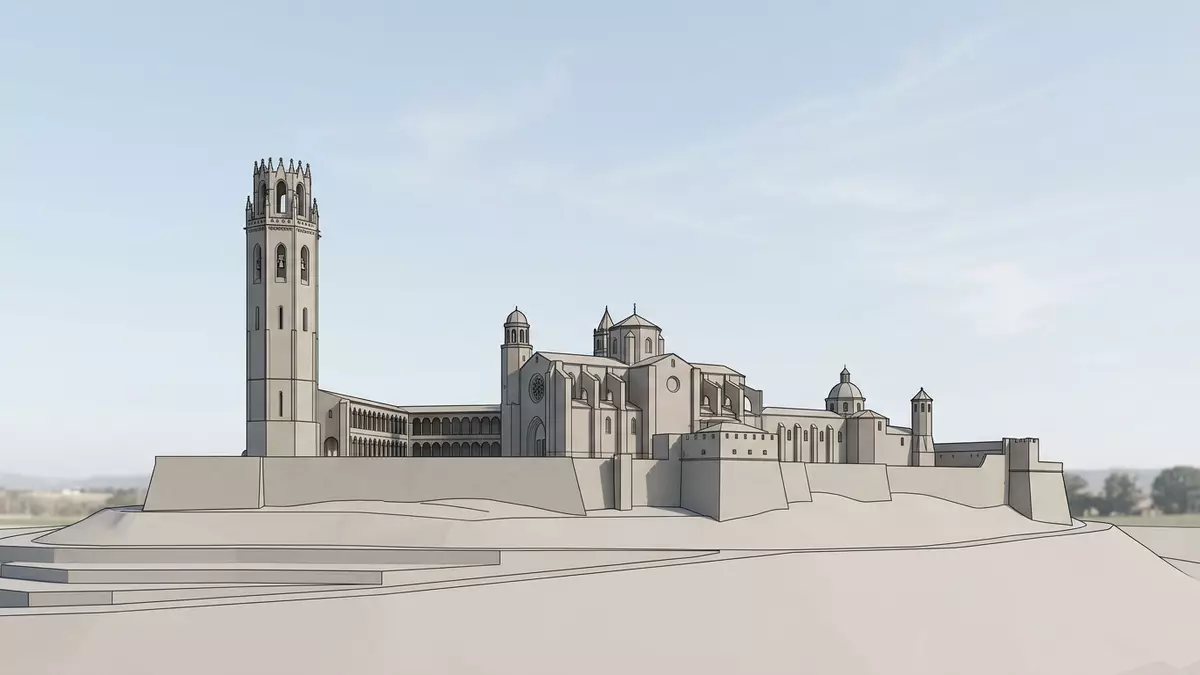
La Seu Vella in Lleida is the former cathedral that crowns the city from its own hill, the Turó de la Seu Vella, turning a religious complex into a stone landmark visible for kilometres around. Built as the Cathedral of Saint Mary and now known simply as La Seu Vella, it combines a church, a cloister and a tower in a single fortified ensemble that still dominates the Segre valley.
A medieval cathedral on the Turó de la Seu Vella
The Old Cathedral of Lleida, widely referred to as La Seu Vella, stands on the Turó de la Seu Vella, the hill that marks the highest point of the city and overlooks the surrounding plain and the river Segre.Old Cathedral of Lleida The building complex grew out of the medieval Cathedral of Saint Mary and was constructed in the late twelfth and thirteenth centuries, when Lleida’s Christian cathedral was established after the reconquest of the city in 1149.first cathedral began in 1193 Medieval masons developed a layout that brings together the main church, its chapels, the surrounding cloister, the bell tower and the residences of the canons in a single precinct.
The architecture shows the transition from Romanesque to Gothic forms within Catalan religious building, with early phases following late Romanesque lines and later work introducing Gothic vaults and windows.transition from Romanesque to Gothic The main church is built in sandstone from the region around Lleida, while more finely carved elements use stone from Vinaixa, creating a subtle contrast between the structural walls and the sculptural decoration.stone from Lleida and Vinaixa Seen from the city below, the mass of the church and the tower read almost like a fortified castle, which is one reason La Seu Vella is also known locally as the “Castell de Lleida”.also known as “Lleida Castle”
The great cloister and sculptural stonework
Within the precinct, the cloister of La Seu Vella forms one of the most striking spaces in the complex and has become one of its defining features.cloister noted for its scale It is laid out as a large trapezoidal courtyard framed by four galleries, each around 48 m (157 ft) long and about 8.8 m (29 ft) wide, creating an open quadrangle of stone arcades and Gothic openings.four galleries of 48 m length Visitors crossing these galleries move between the interior of the church and the open courtyard, with the city and the Segre valley appearing at intervals through the large window bays in the outer walls.
The cloister’s courtyard is covered by pointed vaults, and further pointed vaults in the south-east façade frame openings that act as windows, giving wide views over Lleida and the surrounding countryside.pointed vaults and city views This combination of robust stone structure and carefully carved tracery has led heritage bodies in Catalonia to describe the cloister as one of the largest and most spectacular Gothic cloisters in Europe.one of the largest Gothic cloisters Around it, sculptural work on portals, capitals and façades adds further detail, with figures, foliage and geometric motifs cut into the sandstone, catching the changing light across the day.
From cathedral to monumental complex above Lleida
La Seu Vella served as the cathedral of Lleida for around five centuries, before losing its liturgical role in the early eighteenth century when political and military conflict in Spain brought major change to the building and the city.five centuries as cathedral In 1707 the army of Philip V occupied the site and turned the cathedral into a military installation, adding partitions and extra floors that altered the interior and led to the loss of many works of art.converted into headquarters in 1707 Later conflicts, including the Peninsular War, brought further damage, and La Seu Vella functioned for long periods as barracks and a defensive post rather than a place of worship.
The twentieth century marked a different phase, when its historical and architectural value began to be formally recognised. In 1918 La Seu Vella was declared a historical monument, a status that acknowledged its importance for Catalan heritage even while military use continued on the site.declared historical monument in 1918 After 1948, restoration programmes started to recover the medieval spaces and remove later military accretions, gradually revealing the church, cloister and tower more clearly as parts of a monumental complex on the Turó de Lleida.restoration from 1949 Seen from the modern city, the ensemble offers a layered reading of Lleida’s history, with the former cathedral, the hilltop fortifications and the skyline of the Segre valley all in view at once.
Visiting La Seu Vella: what travellers from Western Europe should know
- La Seu Vella stands on the Turó de la Seu Vella above the centre of Lleida, on the left bank of the river Segre, and is reached along roads climbing from the old town.Turó de la Seu Vella address
- The hilltop precinct includes ramped approaches, interior staircases and, in the tower, a climb up a narrow spiral staircase with several hundred steps to reach the upper levels.tower climb of 238 steps
- From the cloister and the open areas around the church there are wide views across Lleida, the Segre valley and the surrounding Catalan plain, with the modern city spreading out below the medieval hill.views over Lleida and Segre
- Lleida lies in Catalonia in north-eastern Spain; the official languages are Catalan and Spanish and the currency is the euro.
Searching for La Seu Vella on social platforms
These links open searches for La Seu Vella on each platform.Frequently asked questions about La Seu Vella
Where is La Seu Vella located?
La Seu Vella stands on the Turó de la Seu Vella hill above the centre of Lleida, in Catalonia in north-eastern Spain, overlooking the river Segre and the surrounding plain.
What should visitors expect at La Seu Vella?
Visitors encounter a medieval church, an extensive cloister and a bell tower within a walled hilltop precinct, together forming a monumental complex with long internal galleries and wide exterior views.
What makes La Seu Vella distinctive among cathedrals?
Its setting on a separate hill above Lleida, the large Gothic cloister with its four galleries and pointed vaults, and the combination of cathedral and fortifications give La Seu Vella a character that is closely tied to the city skyline.


