
La Seu Vella, Lleida’s sandstone cathedral-fortress on the hill
Published on 09/10/2026 at 09:51 | Editorial responsibility: Rafael Müller, Editor-in-Chief AD HOC NEWS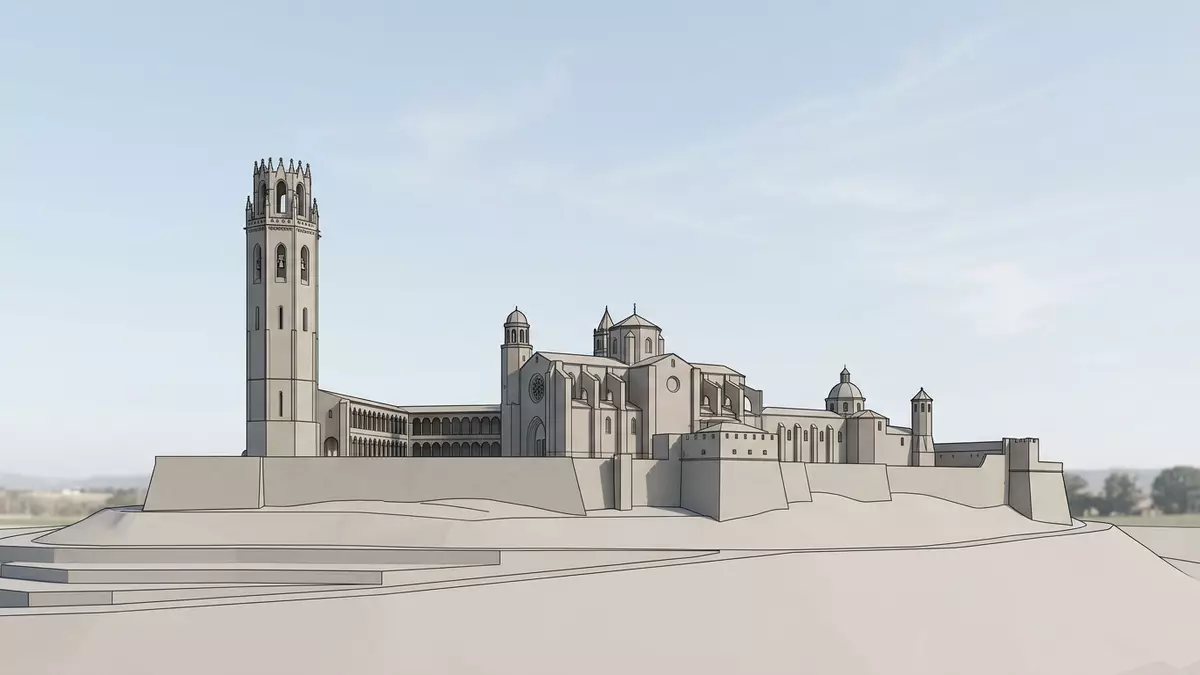
La Seu Vella is the former cathedral that crowns the hill above Lleida in Catalonia, its sandstone mass and tall bell tower forming a landmark visible across the Segrià plain. Raised on the Turó de la Seu Vella, the complex brings together Romanesque and Gothic architecture with later fortifications, and its history as both sacred space and military stronghold gives the site a distinctive character within the city’s skyline.
Sandstone architecture on the Turó de la Seu Vella
La Seu Vella stands on the Turó de la Seu Vella, a hill that forms the highest point of Lleida and looks out over the surrounding countryside.Old Cathedral of Lleida The building known as La Seu Vella is the old Cathedral of Saint Mary, constructed in warm local stone whose colour shifts gently with the light and weather.sandstone mass and bell tower Its plan has three naves arranged with a marked transept and a sanctuary formed by multiple apses, giving the interior a clear axial layout that reflects Romanesque traditions while allowing for Gothic vaulting above.Romanesque layout with three naves
The construction of La Seu Vella began in 1203 under the master builder Pere de Coma, whose project shaped the cathedral’s overall form.construction began in 1203 under Pere de Coma The temple was consecrated in 1278, and work on elements such as the dome and the covering of the naves continued into the late thirteenth century.consecrated in 1278 Over the thirteenth and fourteenth centuries the complex grew into a substantial medieval ensemble that combined ecclesiastical spaces with terraces and defensive walls around the hill.medieval architectural complex
Cloister, tower and sculpted stone
One of the most striking parts of La Seu Vella is its cloister, an open quadrangle of arcades that looks both onto the church and out across the plain from the edge of the hill.cloister, one of the largest in Europe The cloister’s arcades carry an extensive programme of stone carving, with capitals, mouldings and reliefs that reflect the sculptural traditions of southern Europe in the thirteenth century.tradition sculpturale du sud de l’Europe Walking through this space reveals both its role as a circulation route and its position as an elevated terrace, with views taking in the Segrià plain and the roofs of Lleida below.
Adjacent to the church rises the bell tower, whose slender vertical form has become one of Lleida’s principal visual symbols.conjunt monumental de la Seu Vella The tower stands apart from the main nave, connected by passageways and staircases, and its upper levels offer wide-ranging views over the city and the surrounding agricultural landscape where the Segre river runs through the plain.overlooking the Segrià plain Together, the cloister, church and tower form a compact group of stone structures whose profiles define the outline of the hilltop when seen from the city below.
From medieval cathedral to fortified citadel
La Seu Vella was the cathedral church of the Roman Catholic Diocese of Lleida from the late thirteenth century until 1707, and during that period it functioned as a religious, cultural and political centre for the city.cathedral church until 1707 In 1707, during the War of the Spanish Succession, the cathedral lost its religious function and the complex was converted into a military fortress under the authority of Philip V.converted into a headquarters in 1707 Over the seventeenth and eighteenth centuries, fortifications were built and reinforced around the hill, with ramparts and defensive walls enclosing the cathedral, the cloister and the Castell del Rei, also known as La Suda, which stands nearby as a former Moorish fortress adapted for use by the monarchs of the Crown of Aragon.fortifications and Castell del Rei
The long military use of La Seu Vella involved internal alterations, partitions and the loss of liturgical furnishings and decorative elements, marking a significant change in how the building related to the city around it.loss of furnishings under military use In 1918 La Seu Vella was declared a historical monument, and in the decades that followed, restoration and conservation work began to recover its architectural fabric and sculptural heritage.named historical monument in 1918 The hill and its ensemble, known as Turó de la Seu Vella, are today proposed as a cultural property on the UNESCO Tentative List, reflecting the significance of the cathedral-fortress complex within the wider context of Catalan and European medieval architecture.Turó de la Seu Vella de Lleida
Visiting La Seu Vella: what travellers from Western Europe should know
- La Seu Vella stands on the Turó de la Seu Vella above the centre of Lleida, and can be reached on foot from the lower city by streets and pathways climbing the hill.
- The hilltop complex includes terraces, stone steps and sloping paths, and visiting the church, cloister and tower involves walking over uneven surfaces and climbing staircases inside the buildings.
- The Segre river runs near the base of the hill, and the elevated position of La Seu Vella means that many viewpoints around the complex look out over the river corridor and the agricultural plain beyond.
- Lleida lies in Catalonia in north-eastern Spain, where the official languages are Catalan and Spanish and the currency is the euro.
Searching for La Seu Vella on social platforms
These links open searches for La Seu Vella on each platform.
Frequently asked questions about La Seu Vella
Where is La Seu Vella and what kind of place is it?
La Seu Vella is the former Cathedral of Saint Mary on the Turó de la Seu Vella hill above the city of Lleida in Catalonia, Spain.
What can visitors expect when exploring La Seu Vella?
Visitors encounter a Romanesque-Gothic stone church with three naves, an extensive cloister and a tall bell tower within a fortified hilltop complex.
What makes La Seu Vella distinctive among Spanish cathedral sites?
La Seu Vella is distinctive for its combination of medieval cathedral architecture, large sculpted cloister and later fortifications that turned the hilltop ensemble into a citadel.


