
La Seu Vella, Lleida’s hilltop cathedral-fortress
Published on 09/16/2026 at 08:15 | Editorial responsibility: Rafael Müller, Editor-in-Chief AD HOC NEWS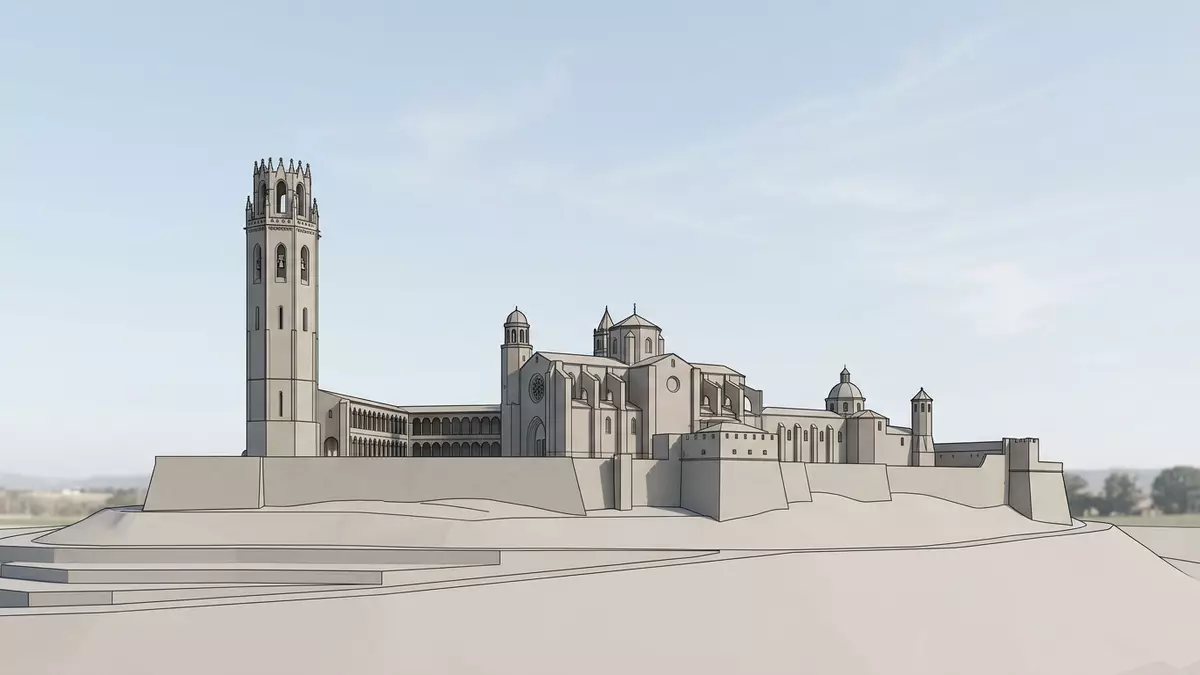
La Seu Vella is the former cathedral that crowns the hill above Lleida in Catalonia, a sandstone complex whose church, cloister and tower form a landmark across the Segrià plain. Raised on the Turó de la Seu Vella, the site brings together Romanesque and Gothic architecture with later fortifications and carries the layered history of religion, power and defence in this corner of Spain.
A cathedral on the hill above Lleida
La Seu Vella stands on the Turó de la Seu Vella, the hill that forms the highest point of Lleida and looks out over the surrounding countryside.Turó de la Seu Vella From the plain, the complex appears as a compact mass of warm stone with the tall bell tower rising beside the church, while the remains of ramparts and bastions edge the plateau.
The building known as La Seu Vella is the old Cathedral of Saint Mary, constructed in local stone whose colour shifts subtly with light and weather.Old Cathedral of Lleida The church stands within a wider monumental ensemble that includes open spaces, defensive walls and the nearby Castle of the King, giving the hilltop the character of a self-contained citadel above the lower city.Seu Vella and Castle of the King-Suda
Romanesque plan, Gothic height and a vast cloister
Construction of the present cathedral began in 1203 under the master builder Pere de Coma, a figure recorded as the author of the initial project.construction began in 1203 The church was consecrated in 1278 and work continued into the fifteenth century, giving the ensemble a clear medieval profile that blends Romanesque and Gothic elements.consecrated in 1278
The layout follows Romanesque tradition, with three naves aligned along a marked transept and a sanctuary formed by multiple apses, while the vaults and openings draw on Gothic forms.Romanesque layout with three naves Beside the church lies an extensive cloister, noted in heritage records for its sculptural work and for being among the largest cloisters of its kind in Europe.one of the largest cloisters Its arcaded walks frame views across Lleida and the plains, while carved capitals and details reflect the craftsmanship of several centuries.
From cathedral of Lleida to fortified stronghold
La Seu Vella served as the cathedral of the Roman Catholic Diocese of Lleida from the late thirteenth century until 1707, when that role passed to the newer cathedral in the lower city.cathedral between 1278 and 1707 The change followed the capture of Lleida by forces loyal to Philip V during the War of the Spanish Succession, after which the hilltop complex was converted into a military fortress with barracks and defensive structures.converted into headquarters in 1707
This military phase lasted for generations and brought internal alterations, compartmentalisation and damage to artistic heritage.barracks and citadel use In the twentieth century the complex gained formal protection when it was declared a historical monument in 1918, and restoration campaigns from 1949 onwards opened the buildings and ramparts once more to visitors, highlighting both the religious architecture and the later layers of fortification.named historical monument and restored
Visiting La Seu Vella: what travellers from Western Europe should know
- La Seu Vella stands on the Turó de la Seu Vella at the upper edge of Lleida, reached from the city by roads that climb to the hilltop complex.
- The ensemble occupies a height above the surrounding plain, and moving between the church, cloister and outer walls involves stairs, ramps and open, elevated terraces.
- Lleida lies in Catalonia in the north-east of Spain; the official language is Catalan alongside Spanish and the national currency is the euro.
- The monumental complex of La Seu Vella is close to the Castle of the King-Suda on the same hill, with the lower city spreading out below.
Searching for La Seu Vella on social platforms
These links open searches for La Seu Vella on each platform.Frequently asked questions about La Seu Vella
Where is La Seu Vella?
La Seu Vella stands on the Turó de la Seu Vella hill above the city of Lleida in Catalonia, in the north-east of Spain.
What can visitors expect at La Seu Vella?
Visitors encounter a Romanesque-Gothic stone church with three naves, a large cloister and a prominent bell tower set within a fortified hilltop ensemble.
What makes La Seu Vella distinctive?
The combination of medieval cathedral architecture, an extensive cloister and the later transformation into a military fortress gives La Seu Vella a character that reflects several centuries of Lleida’s history.


