
La Seu Vella, Lleida’s hilltop cathedral-fortress
Published on 09/04/2026 at 20:51 | Editorial responsibility: Rafael Müller, Editor-in-Chief AD HOC NEWS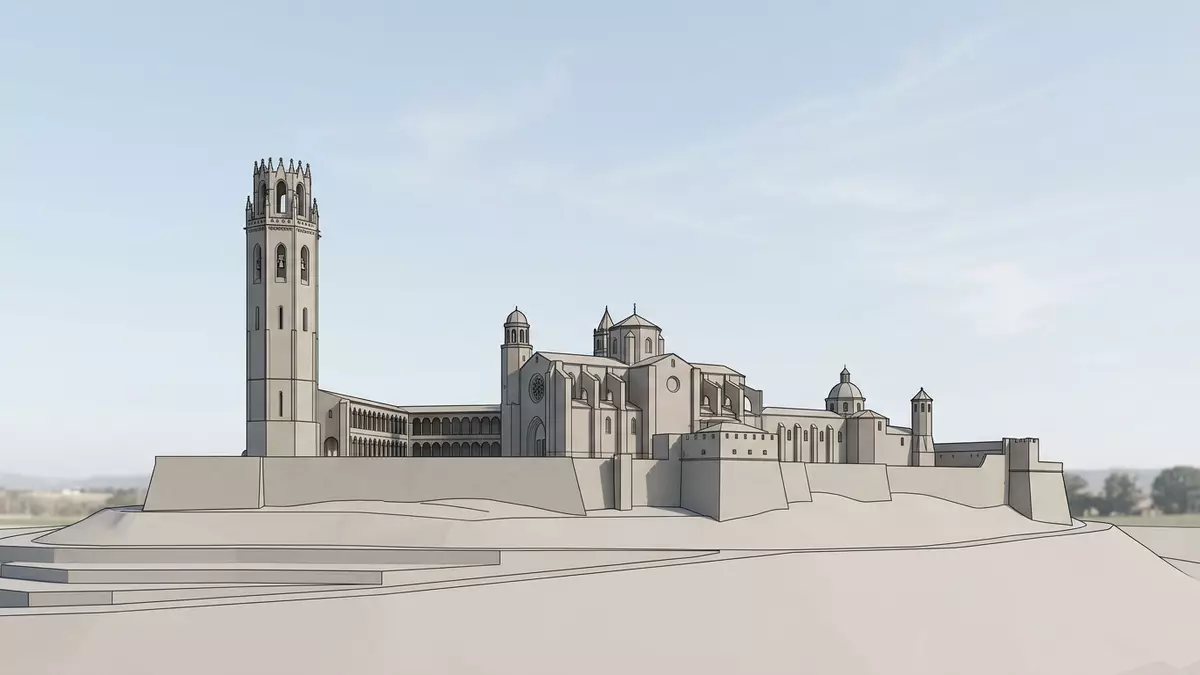
La Seu Vella rises above Lleida on a prominent hill, a former cathedral enclosed within later fortifications and overlooking the Segre valley in western Catalonia. Built as the city’s main cathedral in the thirteenth century and later converted into a military stronghold, it brings together carved stone architecture, a spacious cloister and defensive walls in a single hilltop ensemble.
A cathedral on the Turó de la Seu Vella
The hill known as Turó de la Seu Vella forms the highest point of Lleida, and the cathedral complex occupies its broad summit above the surrounding plain.Old Cathedral of Lleida The church is dedicated to Saint Mary and was consecrated in 1278, marking the completion of the main medieval phase.consecrated in 1278 Its layout follows a Romanesque plan with three naves, a transept beneath a dome and a sanctuary lined with apses, while later Gothic elements appear in the elevation and details.
The ensemble also includes a large cloister and a tall bell tower, both added over the later Middle Ages and helping to define the skyline above Lleida.church, cloister and tower bell The cloister opens directly to the hilltop terrace, and its arcades frame long views across the city and agricultural lands of western Catalonia.cloister, one of the largest and most spectacular in Europe Seen from the valley, the stone mass of the cathedral rises above a ring of fortification walls, making the hill a distinct landmark for travellers arriving from Barcelona or Zaragoza.
From medieval cathedral to fortified citadel
La Seu Vella was built after Lleida passed from Muslim to Christian control in 1149 under Count Ramon Berenguer IV of Barcelona and Ermengol VI of Urgell, replacing an earlier mosque on the same hilltop site.reconquered in 1149 Construction began in 1203 under the master builder Pere de Coma and continued through the reigns of Peter II and James I of Aragon before the church’s consecration later in the century.built between the 13th and 15th centuries For several centuries it served as the cathedral of the Diocese of Lleida, with religious, civic and ceremonial life concentrated on the hill.
In 1707, during the War of the Spanish Succession, the building’s ecclesiastical function ended when royal authorities converted La Seu Vella into a military fortress and transferred cathedral status to a new church in the lower city.closed for worship and converted into military barracks Over the eighteenth and nineteenth centuries the hill was reshaped with ramparts, barracks and defensive works, altering many of the interiors of the medieval complex.converted into a headquarters The ensemble was declared a historic monument in 1918, and military use ceased in the mid-twentieth century, allowing restoration of the cathedral spaces and opening of the site to visitors.declared Monumento Nacional in 1918
Architecture, sculpture and landscape views
The exterior of La Seu Vella combines the mass of the stone church with later fortification walls and platforms that follow the contours of the hill. The bell tower rises above the complex, its vertical silhouette visible along the Segre corridor and across the fields of the Lleida plain.majestueux et harmonieux exemple de l’architecture du XIII siècle Around the church, walkways and open ground reveal the full perimeter of the walls and offer changing views of the city’s street grid and river.
Inside, the Romanesque-Gothic style is expressed in carved capitals, arcades and portals, many of them bearing sculptural decoration that links La Seu Vella to broader southern European traditions.tradition sculpturale du sud de l’Europe The cloister, described as one of the largest in Europe, opens on several sides to the landscape, so the visitor moves between enclosed stone spaces and wide terraces overlooking Lleida.Seu Vella and Castle of the King-Suda The hilltop ensemble, known as Turó de la Seu Vella, has been placed on Spain’s tentative list for UNESCO World Heritage status, underlining its importance as a combined religious and military monument in Catalonia.Turó de la Seu Vella de Lleida
Visiting La Seu Vella: what travellers from Western Europe should know
- La Seu Vella stands on the hill above central Lleida in north-eastern Spain, with access roads climbing from the city and signposted approaches from the Segre riverfront.
- The hilltop complex includes open terraces and interior staircases within the bell tower and fortifications, so a visit involves walking on uneven stone surfaces and climbing steps.
- Lleida lies in Catalonia, Spain; the official language is Catalan alongside Spanish, and the national currency is the euro.
- From the hill there are wide views over the Segre valley and the surrounding agricultural landscape, with the lower city, railway corridor and nearby Castle of the King-Suda within sight.
Searching for La Seu Vella on social platforms
These links open searches for La Seu Vella on each platform.
Frequently asked questions about La Seu Vella
Where is La Seu Vella?
La Seu Vella stands on the Turó de la Seu Vella hill above the city of Lleida in Catalonia, Spain, overlooking the Segre valley and surrounding plain.
What can visitors expect at La Seu Vella?
Visitors encounter a Romanesque-Gothic stone cathedral with a large cloister, extensive fortification walls and open terraces, together forming a hilltop ensemble with wide views.
What makes La Seu Vella distinctive among Iberian cathedrals?
Its combination of medieval cathedral architecture, sculptural cloister and later military fortifications on a single hilltop site gives La Seu Vella a dual character as church and fortress.


