
La Seu Vella in Lleida and its hilltop medieval silhouette
Published on 09/07/2026 at 20:05 | Editorial responsibility: Rafael Müller, Editor-in-Chief AD HOC NEWS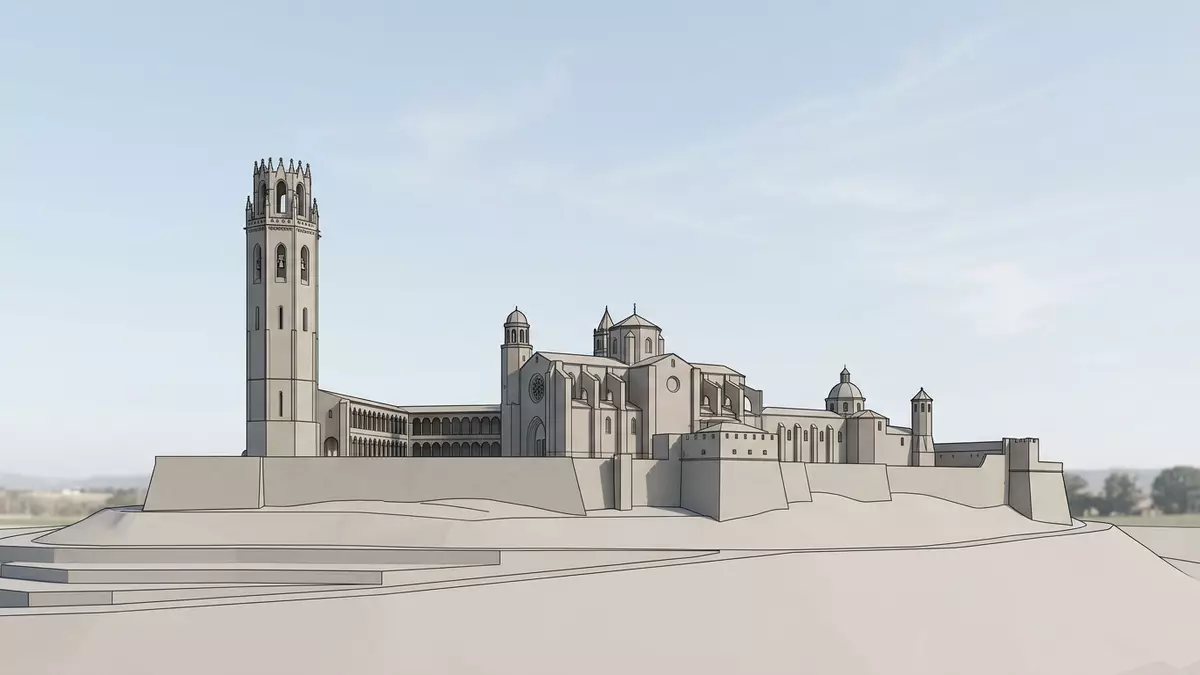
La Seu Vella, the Old Cathedral of Lleida in Spain, crowns a hill above the Segrià plain with a striking ensemble of church, cloister and tower dating from the thirteenth century.Old Cathedral of Lleida Built in a mix of Romanesque and Gothic forms and long used as the cathedral of the Diocese of Lleida, it turns the upper part of the city into a stone terrace open to sky and views.medieval architectural complexes in Catalonia
Hill, cathedral and cloister on the Turó de la Seu Vella
La Seu Vella stands on the Turó de la Seu Vella, the hill that forms the highest point of Lleida and separates the monument from the surrounding grid of streets.Turó de la Seu Vella The complex brings together a stone church, extensive cloister, bell tower and canonry buildings, all enclosed by fortifications that follow the outline of the hill.
The cathedral structure began to rise in 1203 on the site of the main mosque of the former Moorish city of Larida, under the direction of the master builder Pere de Coma.construction of the cathedral began in 1203 The building was consecrated in 1278, and the works continued into the fourteenth and fifteenth centuries as the cloister and the tower were completed.consecrated in 1278 For around five centuries La Seu Vella served as the cathedral of Lleida before liturgical functions shifted elsewhere in the early eighteenth century.catedral antiga de Lleida
Romanesque plan, Gothic vaults and a vast cloister
The church at La Seu Vella follows a Romanesque layout with three naves, a transept and a sanctuary with multiple apses, while its vaults adopt Gothic ribbed forms over the stone supports.Romanesque layout, ribbed vaults The interior carries sculpted capitals, portals and carved decoration that reflect the transition from late Romanesque to Gothic styles in Catalonia.
Beside the church stretches the cloister, an open quadrangle that ranks among the largest medieval cloisters in Europe and frames wide views over Lleida and the Segrià plain.largest and most spectacular cloister The bell tower rises above the ensemble as a vertical marker, while the canonry and ancillary spaces line the internal courts and passages, giving the hilltop the character of a self-contained stone precinct.
From religious seat to fortified site and restored monument
La Seu Vella’s position on the hill made it a strategic site, and in 1707, during the War of the Spanish Succession, the building ceased to function as a cathedral and was converted into military barracks.lost its religious function Fortifications were reinforced around the hill in the seventeenth and eighteenth centuries, and the interior of the cathedral suffered compartmentalisation and loss of liturgical fittings during its long military phase.converted into a headquarters
The monument was declared a historic monument in 1918, and restoration work began in the mid twentieth century as military use ended and the focus shifted to conservation and public access.named as historical monument The hill now combines the cathedral complex with the nearby Castell del Rei, or La Suda, a former fortress associated with the Crown of Aragon, creating a layered historical landscape above the modern city.Castell del Rei
Visiting La Seu Vella: what travellers from Western Europe should know
- La Seu Vella stands on the Turó de la Seu Vella above central Lleida, a short walk uphill from the lower streets and the more recent cathedral near the river.
- The monument occupies a hilltop plateau with open spaces, stone terraces and internal staircases, so visiting involves gradients on foot and sections of uneven stone paving.
- The hill of La Seu Vella rises over the Segrià plain, with views towards the surrounding countryside and across much of Lleida’s compact urban area.
- Lleida lies in Catalonia in north-eastern Spain; the official languages are Catalan and Spanish and the currency is the euro.
Searching for La Seu Vella on social platforms
These links open searches for La Seu Vella on each platform.
Frequently asked questions about La Seu Vella
Where is La Seu Vella located?
La Seu Vella stands on the Turó de la Seu Vella hill above the city of Lleida in Catalonia, north-eastern Spain, overlooking the Segrià plain.
What can visitors expect at La Seu Vella?
Visitors encounter a medieval cathedral complex with church, cloister, tower and fortifications arranged on a stone plateau, together with wide views over Lleida and its surroundings.
What makes La Seu Vella distinctive among Catalan monuments?
The combination of Romanesque and Gothic architecture, a vast cloister and the hilltop setting, plus its long military phase and later restoration, give La Seu Vella a particular character within Catalonia.


