
La Seu Vella above Lleida: stone, height and history
Published on 08/26/2026 at 22:29 | Editorial responsibility: Rafael Müller, Editor-in-Chief AD HOC NEWS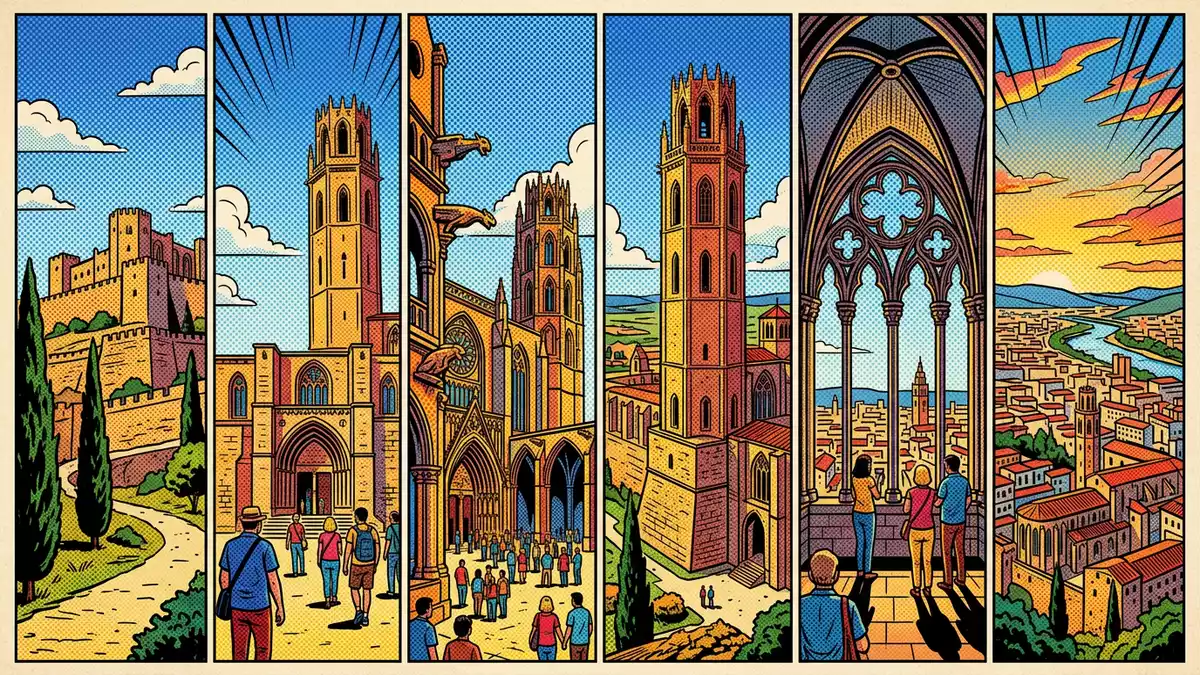
La Seu Vella rises above Lleida on the city hill, where Romanesque mass and Gothic detail meet in one stone complex. The former cathedral was begun in 1193 and remains the city’s clearest landmark on the skyline.
La Seu Vella’s Romanesque core and Gothic additions
The building is also known as the Old Cathedral of Lleida and was the cathedral church of the Diocese of Lleida between 1278 and 1707. Its linked phases are visible in the portals, chapels, cloister and bell tower, with work continuing into the fourteenth and fifteenth centuries.cathedral church
Pere de Coma is the named master associated with the first phase, and the site’s recorded status as a Cultural Asset of National Interest underlines its formal importance. The hilltop position also gives the complex a layered silhouette, with the church, cloister and fortress fabric read together rather than as separate monuments.Pere de Coma
The cloister and tower at the front of the church
One of the most striking parts of La Seu Vella is the cloister, placed in front of the main façade rather than beside it. Its open arcades, carved capitals and city views give the complex a strong outward-facing character.
The tower adds another clear marker. It is octagonal, reaches 60 m (197 ft) and contains 238 steps, details that give the building a measurable vertical presence beside the wider church body.60 m (197 ft)
From cathedral to fortress on Lleida hill
After 1707, the building changed function and became part of a military complex. The surviving fabric therefore carries both ecclesiastical architecture and later fortress use in the same hilltop setting.
The monumental group includes the Cathedral, La Suda castle and the surrounding fortifications. That combination makes La Seu Vella more than a single church: it is a layered hilltop ensemble with Romanesque, Gothic and military elements in one place.La Suda castle
Visiting La Seu Vella: what travellers from Western Europe should know
- La Seu Vella stands on Turó de la Seu Vella in Lleida, above the surrounding plain. The hilltop complex is reached through the city and then on foot through the monument area.
- The tower has 238 steps, and the cloister is set in front of the church façade. The site combines church architecture with fortress walls and the nearby Castle of La Suda.
- The official language is Catalan and the currency is the euro.
- Entry requirements depend on your nationality; UK travellers can check the FCDO travel advice at gov.uk/foreign-travel-advice, Irish travellers the Department of Foreign Affairs at ireland.ie.
Searching for La Seu Vella on social platforms
These links open searches for La Seu Vella on each platform.
Frequently asked questions about La Seu Vella
Where is La Seu Vella?
La Seu Vella stands on Turó de la Seu Vella in Lleida, Catalonia, Spain. The complex sits above the city on a hill that gives it a clear presence in the urban landscape.
What should be expected on a visit?
The place combines a cathedral shell, a cloister, a tower and fortress remains. The tower staircase, the hill setting and the broad stone structures define the visit.
What makes La Seu Vella distinctive?
The cloister stands in front of the church façade, and the tower rises from the same hilltop ensemble. Romanesque beginnings, Gothic additions and military conversion are all visible in the fabric.


