
L'Oceanografic and Valencia’s architecture of the sea
Published on 09/23/2026 at 22:13 | Editorial responsibility: Rafael Müller, Editor-in-Chief AD HOC NEWS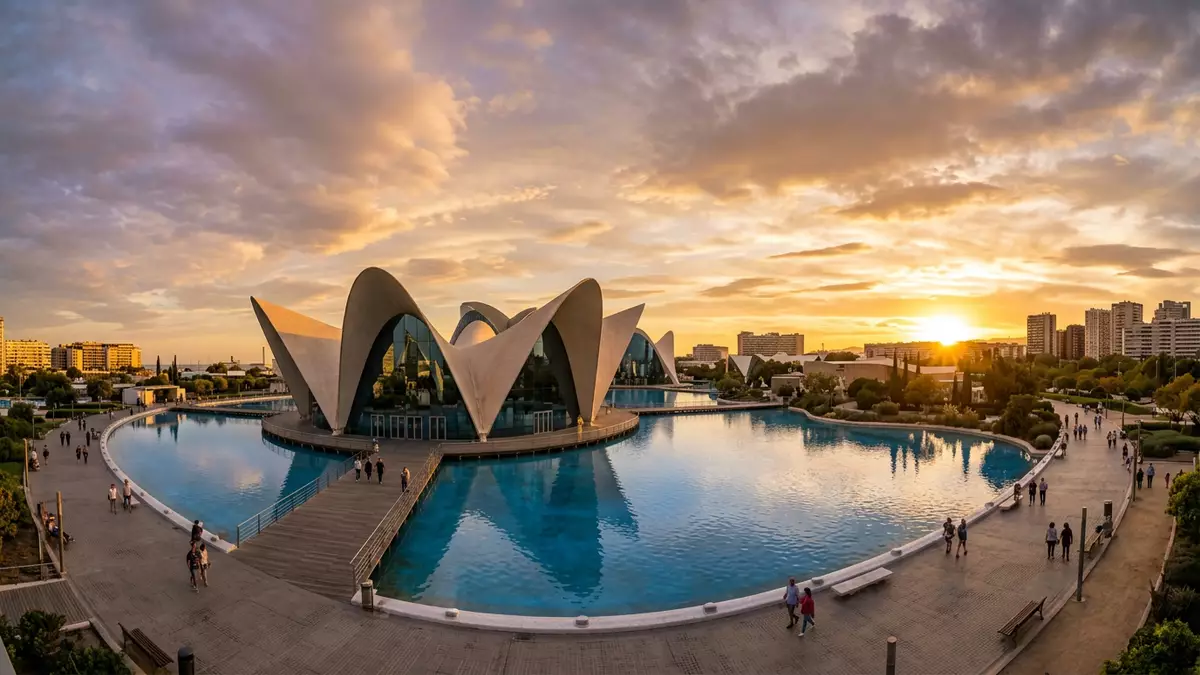
L'Oceanografic is an oceanarium in Valencia’s Garden of the Turia, formed by marine habitats, large aquariums, outdoor pools and expressive concrete shells. Opened on 14 February 2003, it combines the public display of ocean life with the architecture of Félix Candela, Alberto Domingo and Carlos Lázaro.
L'Oceanografic as a landscape of concrete and water
The complex belongs to Valencia’s City of Arts and Sciences, a cultural district built along the former Turia riverbed. Its buildings sit among pools, planted areas, bridges and broad pedestrian routes, creating an open-air setting rather than a single aquarium hall.
Félix Candela’s contribution is visible in the thin-shell concrete structures above the water. Their curved surfaces rise into pale, sweeping profiles, while glazed walls and lower buildings contain the exhibition spaces. The result is an oceanarium that can be read as architecture before the first aquarium appears.
The scale is substantial. L'Oceanografic occupies about 110,000 square metres and contains aquariums with a combined water volume of about 42 million litres. The largest tanks hold sharks, rays and other fish, while separate areas represent distinct marine environments.
From the Mediterranean to the Arctic
The displays bring together habitats associated with the Mediterranean, the Arctic Ocean, tropical seas, temperate waters and the Red Sea. Other areas represent mangroves, marshland and coastal environments, giving the complex a geographical range that extends far beyond Valencia.
Beluga whales, penguins, sea lions, dolphins, sharks, rays, reptiles, birds and invertebrates are among the animals represented. The variety is arranged through underwater galleries, large viewing windows, outdoor spaces and habitat-focused aquariums. marine ecosystems at L'Oceanografic form the central subject of the complex.
A long underwater tunnel passes beneath the water, with marine life visible above and around the walkway. The tunnel belongs to the architecture of viewing itself: visitors move through a constructed underwater environment while the surrounding animals remain in the water.
The dolphinarium occupies a separate part of the site, and a garden contains more than 80 plant species. Together, these areas place marine animals, coastal vegetation and concrete structures within one connected public landscape.
Félix Candela’s final architectural language
Candela was a Spanish-Mexican architect associated with thin-shell concrete construction. At L'Oceanografic, the structural language appears in roof forms that curve, fold and rise above the pools. Alberto Domingo and Carlos Lázaro worked as structural engineers on the project. the opening date and design team place the oceanarium within the architectural history of early twenty-first-century Valencia.
The complex was opened on 14 February 2003, within the broader development of the City of Arts and Sciences. Its identity is therefore both scientific and architectural. The aquariums contain living marine collections, while the surrounding forms give those collections a powerful civic setting.
Several parts of the site can be understood through their relationship with water. Reflecting pools surround the buildings, glass fronts face the aquatic displays, and concrete roofs rise like large shells above the lower volumes. The visible materials remain consistent with the subject: water, glass, concrete and planting occupy the same composition.
The oceanarium’s location in the Garden of the Turia adds another layer to the visit. The garden follows the broad course of Valencia’s former riverbed, and L'Oceanografic stands within the City of Arts and Sciences at its eastern end. the City of Arts and Sciences includes several buildings by Santiago Calatrava, while L'Oceanografic carries Candela’s distinct structural vocabulary.
The place is consequently read at two scales. Inside, the emphasis falls on habitats, species and underwater views. Outside, the emphasis shifts towards rooflines, pools and the contrast between transparent exhibition spaces and solid concrete shells.
Visiting L'Oceanografic: what travellers from Western Europe should know
- L'Oceanografic lies in the City of Arts and Sciences, in the Garden of the Turia southeast of Valencia’s historic centre. Metrovalencia Line 10 serves the Oceanogràfic stop, and city buses connect the complex with other parts of Valencia.
- The site is spread across pools, gardens, bridges and separate exhibition buildings. A visit involves walking between outdoor areas and entering large aquarium galleries.
- The complex includes underwater tunnels, outdoor animal habitats, a dolphinarium, mangrove displays and planted areas. The experience is divided between enclosed galleries and open-air spaces.
- Valencia is in Spain. The official language is Spanish and Valencian, and the currency is the euro.
Searching for L'Oceanografic on social platforms
These links open searches for L'Oceanografic on each platform.
Frequently asked questions about L'Oceanografic
Where is L'Oceanografic?
L'Oceanografic is in Valencia’s Garden of the Turia, within the City of Arts and Sciences in eastern Spain. Metrovalencia Line 10 serves the Oceanogràfic stop.
What can visitors expect inside?
The complex contains habitat-based aquariums, underwater tunnels, outdoor pools, a dolphinarium, mangrove displays and planted areas. Marine life includes sharks, penguins, dolphins, sea lions, beluga whales, reptiles, birds and invertebrates.
What makes L'Oceanografic distinctive?
Its marine collections share the site with Félix Candela’s thin-shell concrete architecture. Pools, glass galleries and sweeping roofs form one large oceanographic landscape.


