
Kumamoto-jo: stone walls and samurai history in Kumamoto
Published on 09/18/2026 at 21:42 | Editorial responsibility: Rafael Müller, Editor-in-Chief AD HOC NEWS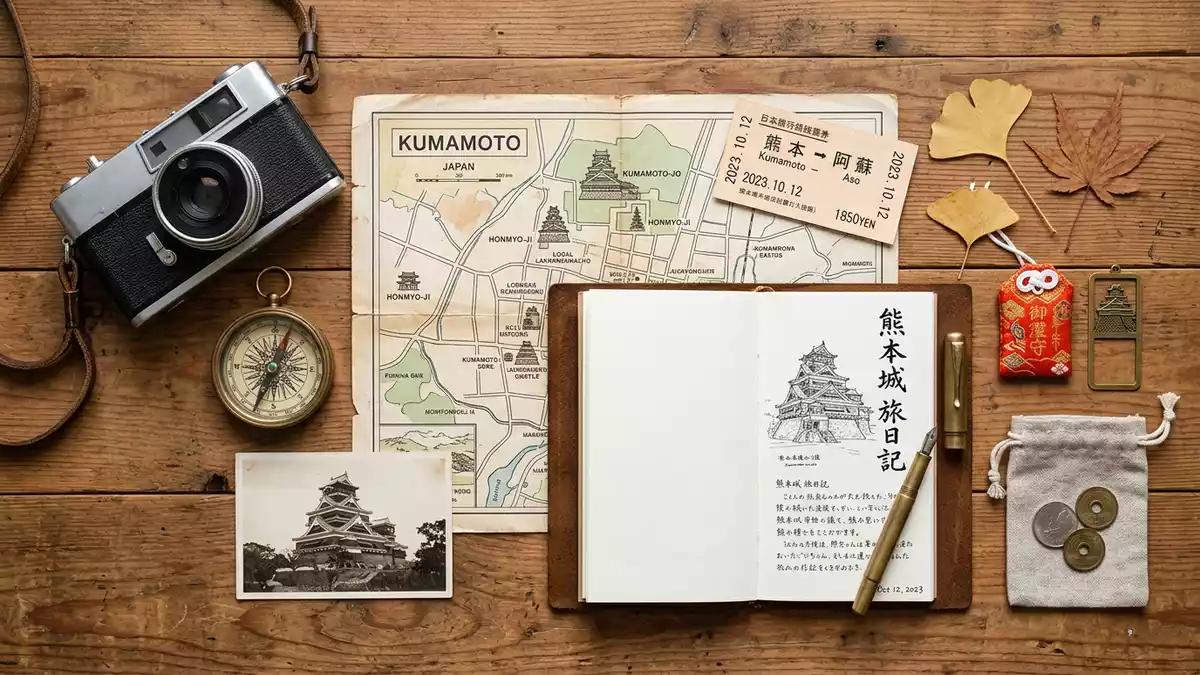
Kumamoto-jo, known in English as Kumamoto Castle, rises above Kumamoto in south-western Japan as a sprawling hilltop fortress whose steep stone walls and tiered keeps define the city’s skyline. Built in the early seventeenth century for the daimyo Kato Kiyomasa, it remains one of the country’s best-known survivors of Japan’s age of samurai rule.
From Kato Kiyomasa’s stronghold to modern symbol
The core form of Kumamoto-jo dates to the early Edo period, when Kato Kiyomasa, a powerful feudal lord on Kyushu, reshaped earlier fortifications on the Chausuyama plateau into a major castle complex completed in 1607.completed in 1607 Kato had been appointed lord of Higo Province in 1588 and used his experience as a castle builder to create a highly defensive stronghold with extensive stone ramparts, moats and multiple keeps.appointed lord of Higo Province in 1588
Less than three decades after the main castle buildings were finished, Kumamoto-jo passed to the Hosokawa clan in 1632, who ruled the surrounding domain from the fortress for more than two centuries.passed to the Hosokawa clan in 1632 During this long period it functioned as the political and military centre of Kumamoto, anchoring a castle town that grew around its base and tying the region closely into the wider Tokugawa shogunate.
Architecture on the Chausuyama plateau
Kumamoto-jo occupies the Chausuyama plateau in central Kumamoto, its main keep and secondary towers standing above a network of stone walls and baileys.Chausuyama Plateau The castle is laid out as a multi-layered fortress, with moats, gates and turrets arranged to make direct approaches difficult; historical descriptions record that the complex once included dozens of towers and gates protecting the inner compounds.dozens of towers and gates
One of the most striking features of Kumamoto-jo is its curved stone walls, known as “musha-gaeshi”, which rise gently from the base and become sharply steeper towards the top.curved stone walls These ramparts are built from fitted stones without visible mortar, forming high embankments that support the timber-framed buildings above and demonstrate the advanced defensive design associated with Kato Kiyomasa’s castles.defensive design associated with Kato Kiyomasa
War, fire and reconstruction
The castle’s strategic position meant it became a focal point in major conflicts. In 1877 Kumamoto-jo served as the main government garrison in Kyushu during the Satsuma Rebellion, when forces led by Saigo Takamori attacked the stronghold in one of the defining battles of Japan’s early Meiji period.Satsuma Rebellion in 1877 During that year the castle’s towers and the Honmaru Goten palace were destroyed by fire, leaving much of the inner compound in ruins.towers and Honmaru-Goten palace burned
In the twentieth century Kumamoto-jo underwent extensive reconstruction, reflecting local efforts to restore a symbol of the city’s heritage. After the Second World War momentum grew among residents to rebuild the castle towers, and in 1960 the exteriors of the large and small keeps were reconstructed in steel-reinforced concrete, recreating their traditional multi-tiered profiles on the original stone bases.reconstructed in steel-reinforced concrete in 1960 Subsequent projects have continued to repair and restore sections of the walls and other structures, integrating modern materials while maintaining the castle’s historic appearance.
Visiting Kumamoto-jo: what travellers from Western Europe should know
- Kumamoto-jo stands in central Kumamoto on the island of Kyushu in south-western Japan, set on the Chausuyama plateau above streets laid out as a traditional castle town.
- The castle grounds rise over stone embankments and terraces, and approaches within the complex involve gradients, steps and passages between high defensive walls.
- Kumamoto-jo lies north-east of JR Kumamoto Station, with city streets and tram routes connecting the station area to the districts around the castle grounds.
- The official language is Japanese and the currency is the yen.
- Entry requirements depend on your nationality; UK travellers can check the FCDO travel advice at gov.uk/foreign-travel-advice, Irish travellers the Department of Foreign Affairs at ireland.ie.
Searching for Kumamoto-jo on social platforms
These links open searches for Kumamoto-jo on each platform.
Frequently asked questions about Kumamoto-jo
Where is Kumamoto-jo located?
Kumamoto-jo stands in Kumamoto City on Kyushu, Japan’s south-western main island, occupying the Chausuyama plateau near the centre of the urban area.
What should visitors expect at Kumamoto-jo?
Visitors encounter high stone walls, timber castle buildings including reconstructed keeps, and extensive grounds laid out as a historic fortress with terraces, gates and inner compounds.
What makes Kumamoto-jo distinctive among Japanese castles?
Kumamoto-jo is notable for its musha-gaeshi curved stone walls, its large hilltop layout from the early Edo period and its strong associations with figures such as Kato Kiyomasa and Saigo Takamori.


