

Kumamoto-jo and the power of stone in Kumamoto
Published on 08/21/2026 at 11:55 | Editorial responsibility: Rafael Müller, Editor-in-Chief AD HOC NEWS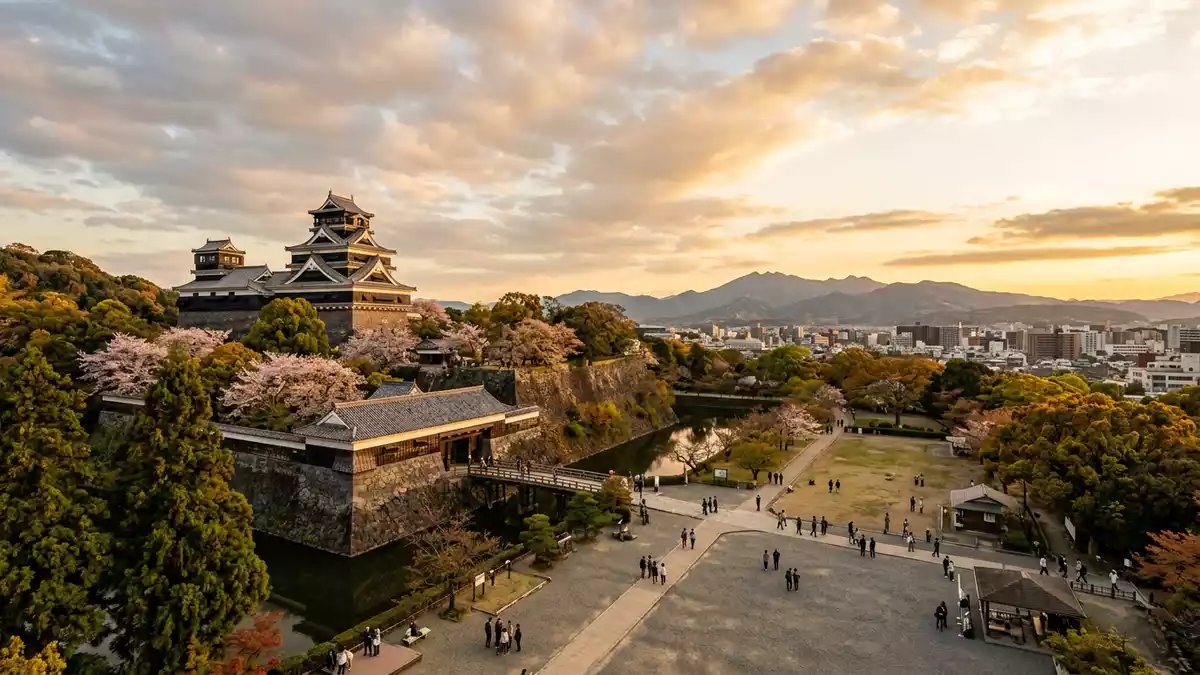
Kumamoto-jo, better known in English as Kumamoto Castle, is a vast hilltop fortress that dominates the centre of Kumamoto in Japan. Its layered stone walls, dark timber keeps and sweeping grounds date back to the early seventeenth century, when the castle complex was completed under the feudal lord Kat? Kiyomasa, and they have anchored the city’s skyline ever since.
Stone walls and a hilltop plan
Kumamoto-jo stands on the Chausuyama hills in what is now Ch?? Ward, using the natural rise to form a broad, elevated platform for the castle compound.Kumamoto Castle is located at the centre of Kumamoto City The core of the site is laid out around a main bailey, with keeps, turrets and gates arranged across terraces that step up from the surrounding streets. The castle grounds extend across a wide area, and the fortifications work as a continuous envelope of stone and earth around the inner precincts.
The identity of Kumamoto-jo is inseparable from its tiered stone defences. The original early Edo-period complex combined high walls with moats and a network of passageways, producing a fortification that was widely regarded as hard to assault.Initial construction was finished in 1607 with kilometres of surrounding walls and dozens of turrets and gates Distinctive curved profiles known as musha-gaeshi rise from broad bases and straighten near the top, giving the stonework a striking profile and complicating any attempt to climb. From outside the perimeter the castle appears as stacked bands of masonry and vegetation, with timber structures lifting above them.
From Ideta fortifications to Kat? Kiyomasa’s fortress
The roots of fortification on this site reach back to the fifteenth century, when Ideta Hidenobu established defences that predated the present castle.Foundations laid by the Ideta clan in 1467 mark the earliest recorded fortifications at Kumamoto Kumamoto-jo as visitors recognise it today took shape between 1601 and 1607, when Kat? Kiyomasa began building a major new stronghold after becoming lord of Higo Province in 1588.The iconic Kumamoto Castle was completed in 1607 by Kat? Kiyomasa Construction over those years produced a main keep, a secondary keep and a dense ring of defensive buildings that formalised the hilltop into a castle town centre.
Beyond the keeps, the completed early seventeenth-century castle included numerous turrets and gates, forming successive lines of defence around the inner compounds.When initial construction was finished in 1607 Kumamoto Castle had one keep, many turrets and turret gates, and several castle gates along extensive walls Within a few decades of its completion, Kumamoto-jo passed from the Kat? clan to the Hosokawa clan, who governed from the castle for over two centuries under the Tokugawa shogunate.The Hosokawa clan took over Kumamoto Castle in the early Edo period and ruled from there for around two centuries The long Hosokawa tenure embedded the fortress deeply into the political and military history of Kyushu and helped to preserve its Edo-period character across generations of change.
Destruction, reconstruction and protected status
Kumamoto-jo has endured fire, war and earthquakes, and its present form reflects both survival and reconstruction. During the Seinan Civil War of 1877, better known as the Satsuma Rebellion, fighting around the castle led to heavy damage, and later bombing in the Second World War destroyed the original main keep.The main keep was lost to fire in the nineteenth century and further damage occurred in the twentieth century In the twentieth century Kumamoto-jo was recognised for its historical importance, with parts of the complex designated as Important Cultural Properties of Japan and the wider grounds receiving Special Historic Site status.Kumamoto Castle includes multiple structures designated as Important Cultural Properties and the site was given Special Historic Site status
The main keep that visitors see is a reconstruction dating from the 1960s, when a concrete structure was built to restore the castle silhouette and house exhibitions.The castle keep was reconstructed in 1960 Around it, surviving wooden gates and towers, stone walls and baileys retain clear traces of the original seventeenth-century design. The combination of rebuilt keeps with historic masonry and timber gives Kumamoto-jo a layered character: part living museum of castle architecture, part active reconstruction project, and part enduring symbol of Kumamoto’s samurai past.
Visiting Kumamoto-jo: what travellers from Western Europe should know
- Kumamoto-jo stands at 1-1 Honmaru in Ch??-ku, Kumamoto City, and is reached from the surrounding streets by approaches that rise towards the hilltop castle precincts.
- The grounds include slopes, stairways and elevated terraces, and moving between different levels of the castle involves climbing steps and walking on stone surfaces.
- Kumamoto-jo lies in Japan, where the official language is Japanese and the currency is the yen.
- Entry requirements depend on your nationality; UK travellers can check the FCDO travel advice at gov.uk/foreign-travel-advice, Irish travellers the Department of Foreign Affairs at ireland.ie.
Searching for Kumamoto-jo on social platforms
These links open searches for Kumamoto-jo on each platform.
Frequently asked questions about Kumamoto-jo
Where is Kumamoto-jo located?
Kumamoto-jo stands on the Chausuyama hills in Ch?? Ward, at the centre of Kumamoto City in south-western Japan.
What should visitors expect at Kumamoto-jo?
Visitors encounter extensive castle grounds with stone walls, gates, turrets and reconstructed keeps, arranged across terraces linked by stairways and sloping paths.
What makes Kumamoto-jo distinctive among Japanese castles?
Kumamoto-jo is distinguished by its musha-gaeshi stone walls, its large early Edo-period compound completed in 1607 and its mix of historic structures with reconstructed main keeps.


