
Kopalnia Soli Wieliczka: an underground world of salt and sculpture
Published on 08/16/2026 at 14:13 | Editorial responsibility: Rafael Müller, Editor-in-Chief AD HOC NEWS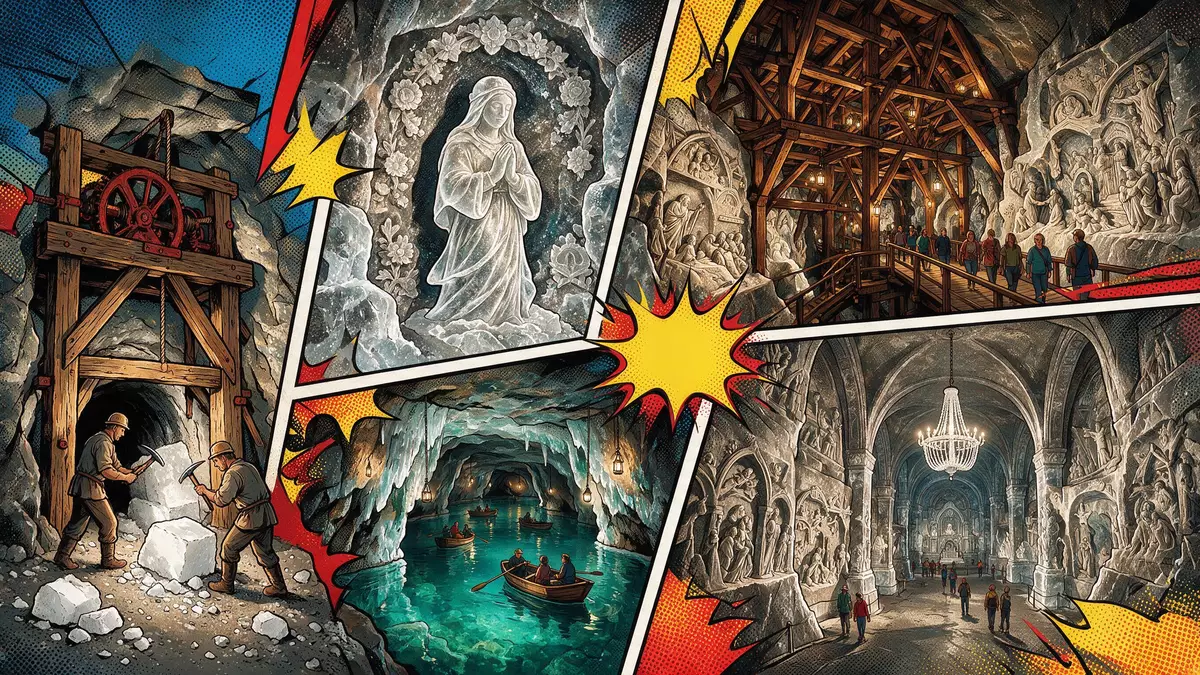
Kopalnia Soli Wieliczka, known in English as the Wieliczka Salt Mine, extends beneath the town of Wieliczka near Kraków in southern Poland, turning centuries of salt extraction into an elaborate underground world of chambers, chapels and passages.Wieliczka Salt Mine The mine’s origins lie in medieval rock salt exploitation that developed from the thirteenth century, and its workings eventually spread down through nine levels to around 327 m (1,073 ft) below the surface.ancient salt mine
Salt mining turned subterranean landscape
The story of Kopalnia Soli Wieliczka begins with the discovery of rock salt in the Middle Ages, when shafts were dug into deposits that had been providing brine for salt production since much earlier times.salt mine history From the thirteenth century onward, systematic mining created a dense network of tunnels and chambers, with work progressing from the upper levels around 57 m below ground to the deepest level IX, more than 300 m down.levels I to IX Over seven centuries, miners drove thousands of chambers and many kilometres of drifts, leaving a voided volume measured in millions of cubic metres under the town.extent of workings
Commercial extraction of rock salt stopped in the late twentieth century, but the mine itself did not fall silent.end of mining Its underground spaces are now used for tourism, museum displays and health treatments, while installations at depth still deal with brine waters that seep into the workings.touristic and medicinal uses This transition from industrial workplace to heritage site means visitors walk through areas that carry visible traces of mining, from timber supports and rails to tool marks left on the salt.
Chapels, carvings and underground architecture
One of the most striking aspects of Kopalnia Soli Wieliczka is the way miners and later sculptors carved the salt itself into architectural and decorative forms, particularly in chapels created underground.subterranean chapels Among these, the Chapel of St Kinga stands out for its scale, with walls, altarpieces and chandeliers fashioned from salt, giving the space a distinct texture and muted sheen under artificial light.Chapel of St Kinga Reliefs depict religious scenes carved in low depth into the rock, while floors show the layered structure of the deposit, reminding visitors that even the most ornate hall belongs to a working mine.
Beyond the chapels, passages open into chambers where salt blocks are stacked, sculptures of historical figures emerge from the walls and pools of saline water reflect surrounding rock faces. Timber frameworks support some ceilings, while elsewhere the exposed salt forms its own massive vaults, giving each chamber a distinct character shaped by geology and mining method. Modern lighting emphasises different colours in the salt, from greyish surfaces to translucent blocks, and reveals details that might otherwise blend into the darkness of a deep-level environment.
Heritage status and routes through the mine
Kopalnia Soli Wieliczka holds a prominent place in Poland’s industrial heritage, recognised formally as a national monument and as part of the Wieliczka and Bochnia Royal Salt Mines UNESCO World Heritage property.Royal Salt Mines inscription The UNESCO listing, made in 1978, placed the mine among the first group of sites acknowledged for outstanding cultural value, highlighting both its mining technology and the artistic work undertaken underground.original UNESCO list This status underlines the combination of geological resource, human labour and creative expression that defines the site.
Visitors experience this heritage through marked routes that weave among chambers on several levels. The standard tourist route descends by staircase to reach areas between roughly 64 m and 135 m below the surface, crossing halls, chapels and former working zones laid out for interpretation.depths of tourist section A separate museum route presents mining equipment, archival material and geological context in chambers adapted for display, while other parts of the mine are reserved for health resort facilities and specialist visits.museum and routes
Visiting Kopalnia Soli Wieliczka: what travellers from Western Europe should know
- Kopalnia Soli Wieliczka lies beneath the town of Wieliczka in Lesser Poland, south-east of Kraków, and is reached overland from the regional capital’s transport hubs.
- The tourist routes involve walking through underground chambers on stepped paths and staircases, including a long initial descent by stairs before reaching the main level.
- The mine is in Poland, where the official language is Polish and the currency is the z?oty.
- Entry requirements depend on your nationality; UK travellers can check the FCDO travel advice at gov.uk/foreign-travel-advice, Irish travellers the Department of Foreign Affairs at ireland.ie.
Searching for Kopalnia Soli Wieliczka on social platforms
These links open searches for Kopalnia Soli Wieliczka on each platform.
Frequently asked questions about Kopalnia Soli Wieliczka
Where is Kopalnia Soli Wieliczka located?
Kopalnia Soli Wieliczka lies beneath the town of Wieliczka in Lesser Poland, close to Kraków in southern Poland, with its workings spreading under the urban area.
What can visitors expect on a visit underground?
Visitors follow marked routes through salt chambers and chapels, descending by stairs to levels more than 60 m below ground and passing mining remnants, carvings and saline pools.
What makes Kopalnia Soli Wieliczka distinctive among historic mines?
The mine combines deep multi-level workings dating back to the thirteenth century with elaborate underground chapels and salt sculptures, and carries UNESCO World Heritage recognition for this blend.


