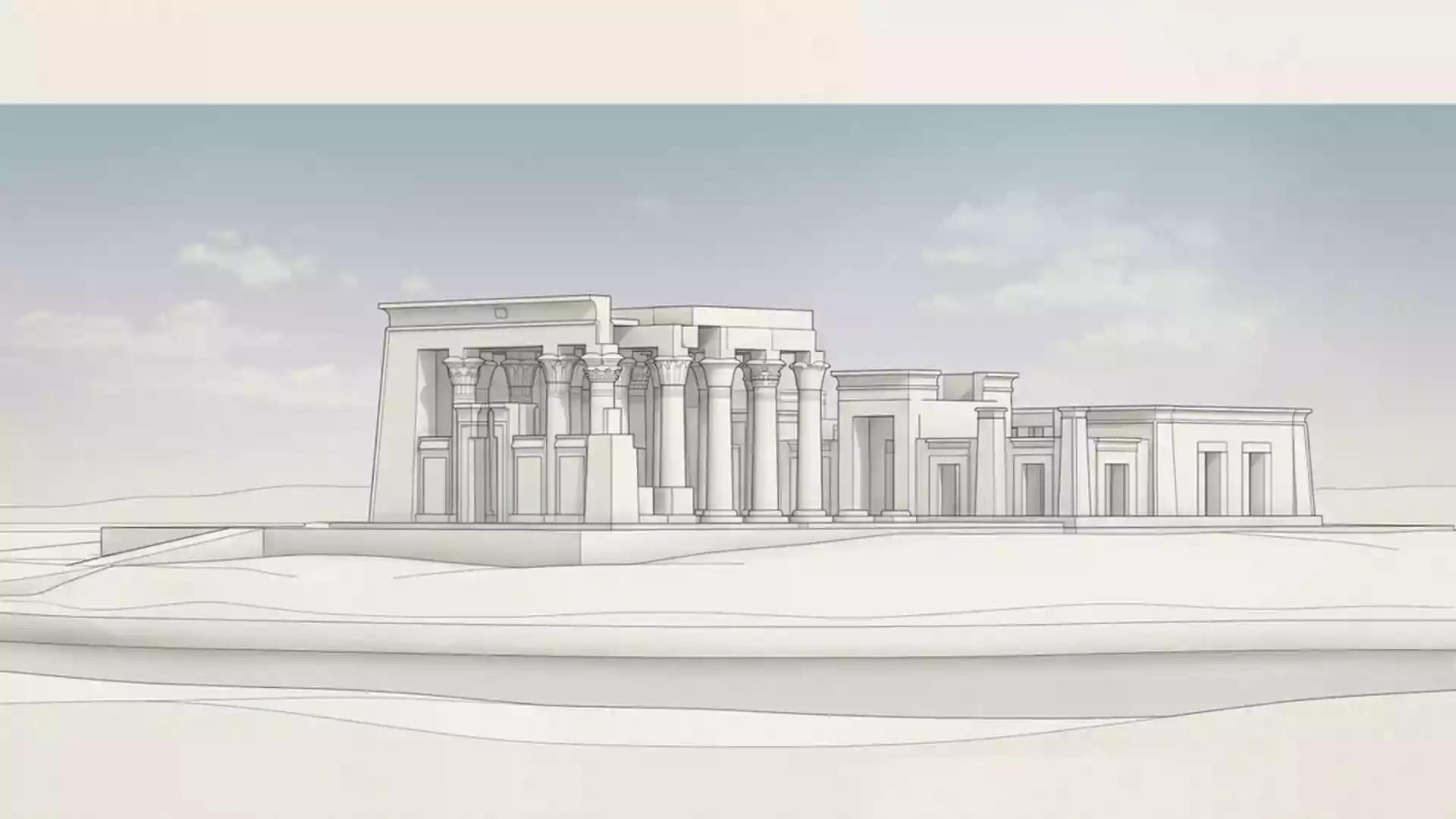
Kom Ombo Temple and its mirrored gods on the Nile
Published on 09/03/2026 at 23:00 | Editorial responsibility: Rafael Müller, Editor-in-Chief AD HOC NEWS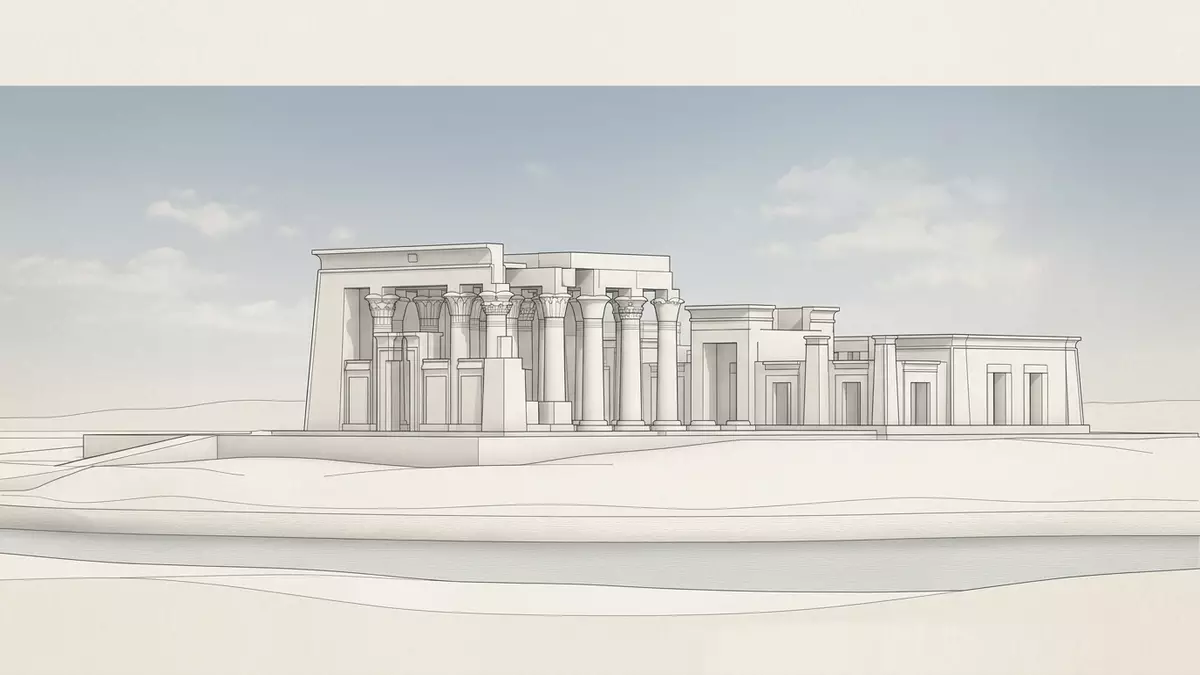
Kom Ombo Temple on the Nile at Kom Ombo in Upper Egypt is a rare double temple, laid out symmetrically for two sets of gods within a single sandstone complex. Built mainly in the Ptolemaic period, beginning in the second century BC under Ptolemy VI Philometor, it brings the crocodile god Sobek and the falcon god Haroeris into one shared plan along parallel axes.
The double temple above the river
Kom Ombo Temple stands on the east bank of the Nile in the town of Kom Ombo, north of Aswan, occupying a low rise that looks over a bend in the river where sacred crocodiles basked in pharaonic times.stands on a promontory The town itself gained prominence with the erection of the temple in the second century BC, when the Ptolemaic rulers of Egypt reshaped the river landscape with new cult centres.rise to prominence
The surviving sandstone temple complex belongs mainly to the Graeco-Roman period between 332 BC and 395 AD, with the earliest royal names carved on its walls belonging to Ptolemy VI Philometor and later rulers such as Ptolemy XII Neos Dionysos.Graeco-Roman Period Archaeological traces show that the site was already sacred in the New Kingdom, but the visible structure visitors walk through dates to the Ptolemaic and Roman eras, when the temple’s grand colonnades and gateways were raised above the river bank.
Sobek and Haroeris sharing one plan
The defining feature of Kom Ombo Temple is its twin dedication: the southern half of the complex is consecrated to Sobek, the crocodile god associated with the Nile, while the northern half honours Haroeris, a form of Horus the Elder linked with healing and kingship.dedicated to two deities The plan mirrors this division, with twin entrances, paired hypostyle halls and two sanctuaries set side by side along a central longitudinal axis.double temple layout
As visitors move inward from the outer court, they pass through colonnaded halls where reliefs of Sobek and Haroeris appear on opposite sides, echoing the temple’s structural symmetry in its decoration. The twin sanctuaries lie close together at the core of the complex, each aligned with its own axis, an arrangement that sets Kom Ombo apart from the single-focus layout of most other temples on the Nile. Inscriptions carved in the Ptolemaic and Roman periods tie the building to several rulers, including Ptolemy VI and Ptolemy XII, whose cartouches punctuate the stone surfaces.
Reliefs, medical carvings and crocodile remains
Kom Ombo Temple preserves a dense programme of reliefs carved on its walls, doorways and column drums, ranging from ceremonial scenes to finely incised hieroglyphic texts. Among the most notable are a series of carvings showing surgical instruments and medical items, which have drawn attention for their detailed depiction of blades, containers and other equipment aligned in orderly rows.temple layout and reliefs These panels, linked with Haroeris, underscore the association of the northern half of the temple with healing.
Adjacent to the main temple stands a Crocodile Museum, where mummified crocodiles discovered in the region are displayed alongside votive objects connected with Sobek’s cult.Temple of Kom Ombo Together, the museum and the temple illuminate the dual religious life of Kom Ombo, linking the crocodile god’s riverine presence with the falcon god’s protective role inside the halls.
Visiting Kom Ombo Temple: what travellers from Western Europe should know
- Kom Ombo Temple lies in the town of Kom Ombo on the east bank of the Nile in Upper Egypt, between Aswan and Edfu, and is reached overland or by Nile cruise vessels that dock below the temple terrace.
- The approach from the river involves an uphill walk from the mooring area to the temple platform, followed by movement over uneven stone paving and through roofed halls supported by sandstone columns.
- The official language is Arabic and the currency is the Egyptian pound.
- Entry requirements depend on your nationality; UK travellers can check the FCDO travel advice at gov.uk/foreign-travel-advice, Irish travellers the Department of Foreign Affairs at ireland.ie.
Searching for Kom Ombo Temple on social platforms
These links open searches for Kom Ombo Temple on each platform.Frequently asked questions about Kom Ombo Temple
Where is Kom Ombo Temple located?
Kom Ombo Temple is in Upper Egypt on the east bank of the Nile, in the town of Kom Ombo north of Aswan.
What can visitors expect inside Kom Ombo Temple?
Visitors walk through a sequence of courtyards and hypostyle halls into two sanctuaries, seeing reliefs of Sobek and Haroeris and finely carved Ptolemaic inscriptions.
What makes Kom Ombo Temple distinctive among Nile temples?
Kom Ombo Temple is distinctive for its double plan, with twin entrances, halls and sanctuaries aligned symmetrically for Sobek and Haroeris within one sandstone complex.