
Kom Ombo Temple and its mirrored gods on the Nile
Published on 08/26/2026 at 23:02 | Editorial responsibility: Rafael Müller, Editor-in-Chief AD HOC NEWS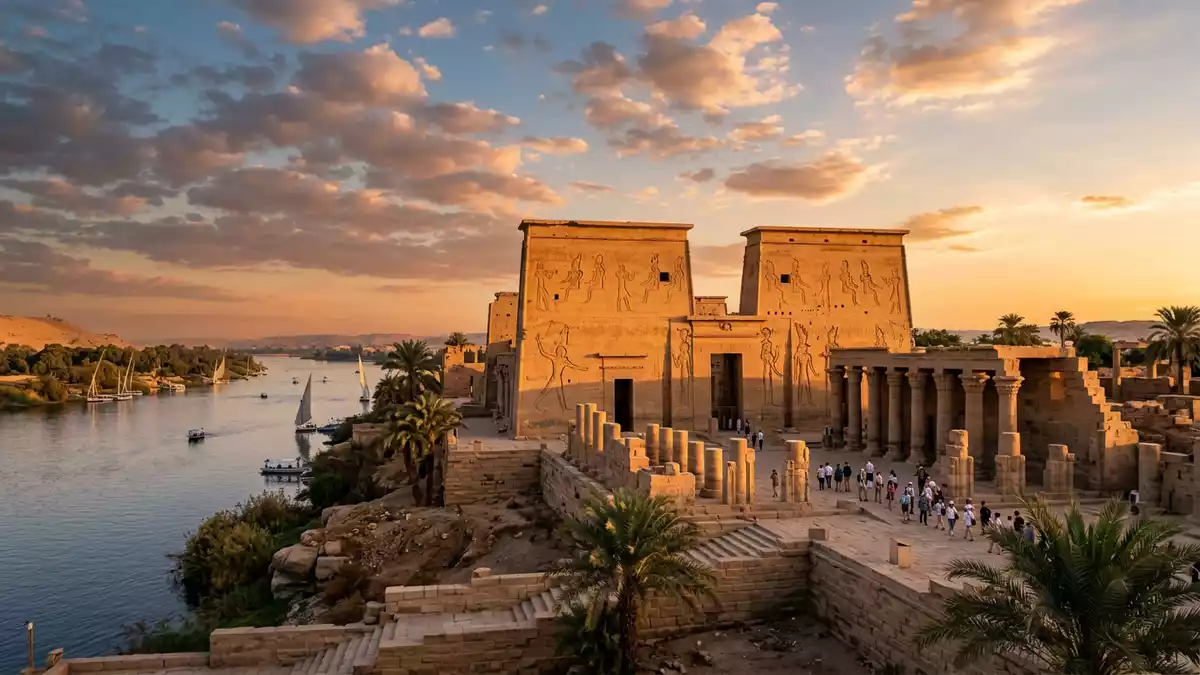
Kom Ombo Temple in Upper Egypt is a rare example of an ancient sanctuary divided into two mirrored halves, dedicated equally to Sobek and Horus along a single axis. Standing on the east bank of the Nile near the town of Kom Ombo, the Ptolemaic?period complex brings together twin gateways, halls and sanctuaries in one riverside setting.
A double temple for Sobek and Horus
Kom Ombo Temple is laid out as an unusual double temple, with every major element replicated for two deities sharing the same platform. The complex honours the crocodile god Sobek and Horus the Elder, a falcon god, in parallel cults housed within one structure.dedicated to two deities Each side has its own entrance, forecourt, hypostyle halls and inner sanctuary, arranged so that the plan appears symmetrical when seen along the central axis of the temple.two entrances, courts and halls
The division runs through the heart of the complex, separating the Sobek side from the Horus side while maintaining an overall architectural unity. Reliefs in the colonnaded halls depict both gods, and the twin sanctuaries stand side by side towards the rear of the main building. The temple’s overall form reflects the coexistence of these two cults in a single, carefully ordered arrangement from the Ptolemaic and later Roman periods.built during the Graeco-Roman period
Ptolemaic foundations on a Nile promontory
The standing Kom Ombo Temple belongs largely to the Ptolemaic dynasty that ruled Egypt in the second and first centuries BC. The earliest royal name inscribed in the present structure is that of Ptolemy VI Philometor, whose reign began in 180 BC, and much of the decoration was completed under Ptolemy XII Neos Dionysos in the first century BC.built during the Graeco-Roman Period The temple therefore belongs to the later phases of ancient Egyptian temple building, when Greek?speaking rulers commissioned monuments in pharaonic forms.
The complex stands on a slight rise on the east bank of the Nile between Aswan and Luxor, facing the river along a prominent bend. Kom Ombo itself is an agricultural town north of Aswan in the Aswan Governorate, and its position on the river helped connect trading routes along the valley.Kom Ombo is an agricultural town in Egypt Stone terraces and platforms lead from the riverside towards the main pylon, giving the temple a strong relationship with the watercourse that passes below.
Layout, reliefs and the crocodile connection
The plan of Kom Ombo Temple repeats key elements along two parallel lines, making it a clear example of a deliberately mirrored sacred complex. Behind the twinned entrances lie matching courts with surrounding colonnades, followed by hypostyle halls whose roof is carried on densely spaced stone columns. Each hall leads towards its respective sanctuary, one for Sobek and one for Horus, with side chapels and subsidiary rooms branching off the main axis.the temple has two entrances, courts and sanctuaries
Reliefs carved into the sandstone walls show offerings to Sobek and Horus, scenes of royal rituals and detailed registers of medical and astronomical information. The association with Sobek links the temple to the crocodiles that once basked on nearby riverbanks, and excavated crocodile remains from the area are displayed in a dedicated museum close to the main complex.a double temple dedicated to Sobek and Horus From the higher parts of the site, stonework opens towards views of the Nile and the cultivated land beyond, placing the colonnades and courts within a broader riverine landscape.
Visiting Kom Ombo Temple: what travellers from Western Europe should know
- Kom Ombo Temple stands on the east bank of the Nile in Kom Ombo, north of Aswan in southern Egypt, and is reached by road or river vessels that stop near the town.
- The approach from the river involves a short walk up from the docks to the temple platform, with stone steps and sloping paths leading through the entrance towards the inner courts.
- The temple lies within the Aswan Governorate in Egypt, where the official language is Arabic and the currency is the Egyptian pound.
- Entry requirements depend on your nationality; UK travellers can check the FCDO travel advice at gov.uk/foreign-travel-advice, Irish travellers the Department of Foreign Affairs at ireland.ie.
Searching for Kom Ombo Temple on social platforms
These links open searches for Kom Ombo Temple on each platform.
Frequently asked questions about Kom Ombo Temple
Where is Kom Ombo Temple located?
Kom Ombo Temple stands on the east bank of the Nile in the town of Kom Ombo in the Aswan Governorate of southern Egypt, north of Aswan.
What should visitors expect during a visit?
Visitors encounter a sandstone complex with twin entrances, colonnaded courts, hypostyle halls and side chapels, all arranged around a central axis that leads to paired sanctuaries.
What makes Kom Ombo Temple distinctive among Egyptian temples?
Kom Ombo Temple is distinctive because it is a double temple, with mirrored layouts dedicated to Sobek and Horus the Elder, reflecting two parallel cults within a single riverside monument.


