
Kom Ombo Temple and its mirror-like double sanctuary on the Nile
Published on 08/27/2026 at 12:31 | Editorial responsibility: Rafael Müller, Editor-in-Chief AD HOC NEWS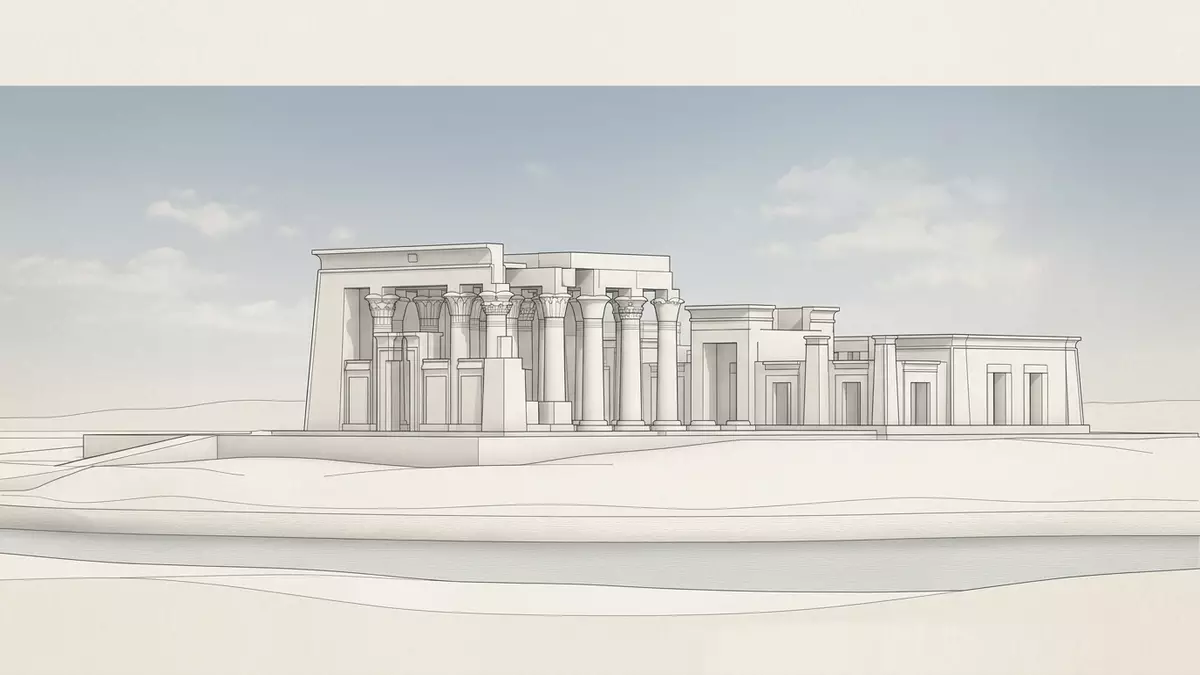
Kom Ombo Temple stands above a bend of the Nile at Kom Ombo in Upper Egypt, a Ptolemaic and Roman-period sanctuary laid out as a rare double temple. Its plan mirrors two parallel shrines, one for the crocodile god Sobek and one for Horus the Elder, set within a single riverside complex.
A double temple for Sobek and Horus
Kom Ombo Temple belongs to the Ptolemaic dynasty and later Roman period, with major construction beginning in the second century BC under Ptolemy VI Philometor and continuing under subsequent rulers. The visible remains date broadly from about 180 BC into the first centuries AD, when Roman emperors such as Tiberius added architectural elements and reliefs.Major construction in the second century BC The temple stands on the east bank of the Nile in the town of Kom Ombo, between Aswan and Edfu in Upper Egypt.Its position on the east bank between Edfu and Aswan
From the entrance onward, Kom Ombo Temple is organised along a central axis that divides it into two near-identical halves. One half is dedicated to Sobek, represented as a crocodile-headed deity, and the other to Horus the Elder, a falcon god linked to royal power.The division between Sobek and Horus Courts, columned halls and sanctuaries line up in pairs on either side of this axis, creating a plan that repeats doorways, reliefs and chambers for each god.
Walking through a mirrored ground plan
Arriving from the Nile side, visitors cross an open forecourt framed by columns before stepping into the more enclosed hypostyle halls. These halls carry rows of thick stone columns carved with hieroglyphic texts and scenes that honour both Sobek and Horus, with duplicated processions and offering scenes on each side of the central line.A rare double temple with mirrored halls The twin sanctuaries lie deeper inside the complex, set back one behind the other, each reached through its own sequence of rooms.
Along various walls, carved reliefs preserve details of Ptolemaic ritual and royal display. Among them are representations of Ptolemaic rulers making offerings to the gods, inscriptions that record the dedications of different parts of the temple, and reliefs that depict tools and instruments, including a sequence often associated with medical or surgical items.Reliefs with ritual and practical imagery The sandstone blocks show traces of painted decoration in places, reminders that the ensemble once carried strong colours against the pale desert light.
Crocodile mummies and the Nile-side setting
Kom Ombo’s association with Sobek is underlined by a dedicated Crocodile Museum incorporated into the archaeological complex. Inside this modern display space, rows of mummified crocodiles, crocodile eggs and related votive objects recovered from nearby burial deposits are presented as part of the temple’s ancient cult of Sobek.The Crocodile Museum with mummified crocodiles The museum environment protects these fragile remains while allowing close viewing of the linen wrappings and the shapes of the preserved animals.
The wider setting is defined by the Nile and the low desert landscape of Upper Egypt. The temple stands close to the riverbank, raised on a slight height above the water, with views along the broad curve of the Nile and across to the opposite bank.Its position near a bend in the Nile Stone embankments, scattered blocks and subsidiary ruins around the main enclosure show how the sacred precinct once extended towards the river, linking temple rituals with the riverine landscape.
Visiting Kom Ombo Temple: what travellers from Western Europe should know
- Kom Ombo Temple stands in the town of Kom Ombo on the east bank of the Nile in Upper Egypt, between Aswan and Edfu, and is reached by road or Nile cruise vessels.
- The archaeological site consists of stone paving, uneven ground and worn steps between the forecourt, hypostyle halls and rear chambers, so moving through the complex involves repeated short climbs and descents.
- The temple stands in a desert climate beside the Nile, with little natural shade away from the columned halls, and visits involve spending extended time outdoors on exposed stone surfaces.
- The official language is Arabic and the currency is the Egyptian pound.
- Entry requirements depend on your nationality; UK travellers can check the FCDO travel advice at gov.uk/foreign-travel-advice, Irish travellers the Department of Foreign Affairs at ireland.ie.
Searching for Kom Ombo Temple on social platforms
These links open searches for Kom Ombo Temple on each platform.
Frequently asked questions about Kom Ombo Temple
Where is Kom Ombo Temple located?
Kom Ombo Temple stands in the town of Kom Ombo in Upper Egypt, on the east bank of the Nile between Aswan and Edfu.
What can visitors expect to see at Kom Ombo Temple?
Visitors encounter a mirrored double temple with paired courts, columned halls and sanctuaries for Sobek and Horus, alongside a Crocodile Museum displaying mummified crocodiles and related finds.
What makes Kom Ombo Temple distinctive among Egyptian temples?
Kom Ombo Temple is distinctive for its dual dedication and mirrored ground plan, which divide the sanctuary into two parallel halves for Sobek and Horus within one integrated complex.


