
Kom Ombo Temple and its double life beside the Nile
Published on 09/10/2026 at 17:46 | Editorial responsibility: Rafael Müller, Editor-in-Chief AD HOC NEWS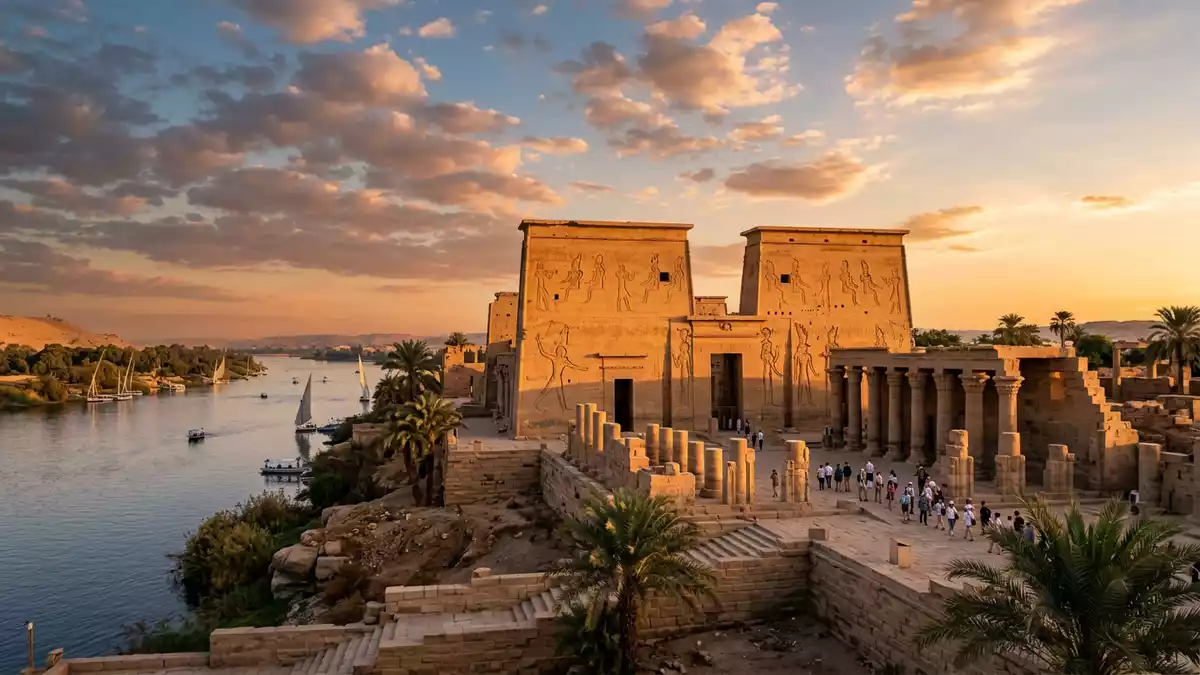
Kom Ombo Temple in southern Egypt stands on a rise above the Nile, facing the river with a rare double layout that mirrors one sanctuary against another. Built during the Ptolemaic period and completed under rulers including Ptolemy VI Philometor and Ptolemy XII Neos Dionysos, it combines two temples dedicated to different deities within a single sandstone complex.Graeco-Roman period construction Visitors encounter a place where every main architectural element exists in duplicate, reflecting the temple’s dual commitment to Sobek and Horus the Elder.
Kom Ombo Temple: a dual sanctuary for Sobek and Horus
Kom Ombo Temple is dedicated to two distinct sets of gods, a feature that shapes everything from its ground plan to its decoration. One side honours Sobek, the crocodile god associated with the Nile’s waters, while the other side is devoted to Horus the Elder, the falcon god linked with the sky and solar power.Sobek and Horus the Elder Each deity forms part of a triad: Sobek appears with Hathor and their child Khonsu, while Horus the Elder is paired with Tasenetnofret and their child Panebtawy, the “Lord of the Two Lands”.
This religious split is expressed physically. The temple is arranged as a double sanctuary, with chambers duplicated along the main axis to serve each god separately.double design dedicated to Sobek and Horus There is a double entrance, twin courts and colonnades, two hypostyle halls and two inner sanctuaries, all aligned so that an imaginary line divides Sobek’s precinct from that of Horus. The right-hand side of the complex is associated with Sobek, while the left-hand side belongs to Horus, a division recorded in ancient descriptions of the place.imaginary line through the temple
Sandstone architecture on the bend of the Nile
Architecturally, Kom Ombo Temple follows a pattern familiar from other major sanctuaries of the Ptolemaic era, yet its material and siting give it a character of its own. The main temple structures are built of local sandstone quarried at Gebel el-Silsila, a source that supplied stone for several monuments along this stretch of the Nile.sandstone from Gebel el-Silsila Around the stone core lies a series of mud-brick enclosure walls that once separated sacred space from the surrounding town and riverbank.
The temple rises on a sandstone outcrop overlooking the river, giving wide views along the Nile and across the flat agricultural land around Kom Ombo.sandstone outcrop above the Nile Within the enclosure, the plan unfolds in a sequence of spaces that echo each other: a court with columns on several sides, followed by hypostyle halls supported by carved pillars, then a suite of inner chambers leading towards two separate sanctuaries for Sobek and Horus. Reliefs on the walls record Ptolemaic kings presenting offerings, and some surviving ceilings show astronomical motifs such as stars and protective birds.astronomical ceilings and reliefs
History of Kom Ombo and its river temple
The town of Kom Ombo lies in Upper Egypt, on the east bank of the Nile within Aswan Governorate. Its position along the river north of Aswan gave it access to trade routes between Nubia and the Nile Valley, and the construction of Kom Ombo Temple in the second century BC marked a period when the settlement gained greater prominence.rise of Kom Ombo in the second century BC The temple itself stands near the site of an earlier sanctuary from the New Kingdom, though the present layout belongs to the Graeco-Roman era.
Construction of the double temple is tied to the reign of Ptolemy VI Philometor, whose name appears among the earliest royal cartouches carved on the building.Ptolemy VI Philometor at Kom Ombo Much of the decoration, including later reliefs and architectural elements, dates to the reign of Ptolemy XII Neos Dionysos, father of Cleopatra VII.Ptolemy XII Neos Dionysos The complex continued in use into the Roman period, with additions and repairs recorded across several centuries of Graeco-Roman rule.
Visiting Kom Ombo Temple: what travellers from Western Europe should know
- Kom Ombo Temple stands on the east bank of the Nile in Upper Egypt, in the town of Kom Ombo north of Aswan; it lies along the traditional river route between Aswan and Edfu.
- Approaching the temple involves walking over uneven stone surfaces and climbing low steps between the courts, halls and surrounding terraces.
- The site lies close to the Nile, with agricultural fields and the town of Kom Ombo nearby, so the temple visit combines river views with the surrounding settlement.
- For travellers from Western Europe, the official language is Arabic and the currency is the Egyptian pound.
- Entry requirements depend on your nationality; UK travellers can check the FCDO travel advice at gov.uk/foreign-travel-advice, Irish travellers the Department of Foreign Affairs at ireland.ie.
Searching for Kom Ombo Temple on social platforms
These links open searches for Kom Ombo Temple on each platform.
Frequently asked questions about Kom Ombo Temple
Where is Kom Ombo Temple located?
Kom Ombo Temple is in the town of Kom Ombo in Upper Egypt, on the east bank of the Nile within Aswan Governorate north of Aswan.
What can visitors expect when exploring the temple complex?
Visitors walk through duplicated courts, columned halls and inner chambers, seeing reliefs dedicated separately to Sobek and Horus, all built of local sandstone above the river.
What makes Kom Ombo Temple distinctive among Egyptian temples?
Its mirrored plan, with twin entrances, courts, hypostyle halls and sanctuaries dedicated to two deities, makes Kom Ombo Temple a rare example of a double sanctuary in one structure.


