Knossos and the layered palace landscape of Minoan Crete
Published on 09/05/2026 at 18:13 | Editorial responsibility: Rafael Müller, Editor-in-Chief AD HOC NEWS
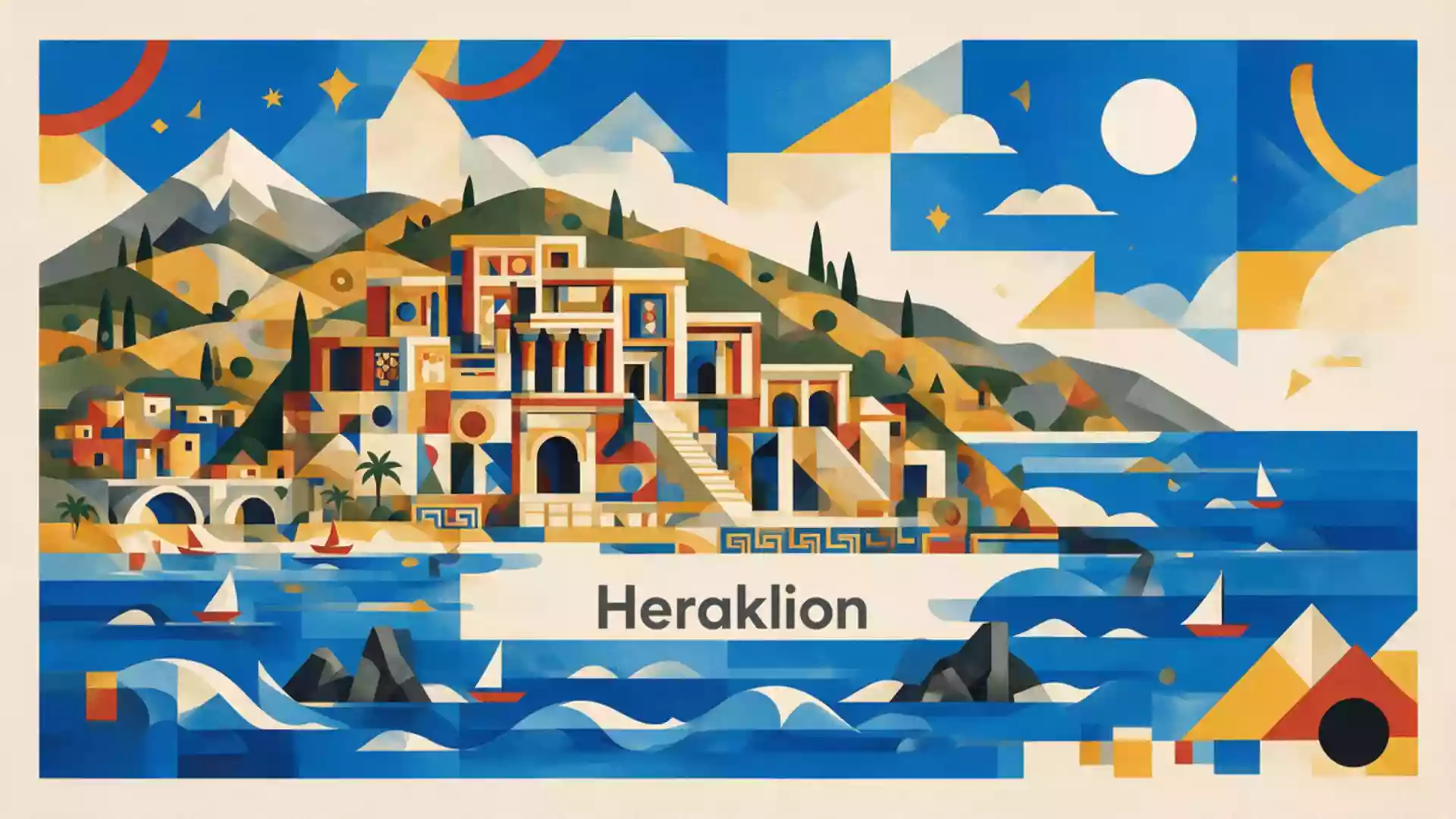
On the low hill of Kefala just outside Heraklion, Knossos presents an ancient palace and surrounding city that turn Bronze Age Crete into something visibly three-dimensional. The remains of the so?called Palace of Minos spread across terraced levels, staircases and courts, all within a wider archaeological landscape that extends far beyond the central ruins.Knossos as an archaeological site
The palace at the core of Minoan Knossos
The palace at Knossos forms the architectural heart of the site, occupying a prominent position on Kefala Hill to the south of Heraklion on Crete. Excavations have identified a large palatial complex built by the Bronze Age civilisation conventionally known as the Minoans, with rooms and corridors grouped around a central court and linked by staircases, internal courtyards and long galleries.Bronze Age palace complex The structure seen in the ruins belongs to a sequence of palaces whose major phases fall in the second millennium BC, with the best-preserved parts ranging from around Middle Minoan II in the early second millennium BC to habitation that continued into Late Minoan IIIA in the thirteenth century BC.Middle and Late Minoan phases
The palace covers an area measured in the tens of thousands of square metres, with estimates around 14,000 to over 20,000 m² (150,000 to over 215,000 sq ft), and includes more than a thousand rooms arranged on multiple levels.extent of the palace Staircases rise between floors, while long narrow storerooms, magazines for large storage jars, reception halls and areas associated with cult activity reflect the range of functions carried by such a complex. The remains visitors see incorporate both original Minoan masonry and early twentieth?century reconstructions, especially in plaster and concrete, introduced by the British archaeologist Sir Arthur Evans after his excavations, which began in 1900.excavations by Arthur Evans
A palatial city and its wider landscape
Knossos is more than a solitary palace: the site formed a substantial urban centre in antiquity, with the palace set within a town that stretched across the surrounding slopes and valleys. Archaeological work has defined an extensive landscape around the core ruins, with the wider area of the Knossos archaeological zone covering about 10 km² (3.9 sq mi), including cemeteries, villas, smaller buildings and terrain features related to the ancient settlement.extent of the Knossos landscape The low hill and nearby stream courses help explain the way the complex steps down the slope, with terraces giving access to different wings and courts.
Within this wider setting, the palace itself has been described as the largest of the palatial centres built by the Minoans on Crete, and as one of the key nodes of the civilisation that once dominated the island.largest of the Minoan palaces The site preserves traces of Neolithic occupation beneath the Bronze Age structures, indicating that settlement on Kefala Hill goes back several millennia before the heyday of the palace.Neolithic beginnings at Knossos Layers of building, destruction and rebuilding across the second millennium BC make the ruins a literal cross?section through the architectural history of Minoan Crete.
Myth, colour and reconstructed spaces
Knossos is deeply entangled with Greek myth, particularly the figure of King Minos and the story of the labyrinth. Later traditions place Minos as ruler at Knossos and describe a maze built by the craftsman Daedalus to contain the Minotaur, although the physical remains at the site correspond to a complex palace rather than a single formal labyrinth.myth of Minos and the labyrinth The interlocking corridors, staircases and magazines nonetheless give a sense of how such stories could attach themselves to the architecture.
Visitors encounter restored spaces with painted plaster, columns and partial wall reconstructions that reflect early twentieth?century interpretations of Minoan design. Some reconstructions re?create fragments of famous frescoes such as scenes with bull?leaping and processional figures, while others mark structural elements like columned halls and stepped access routes. These interventions, together with original stonework and exposed foundations, create a distinctive mixture of ruin and rebuilding characteristic of Knossos as seen on the ground.reconstructed palace areas
Visiting Knossos: what travellers from Western Europe should know
- Knossos lies on Kefala Hill in the southern periphery of Heraklion on Crete, reached overland from the city along the road signposted to the archaeological site.location 5 km south of Heraklion
- The archaeological area consists of uneven ground, stone surfaces and staircases within the palace, with multi?level ruins that require walking between courts, halls and terraces.
- The surrounding region includes the modern city of Heraklion to the north and other Minoan sites elsewhere on Crete, making Knossos a focal point for exploring Bronze Age remains on the island.Knossos as a major Minoan centre
- The official language is Greek and the currency is the euro.
Searching for Knossos on social platforms
These links open searches for Knossos on each platform.
Frequently asked questions about Knossos
Where is Knossos and what kind of place is it?
Knossos is an ancient Minoan palace and urban centre on Kefala Hill about 5 km south of Heraklion on the island of Crete in Greece.position near Heraklion
What can visitors expect to see at Knossos?
Visitors walk through extensive ruins of a multi?level Bronze Age palace, with courts, staircases, storerooms and reconstructed areas showing columns, plasterwork and fragments of fresco decoration.palatial remains and reconstructions
What makes Knossos distinctive among ancient sites on Crete?
Knossos combines its role as a major centre of Minoan civilisation, its large, complex palace and its deep connection with the myths of King Minos and the labyrinth, all set within a broad archaeological landscape.importance among Minoan palaces