
Kiyomizu-dera and the great wooden stage above Kyoto
Published on 09/14/2026 at 10:33 | Editorial responsibility: Rafael Müller, Editor-in-Chief AD HOC NEWS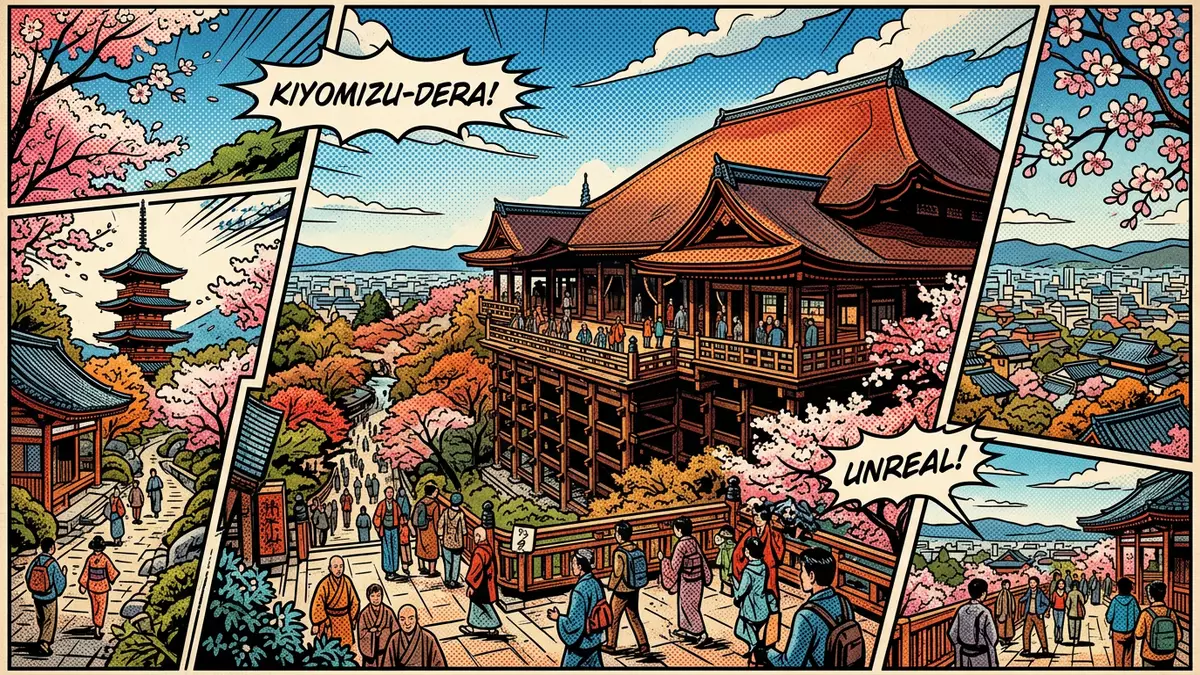
Kiyomizu-dera is a Buddhist temple complex on the eastern hills of Kyoto, known for a main hall that seems to hang above the forested slope on a vast wooden stage. Founded in the eighth century and rebuilt in the early seventeenth century, it stands today as part of the Historic Monuments of Ancient Kyoto recognised on the UNESCO World Heritage List.
A temple suspended over the Otowa hillside
The defining experience of Kiyomizu-dera is the encounter with its main hall, or Hond?, and the broad wooden terrace that projects over the steep hillside below. The hall stands on the slope of Mount Otowa, so that the veranda extends out from the building over the valley, supported by a dense framework of timber columns and cross-bracing beams rising directly from the ground. The present form of the Hond? dates from 1633, when it was reconstructed in the early Edo period under the Tokugawa shogunate, and it has become a recognised example of kake-zukuri, a hanging-style carpentry that carries the hall above the terrain without relying on metal fastenings.The Hondo, built in 1633 From the terrace, views open westwards over the roofs of Kyoto and towards distant hills, with the forested valley immediately below emphasising the height of the stage.
The structural grid beneath the terrace is as characteristic as the panorama above. Tall wooden posts are braced together in both directions, forming the supporting frame of the stage and allowing the floor of the hall and veranda to sit high above the slope. This overhanging construction is a key reason why Kiyomizu-dera is frequently associated with bold decisions in Japanese cultural reference, as the stage is widely invoked in a saying about taking a leap. The temple’s cliff-side position also means that, as visitors walk along the veranda, they look down not onto a flat courtyard but into a wooded ravine, with smaller structures and paths connecting the lower parts of the complex.
Origins in 778 and the Edo-period rebuilding
Kiyomizu-dera traces its foundation to 778, in the period when Kyoto was emerging as the imperial capital and the surrounding hills were being settled by religious communities. Tradition associates the foundation with the monk Enchin, who established a temple on the slope facing the Otowa Waterfall, dedicating it to Kannon Bodhisattva and anchoring its identity in the flow of clear water from the hillside.Otowa-san Kiyomizu-dera Temple was founded in 778 In 798, the military leader Sakanoue no Tamuramaro is recorded as building a hall on the site, bringing official patronage and linking the temple to the court of Emperor Kanmu in the early Heian period.Sakanoue Tamuramaro embellished the site with a large hall
The complex has suffered repeated destruction by fire over the centuries, with many earlier buildings lost and rebuilt. Most of the principal structures that stand today date from reconstructions carried out in the early seventeenth century, when the third Tokugawa shogun, Tokugawa Iemitsu, ordered the rebuilding of the main hall, pagoda and other important halls.the current complex consists primarily of reconstructions carried out from 1631 to 1633 These Edo-period buildings include the Nio-mon gate at the entrance, the Sai-mon west gate, the three-storied pagoda and several halls aligned broadly east–west across the slope, forming a sequence of spaces between the city and the wooded hillside.Hondo (Main hall) ... reconstructed in 1633
Otowa Waterfall and the “pure water” name
Beneath the main hall and its terrace, the Otowa Waterfall flows from the hillside into basins under shelters, dividing into three separate streams that give Kiyomizu-dera its name. The temple’s name combines characters meaning “pure water”, referring to these clear cascades and the spring that feeds them.Otowa Waterfall and its spring that flows to the temple is the temple’s namesake Paths lead down from the terrace level to the waterfall, where visitors can see the streams channelled into troughs and bowls beneath the shelter roofs.
The waterfall has long been associated with wishes and good fortune. The three streams are linked in tradition to different aspects of life, and visitors use long-handled cups to take water from the channels, mindful of the stories attached to each. Whatever their own view of these associations, travellers see the way water, basins, stone and timber structures are intertwined at the foot of the main hall. The presence of the waterfall beneath the overhanging terrace makes the connection between the temple’s architecture and its name visible on foot, and reinforces the sense that Kiyomizu-dera is shaped by its hillside setting as much as by its religious role.
Visiting Kiyomizu-dera: what travellers from Western Europe should know
- Kiyomizu-dera stands on the slopes of Mount Otowa in Kyoto’s Higashiyama district, east of the city centre. It is reached along streets that climb from the lower urban area into the temple approaches.
- The main hall and terrace sit high above a steep, wooded hillside, with stairways and sloping paths linking the different levels. Visiting the complex involves walking on gradients and climbing flights of stone steps.
- Other structures such as gates, pagodas and subsidiary halls are spread across the slope, connected by paved paths. Moving between them involves frequent changes in level rather than a single flat circuit.
- The official language is Japanese and the currency is the yen. Entry requirements depend on your nationality; UK travellers can check the FCDO travel advice at gov.uk/foreign-travel-advice, Irish travellers the Department of Foreign Affairs at ireland.ie.
Searching for Kiyomizu-dera on social platforms
These links open searches for Kiyomizu-dera on each platform.
Frequently asked questions about Kiyomizu-dera
Where is Kiyomizu-dera located?
Kiyomizu-dera stands on the slopes of Mount Otowa in Kyoto’s Higashiyama district, on the eastern side of the city, above streets that climb into the hills.
What should visitors expect on a visit?
Visitors move through a sequence of gates, halls and terraces built along a hillside, with stairways, sloping paths and a wooden stage projecting over a forested valley.
What makes Kiyomizu-dera distinctive among Kyoto’s temples?
The temple’s main hall is carried above a steep slope on an extensive wooden terrace, reconstructed in 1633, with the Otowa Waterfall flowing beneath and giving the site its “pure water” name.


