
Kiyomizu-dera and its wooden stage above Kyoto
Published on 09/18/2026 at 08:21 | Editorial responsibility: Rafael Müller, Editor-in-Chief AD HOC NEWS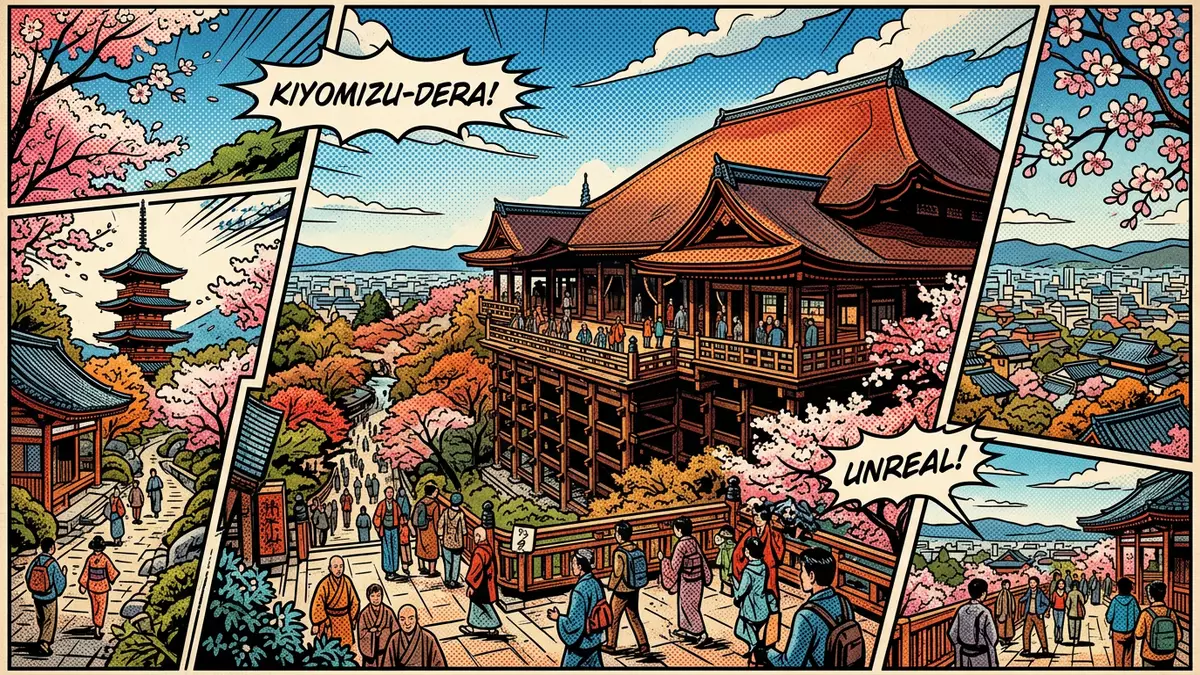
Kiyomizu-dera is a Buddhist temple complex on the eastern slopes of Kyoto, known above all for a vast wooden terrace that projects over the hillside from its main hall. Set among trees on Mount Otowa, it traces its foundation to 778 during the late Nara period, giving it roots that reach back before Kyoto became the imperial capital.
A temple of pure water and steep timbered slopes
The name Kiyomizu-dera is commonly translated as “Temple of Pure Water”, and that purity refers to the Otowa waterfall that springs from the hillside beneath the main buildings.Otowa-no-taki waterfall flows down a cleft in the rock, collected in channels where visitors use metal cups on long handles to drink from the streams. The association with water runs through the temple’s identity as a place dedicated to Kannon, the bodhisattva of compassion, and through legends about monks who encountered a spring on the mountain and enshrined an image there.
The temple belongs to the Hosso tradition of Buddhism and is part of the long religious history of Kyoto, where Kannon worship has been present for many centuries.Enchin Shonin is associated with its foundation in 778, while the warrior Sakanoue no Tamuramaro is connected with a hall built there in 798.Imperial patronage from Emperor Kanmu followed in the Heian period, placing the temple within the official religious framework of the capital.
The wooden stage and kakezukuri architecture
The most striking feature at Kiyomizu-dera is the main hall, or Hondo, which stands on a steep cliff and carries a deep veranda known as the Kiyomizu stage. The hall, rebuilt in 1633 under the Tokugawa shogunate, is an example of kakezukuri, a form of overhang architecture where a platform projects out over the slope.Tall wooden columns and cross-bracing support the stage, and traditional carpentry joints bind the structure without the need for nails, creating a lattice of timbers that lifts the hall high above the ground.
The view from the stage takes in the roofscape of Kyoto and the wooded ravine below, while inside the Hondo an eleven-faced statue of Kannon stands as the principal image.The present main hall from 1633 is recognised as a national treasure, and the phrase “to jump off the stage at Kiyomizu” has entered Japanese language as a metaphor for taking a decisive leap. Historically, people did make such jumps from the stage into the forested drop, a practice that no longer takes place but that still colours the way the building is imagined.
Pagodas, gates and a World Heritage landscape
Kiyomizu-dera is not a single hall but a compound with many structures aligned along the slope. Approaching from the city, visitors pass through a gate and climb towards the Sai-mon, or west gate, and other halls that frame the route.The three-storied pagoda rises beside the main buildings, and further elements such as the sutra hall, belfry, founder’s hall and smaller shrines are arranged around the Hondo.
The entire temple forms part of the “Historic Monuments of Ancient Kyoto”, a World Heritage property that links sites across Kyoto, Uji and Otsu.Kiyomizu-dera’s inscription reflects both its religious role and its architectural value, especially the harmony between wooden structures and forested terrain. Paths run between buildings, some leading to the Joju-in Garden, which uses borrowed scenery techniques to frame views of the surrounding landscape within its composition.
Visiting Kiyomizu-dera: what travellers from Western Europe should know
- Kiyomizu-dera stands on the slopes of Higashiyama on the eastern side of Kyoto, reached on foot from nearby streets and via city transport to the surrounding district.
- The temple complex climbs a hillside; approaches involve sustained walking on stone paths and stairways, and the route to the main hall includes steps and sloping ground.
- The Otowa waterfall and its basins lie beneath the main hall, reached by descending from the terrace to the lower level, where queues may form along narrow walkways.
- Kyoto is in Japan, where the official language is Japanese and the currency is the yen (JPY).
- Entry requirements depend on your nationality; UK travellers can check the FCDO travel advice at gov.uk/foreign-travel-advice, Irish travellers the Department of Foreign Affairs at ireland.ie.
Searching for Kiyomizu-dera on social platforms
These links open searches for Kiyomizu-dera on each platform.
Frequently asked questions about Kiyomizu-dera
Where is Kiyomizu-dera located?
Kiyomizu-dera stands on Mount Otowa on the eastern side of Kyoto, in the Higashiyama district above city streets and traditional neighbourhoods.
What can visitors expect during a visit?
A visit involves walking uphill through temple gates and halls, reaching the main wooden stage of the Hondo, with further paths leading to the Otowa waterfall and gardens.
What makes Kiyomizu-dera distinctive among Kyoto’s temples?
Its kakezukuri main hall with a large wooden stage over a steep slope, the association with pure spring water, and its status within Kyoto’s World Heritage sites together give Kiyomizu-dera a particular character.


