
Kiyomizu-dera and its great wooden stage over Kyoto
Published on 09/19/2026 at 18:06 | Editorial responsibility: Rafael Müller, Editor-in-Chief AD HOC NEWS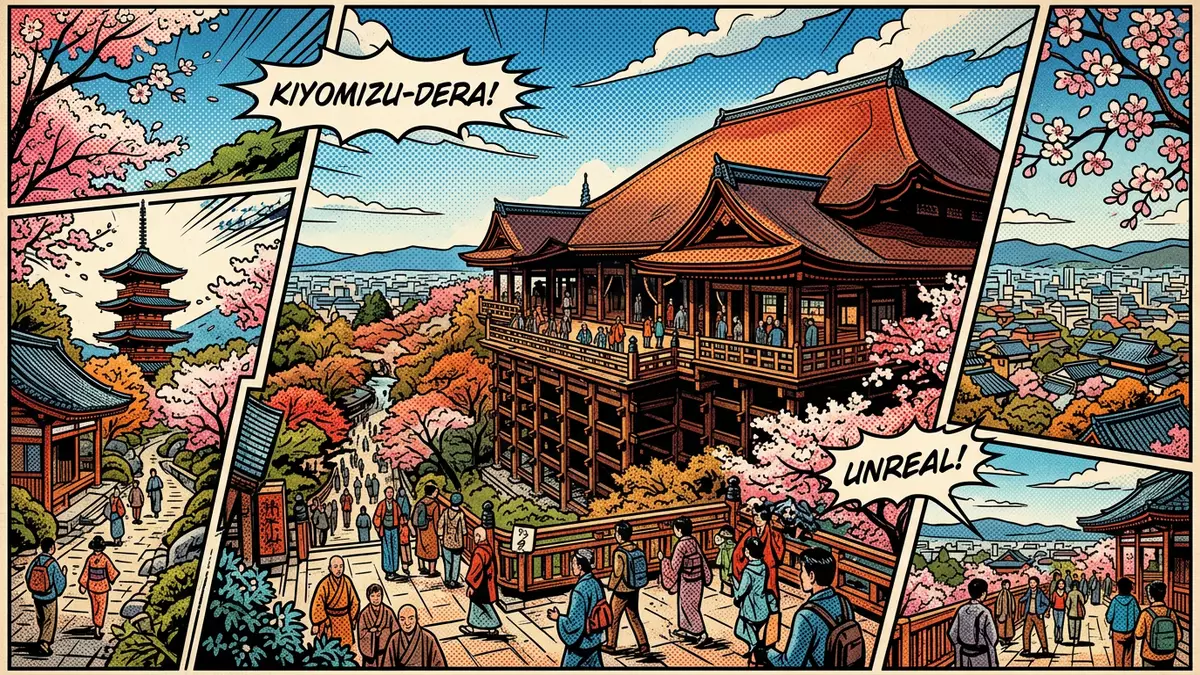
Kiyomizu-dera is a Buddhist temple complex in Kyoto’s eastern hills, best known for a main hall whose vast wooden stage projects over a steep valley and faces the city below. Founded in the eighth century near the Otowa Waterfall and rebuilt in the early seventeenth century, it forms part of the Historic Monuments of Ancient Kyoto recognised on the UNESCO World Heritage List.
The temple on the slope: stage, valley and city
The defining experience of Kiyomizu-dera is stepping out from the main hall onto the wooden stage that hangs above the forested hillside. The platform extends out from the hall over the Otowa valley, carried by a lattice of tall timber columns and beams that hold it above the ground without metal fixings in the joints.The Hondo, built in 1633, is the central hall and the projecting veranda beneath it is described as an example of kakezukuri, an “overhang” construction adapted to steep slopes.
From the edge of the stage, the view stretches across temple roofs and trees towards the basin of Kyoto. In the foreground, the framework of columns rises from stone footings and interlocking braces run through them, while beyond the complex the city’s grid lies below the higher ground of the Higashiyama district. The main hall itself is designated as a National Treasure of Japan, underscoring the status of its timber architecture within the wider ensemble of gates, pagodas and subsidiary halls.Discover Kyoto notes the main hall as a National Treasure and emphasises the seventeenth-century date of the principal buildings.
Founding on the Otowa Waterfall and Edo-period rebuilding
Kiyomizu-dera’s origins lie in the late eighth century, when the monk Enchin is recorded as founding a temple on Mount Otowa above the Otowa-no-taki Falls.Kyoto’s cultural property listing dates the origin to 778, in the Nara and early Heian periods, and links it to Sakanoue no Tamuramaro, the general who built the first large-scale hall under imperial patronage. The temple’s name, “Kiyomizu”, refers to the clear water of the falls, and the Otowa Waterfall remains one of the focal points of the site, with three streams running into a basin beneath the main terrace.Japan Guide describes the temple as founded on the site of the Otowa Waterfall in the wooded hills east of Kyoto.
The buildings that stand today largely date from a major reconstruction in 1633 under Tokugawa Iemitsu, the third shogun of the Tokugawa dynasty.Sacred Japan notes that the current halls were rebuilt in 1633 under Iemitsu after earlier structures were lost to fire. This Edo-period rebuilding shaped the present alignment of gates, pagodas, sutra halls and the main hall along an east–west axis on the slope. The complex was inscribed in 1994 as part of the Historic Monuments of Ancient Kyoto, a UNESCO World Heritage Site grouping temples, shrines and castles associated with Kyoto’s long history as an imperial capital.Kiyomizu-dera is listed within the Historic Monuments of Ancient Kyoto, reinforcing its international recognition.
Architecture in kakezukuri style and the Otowa precinct
The stage beneath the main hall exemplifies kakezukuri, a construction style that extends a structure outward over a slope by resting it on a frame of high pillars. At Kiyomizu-dera, these columns are made from Japanese zelkova and are locked together with horizontal beams into a self-supporting framework.Descriptions of the main hall emphasise 139 pillars of zelkova assembled without nails, and city records describe the veranda as an imposing stage raised on tall wooden supports.The official listing calls the veranda the “Kiyomizu-dera stage” and underlines its overhang form.
Below the stage, a flight of steps leads down towards the Otowa-no-taki waterfall, where three separate streams fall into a collection basin and visitors use long-handled ladles to catch water from one of the flows.Guides link the three streams to local traditions of blessings, and the surrounding precinct includes smaller halls, pagodas and a shrine dedicated to a tutelary deity. Together, the stage, halls and waterfall form a layered landscape in which timber architecture, running water and hillside paths are closely interwoven.
Visiting Kiyomizu-dera: what travellers from Western Europe should know
- Kiyomizu-dera stands on the slope of Mount Otowa in the Higashiyama district on the eastern side of Kyoto, reached by walking uphill streets from the city’s lower grid and local bus routes that serve the area.
- The temple complex is built on uneven ground, with stone approaches, stepped lanes and internal stairways; reaching the main hall and the stage involves sustained walking on inclines and climbing flights of steps.
- From the wooden stage, the outlook takes in nearby temple buildings and the urban plain of Kyoto, and paths continue around the hillside to pagodas and viewpoints within the same precinct.
- The official language is Japanese and the currency is the yen.
Searching for Kiyomizu-dera on social platforms
These links open searches for Kiyomizu-dera on each platform.
Frequently asked questions about Kiyomizu-dera
Where is Kiyomizu-dera located?
Kiyomizu-dera stands on the slopes of Mount Otowa in the Higashiyama district on the eastern side of Kyoto, above the city’s main built-up area.
What should visitors expect at Kiyomizu-dera?
A visit centres on the wooden stage of the main hall, hillside paths linking gates, halls and pagodas, and the Otowa Waterfall reached by descending steps beneath the terrace.
What makes Kiyomizu-dera distinctive among Kyoto’s temples?
Its projecting timber stage in kakezukuri style, the combination of Edo-period halls with the Otowa Waterfall, and its inclusion in the Historic Monuments of Ancient Kyoto give the site a particular character.


