
Kiyomizu-dera and its great wooden stage above Kyoto
Published on 09/16/2026 at 08:56 | Editorial responsibility: Rafael Müller, Editor-in-Chief AD HOC NEWS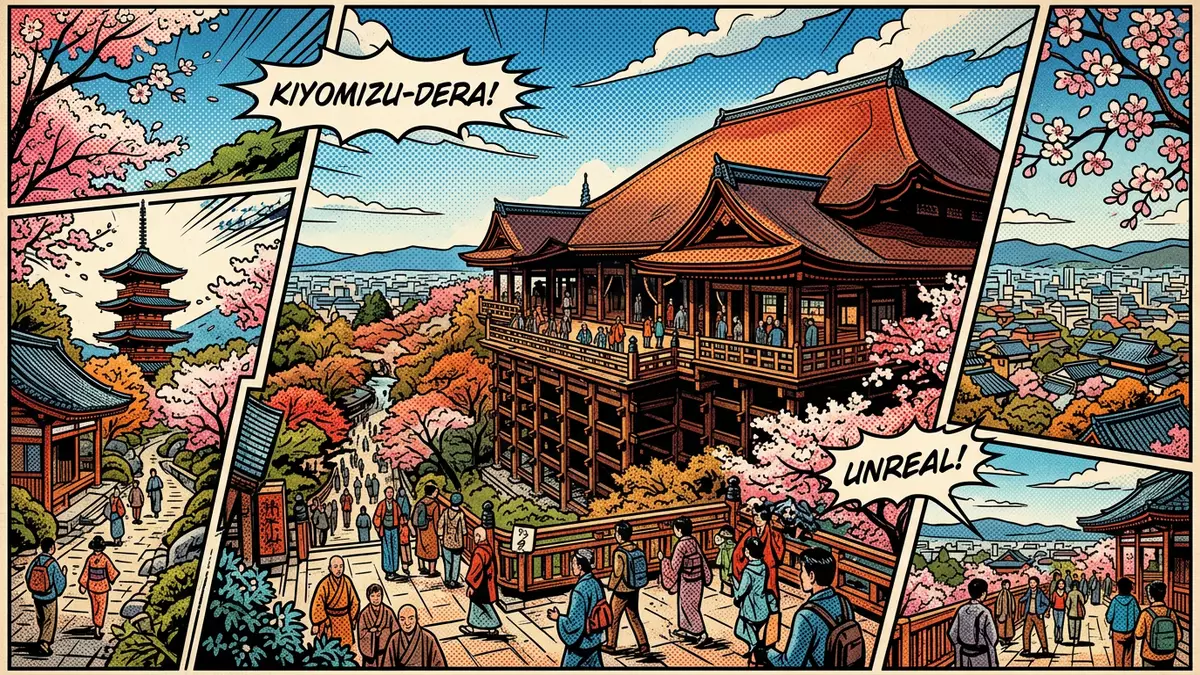
Kiyomizu-dera is a Buddhist temple complex on the eastern hills of Kyoto, known for a main hall that projects over a steep slope on a vast wooden stage. Founded in 778 on the site of the Otowa Waterfall and reconstructed in the early seventeenth century, it forms part of the Historic Monuments of Ancient Kyoto recognised on the UNESCO World Heritage List, tying its timber terraces to a wider landscape of imperial-period temples and gardens.Historic Monuments of Ancient Kyoto
The wooden stage and kakezukuri architecture
The main hall of Kiyomizu-dera stands on a dramatic veranda that extends out from the hillside, supported by a dense forest of timber columns and cross-bracing beams rising from the slope. This structure is an example of kakezukuri, a traditional “overhang” construction used for buildings on steep ground, and the framework beneath the terrace is built from cypress wood in interlocking joints without a single metal nail.an example of kakezukuri From the edge of the stage, the view stretches across layers of temple roofs, maple and cherry trees and the urban plain of Kyoto beyond.
The present main hall is a product of the early Edo period, rebuilt between 1631 and 1633 under the Tokugawa shogunate after repeated fires damaged earlier structures.rebuilt between 1631 and 1633 The hall houses an image of the eleven-faced, thousand-armed Kannon, the bodhisattva of compassion, and the great wooden terrace outside its doors has long been one of Kyoto’s emblematic viewpoints over the city and surrounding hills.eleven-faced, thousand-armed Kannon
Pure water and the origins of the temple
The history of Kiyomizu-dera is traditionally dated to 778 in the late Nara period, when the monk Enchin is recorded as founding a temple on Mount Otowa above the Otowa-no-taki Falls.originated in 778 when the monk Enchin In 798, the general Sakanoue no Tamuramaro is associated with building a hall on the site, bringing the complex under imperial patronage during the period when Kyoto, then Heian-kyo, was emerging as the capital.Sakanoue no Tamuramaro builds the main hall These early foundations anchor the temple in the transition from Nara to Heian rule, and they are recalled in the founder’s hall within the grounds.
The name Kiyomizu-dera means “Pure Water Temple” and refers directly to the spring that feeds the Otowa Waterfall beneath the buildings. The clear, gushing waters have long been described as “Konjiki-sui” (golden water) and “Enmei-sui” (life-prolonging water) and are used in rituals of purification.clear, gushing waters At the base of the falls the water is divided into three streams, each associated with particular blessings such as longevity, success in studies or work, and fortune in love, and visitors drink from ladles at covered basins below the terrace.divided into three streams
A layered temple landscape above Kyoto
Kiyomizu-dera forms part of a larger temple precinct in the Higashiyama hills, aligned along an east–west axis that climbs the slope. The principal buildings include the Niomon gate of Deva Kings, the Saimon west gate, the Sanjunoto three-storey pagoda, the Kyodo sutra hall, the Tamurado founder’s hall, the Todorokimon middle gate, the Asakurado hall, the Hondo main hall and the Amidado hall dedicated to Amida Buddha.principal temple buildings Around them stand smaller structures such as the belfry, hitching stables and subsidiary shrines including Jishu-jinja, creating a dense ensemble of timber architecture stepping up the mountainside.
The temple belongs to the Kita-Hosso sect of Buddhism, a branch that grew from the ancient Hosso school, and its religious life is centred on devotion to Kannon Bodhisattva.belongs to the Buddhist Kita-Hosso sect In 1994, Kiyomizu-dera was inscribed as part of the Historic Monuments of Ancient Kyoto on the UNESCO World Cultural Heritage List, recognising both its religious significance and its timber architecture on the slope above the city.Historic Monuments of Ancient Kyoto UNESCO World Heritage Site
Visiting Kiyomizu-dera: what travellers from Western Europe should know
- Kiyomizu-dera stands on the wooded eastern hills of Kyoto, in the Higashiyama district, with approaches rising from streets lined with shops and smaller temples.
- The complex climbs a slope and includes long flights of stone steps and steep paths between gates, halls and the main wooden terrace above the Otowa Waterfall.
- From the terrace and pagoda there are elevated views across the city and surrounding hills, with temple roofs, trees and urban districts spreading below the platforms.
- The official language is Japanese and the currency is the Japanese yen.
- Entry requirements depend on your nationality; UK travellers can check the FCDO travel advice at gov.uk/foreign-travel-advice, Irish travellers the Department of Foreign Affairs at ireland.ie.
Searching for Kiyomizu-dera on social platforms
These links open searches for Kiyomizu-dera on each platform.Frequently asked questions about Kiyomizu-dera
Where is Kiyomizu-dera located?
Kiyomizu-dera stands on the slopes of Mount Otowa in the Higashiyama district on the eastern side of Kyoto, above streets of traditional houses and shops.
What can visitors expect on a visit to Kiyomizu-dera?
A visit involves walking through temple gates and halls on a rising slope, climbing stone steps and standing on the large wooden terrace above the Otowa Waterfall.
What makes Kiyomizu-dera distinctive among Kyoto’s temples?
Its great wooden stage built in kakezukuri style over the hillside, the focus on the “pure water” of Otowa Waterfall and its status as a UNESCO-listed Historic Monument of Ancient Kyoto together make it distinctive.


