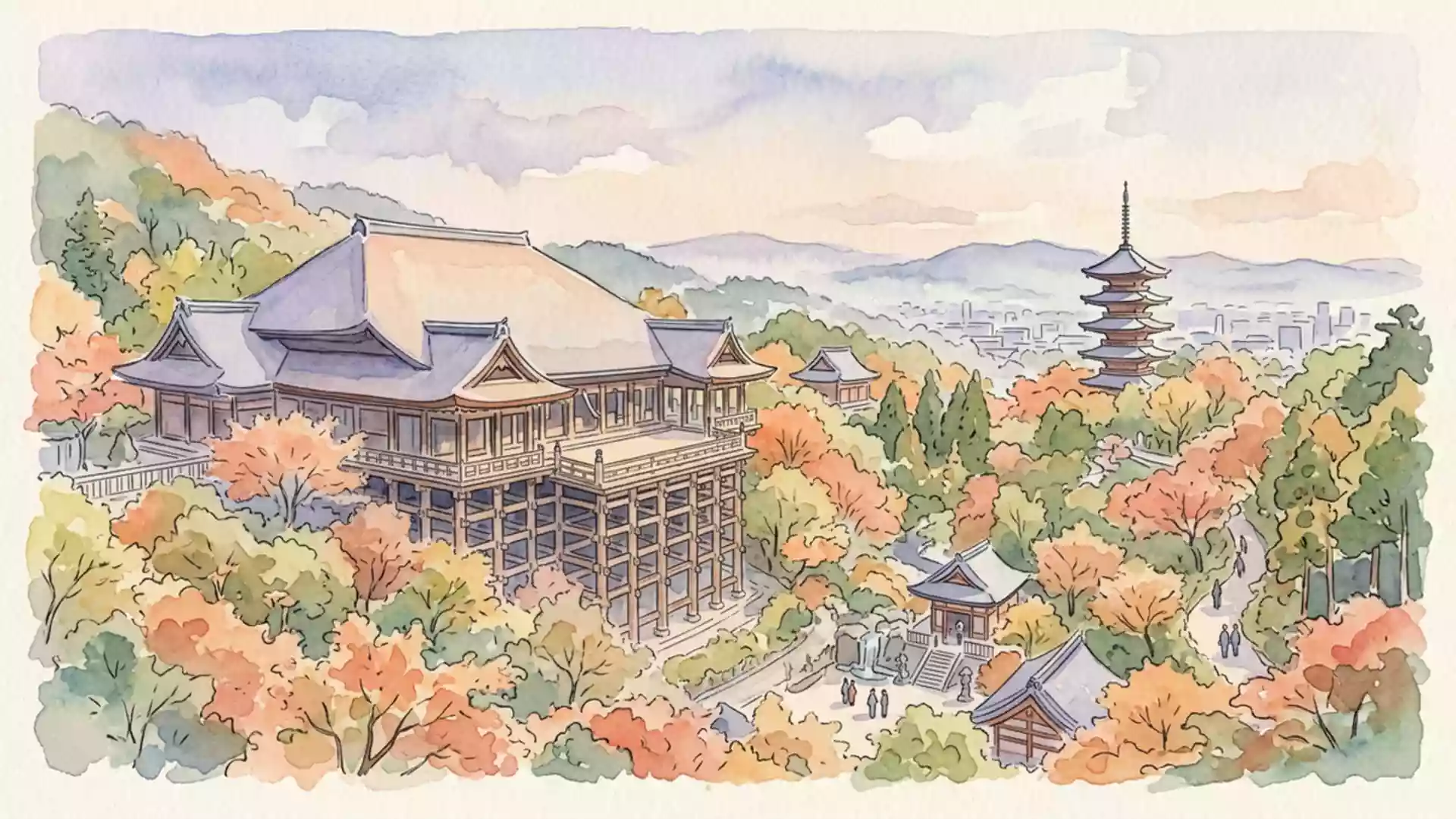
Kiyomizu-dera and its great wooden stage above Kyoto
Published on 08/28/2026 at 08:18 | Editorial responsibility: Rafael Müller, Editor-in-Chief AD HOC NEWS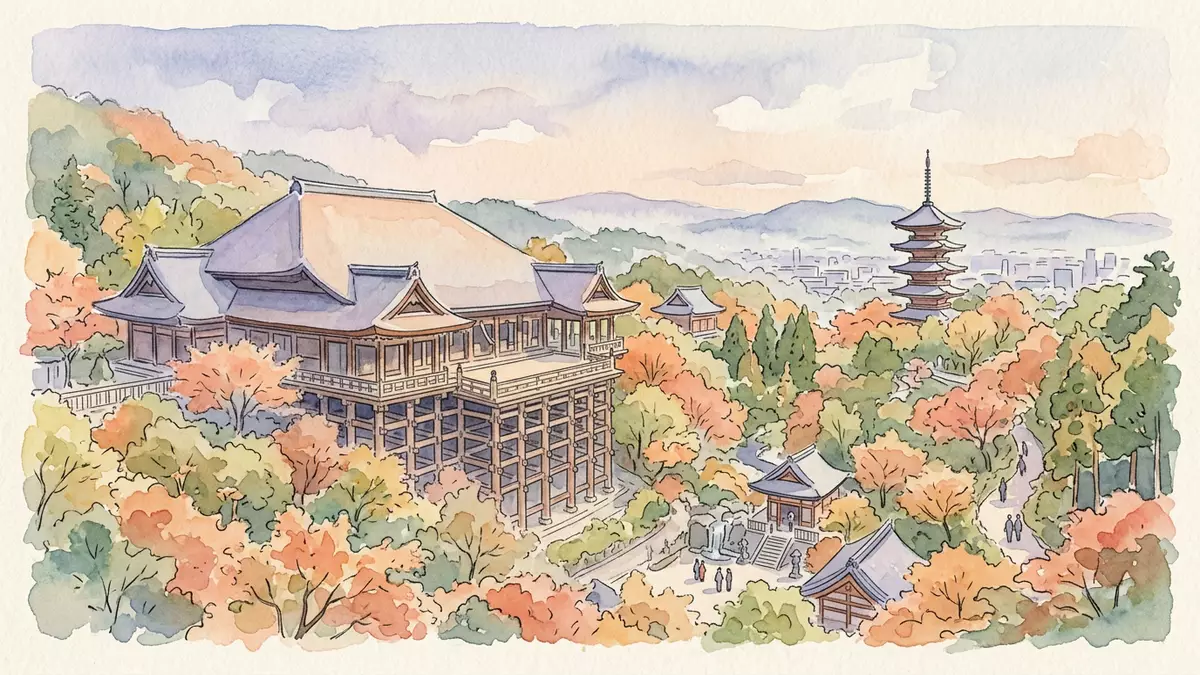
Kiyomizu-dera in Kyoto is a Buddhist temple complex known above all for a main hall that projects over a steep hillside on a vast wooden stage, with the pure waters of Otowa Waterfall running below. Founded in the eighth century and rebuilt in the early seventeenth century, it stands today as part of the Historic Monuments of Ancient Kyoto, recognised on the UNESCO World Heritage List.
A temple on the slope of Mount Otowa
Kiyomizu-dera stands on the wooded slopes of Mount Otowa in Kyoto’s Higashiyama district, with its buildings stepping up and along the contour of the hill. The temple’s full name, Otowa-san Kiyomizu-dera, links it directly to the mountain and to the “pure water” that gave the site its identity.Otowa-san Kiyomizu-dera The complex has grown over more than a millennium into a sequence of gates, halls and pagodas, each sitting on terraces cut into the slope.
The origins of Kiyomizu-dera reach back to 778, when the monk Enchin is recorded as founding a temple here in the Nara–Heian transition period.founded in 778 CE by Enchin Later, in 798, the general Sakanoue no Tamuramaro is associated with building a hall on the site overlooking the Otowa Falls.Sakanoue no Tamuramaro built a Buddha hall These early foundations anchor the temple in the period when Kyoto was emerging as the imperial capital, and they are still recalled in Kiyomizu-dera’s founder’s hall within the grounds.
The great wooden stage and kake-zukuri carpentry
The main hall, or hond?, at Kiyomizu-dera stands on the edge of a cliff face, its wooden stage projecting out over the valley below in a bold hanging-style structure. The building in its present form dates from 1633, when it was reconstructed under the Tokugawa shogunate in the early Edo period.reconstructed in 1633 The stage is supported by a dense framework of tall timber columns and cross-bracing beams, rising from the slope without metal fastenings, in a carpentry tradition known as kake-zukuri or “hanging” architecture.kakezukuri hanging-style architecture
From the edge of the stage, the view opens across the roofs of the temple complex, over the three-storey pagoda and out towards the city of Kyoto. The expression “to jump off the Kiyomizu stage” has entered Japanese language as a metaphor for taking a decisive leap, reflecting how visible and distinct this projecting platform has become in national culture.origin of the Japanese expression Beneath the beams, the forested hillside drops away, giving a clear sense of how the carpenters of the seventeenth century worked with the existing slope to extend the temple over empty space.
Otowa Waterfall, pagodas and sacred routes
At the rear of the complex, Otowa Waterfall flows from the hillside into a stone basin beneath shelters, dividing into three distinct streams. The name Kiyomizu, “pure water”, comes from these clear falls, and they are closely tied to the earliest recorded worship at the site.on the site of the Otowa Waterfall Over centuries, the water has carried associations with longevity, health and success, and the route through the temple brings visitors past this point as part of the wider circuit of halls.
The core buildings at Kiyomizu-dera include west and middle gates, a three-storied pagoda, the sutra hall, the founder’s hall and further worship spaces aligned along an east–west axis on the mountain terrace.principal temple buildings aligned east–west Within the grounds also stands Jishu-jinja, a shrine dedicated to a tutelary deity, and Joju-in Garden, an Edo-period garden that uses “borrowed scenery” from the surrounding landscape as part of its composition.Joju-in Garden with borrowed scenery Together, the halls, pagodas, shrine and garden form a dense religious landscape that is walked rather than seen at a single glance.
Visiting Kiyomizu-dera: what travellers from Western Europe should know
- Kiyomizu-dera stands in the Higashiyama district on the eastern side of Kyoto, on the slope of Mount Otowa, reached on foot from surrounding streets that climb towards the temple.
- The approach to the main hall includes uphill stone paths and staircases, and moving through the complex involves further steps and terraces along the hillside.
- Within Kyoto, Kiyomizu-dera lies near other historic sites in Higashiyama, including traditional streets such as Sannenzaka and Ninenzaka that connect towards the temple.
- The official language is Japanese and the currency is the yen.
- Entry requirements depend on your nationality; UK travellers can check the FCDO travel advice at gov.uk/foreign-travel-advice, Irish travellers the Department of Foreign Affairs at ireland.ie.
Searching for Kiyomizu-dera on social platforms
These links open searches for Kiyomizu-dera on each platform.
Frequently asked questions about Kiyomizu-dera
Where is Kiyomizu-dera located?
Kiyomizu-dera is on the eastern side of Kyoto, on the forested slope of Mount Otowa in the city’s Higashiyama district.
What should visitors expect on a visit to Kiyomizu-dera?
A visit involves uphill stone approaches, wooden terraces and stages, multiple halls and gates, and a route that passes the Otowa Waterfall within the temple grounds.
What makes Kiyomizu-dera distinctive among Kyoto’s temples?
Kiyomizu-dera is distinguished by its large wooden stage projecting over a steep hillside, its association with “pure water” from Otowa Falls, and its UNESCO World Heritage status.