
Kinkaku-ji and the three faces of Kyoto’s Golden Pavilion
Published on 09/23/2026 at 22:52 | Editorial responsibility: Rafael Müller, Editor-in-Chief AD HOC NEWS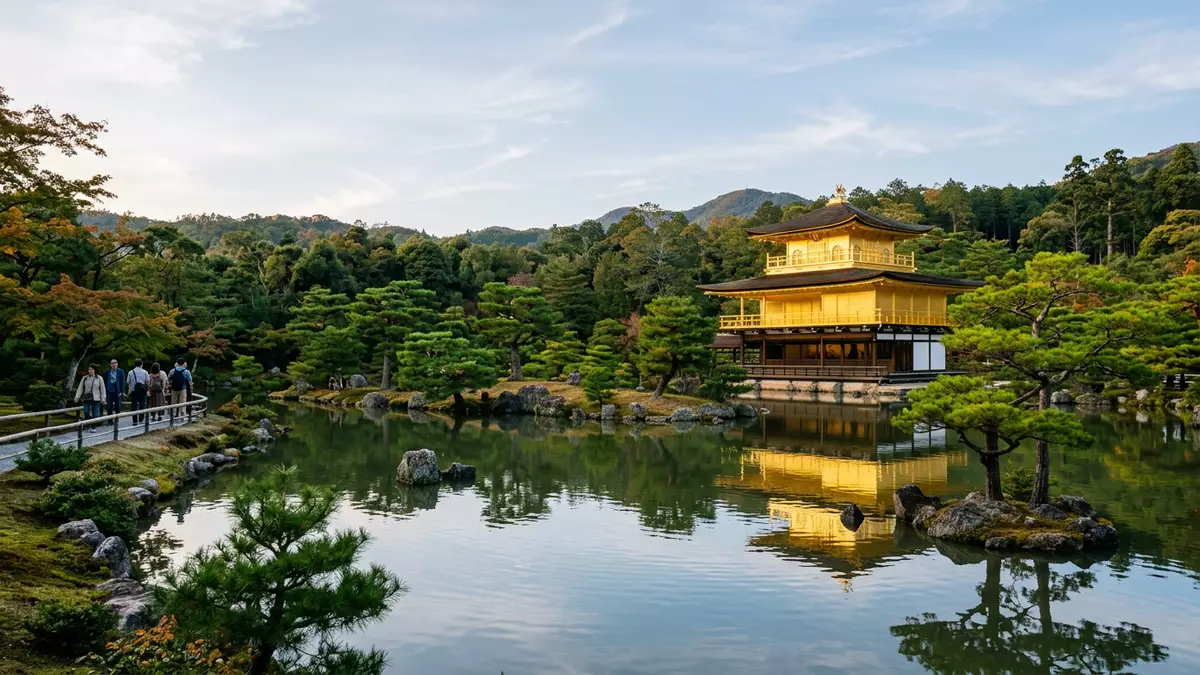
Kinkaku-ji, Kyoto’s Golden Pavilion, rises beside a pond with its upper storeys covered in gold leaf. The pavilion combines courtly, samurai and Zen architectural traditions in one compact building.
Kinkaku-ji beside the reflective pond
The pavilion forms part of Rokuon-ji, a Zen Buddhist temple in northern Kyoto. Its setting includes a pond, wooded slopes, stone arrangements and carefully composed garden views.
The building stands above the water on timber supports. Gold leaf covers the upper storeys, while the lower level remains open and visually lighter. A phoenix ornaments the roof ridge, adding a small vertical accent to the pavilion’s low profile.
From Ashikaga Yoshimitsu’s villa to Rokuon-ji
In 1397, Ashikaga Yoshimitsu, the third shogun of the Ashikaga shogunate, acquired the property and developed it as the Kitayama villa. The site belonged to the Muromachi period, when military government, court culture and Zen Buddhism shaped Kyoto’s arts.
After Yoshimitsu’s death in 1408, the villa became a Zen temple according to his will. Kinkaku-ji is part of the Historic Monuments of Ancient Kyoto, inscribed on the World Heritage list in 1994. The pavilion was destroyed by fire in 1950 and reconstructed in 1955, giving the visible building a twentieth-century structure within a medieval temple landscape.
Three architectural languages in one pavilion
Each storey presents a different architectural vocabulary. The first uses shinden-zukuri, associated with aristocratic residences of the Heian period. The second follows buke-zukuri, linked with samurai houses. The top storey adopts Chinese-influenced Zen architecture.
This vertical arrangement makes Kinkaku-ji readable as a layered history of Japanese design. The pavilion’s name refers to its golden appearance, while its official temple name, Rokuon-ji, means Deer Garden Temple.
Visiting Kinkaku-ji: what travellers from Western Europe should know
- Kinkaku-ji is in Kita-ku, northern Kyoto. Kyoto City Bus routes serve the Kinkakuji-michi stop, and the temple address is 1 Kinkakuji-cho.
- The visit follows a garden route with views towards the pavilion and pond. The Golden Pavilion itself is viewed from outside.
- The official language is Japanese and the currency is the Japanese yen.
Searching for Kinkaku-ji on social platforms
These links open searches for Kinkaku-ji on each platform.
Frequently asked questions about Kinkaku-ji
Where is Kinkaku-ji?
Kinkaku-ji is in Kita-ku, northern Kyoto, Japan. It forms part of the Rokuon-ji temple complex.
What can visitors expect at Kinkaku-ji?
The route passes through landscaped grounds and offers exterior views of the Golden Pavilion beside its pond. The pavilion’s interior is not part of the public view.
What makes Kinkaku-ji distinctive?
Its upper storeys are covered in gold leaf, and its three levels express shinden, samurai and Zen architectural traditions. The pavilion combines these forms within a single building beside the water.


