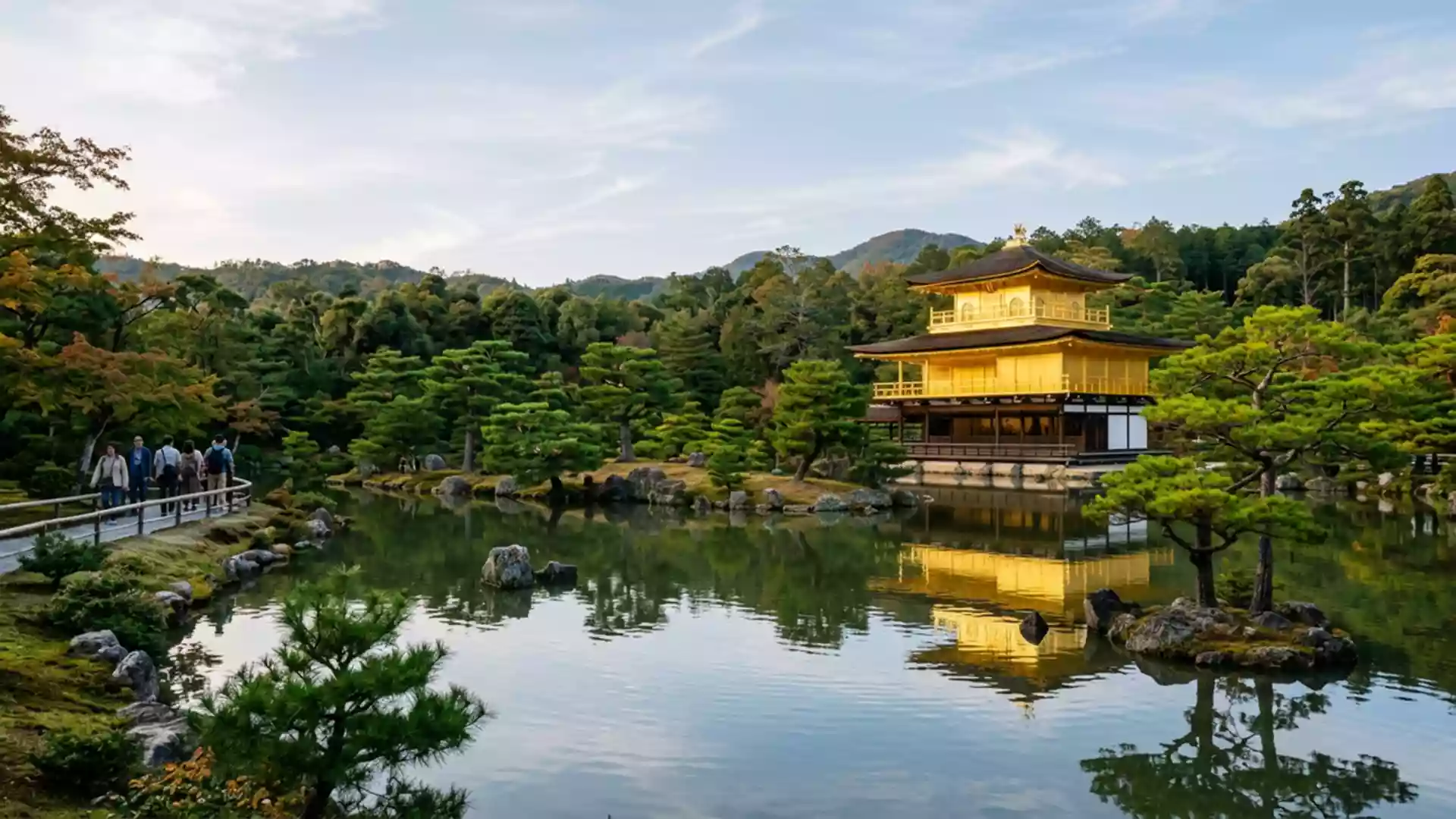
Kinkaku-ji and the glow of gold over water
Published on 09/09/2026 at 12:38 | Editorial responsibility: Rafael Müller, Editor-in-Chief AD HOC NEWS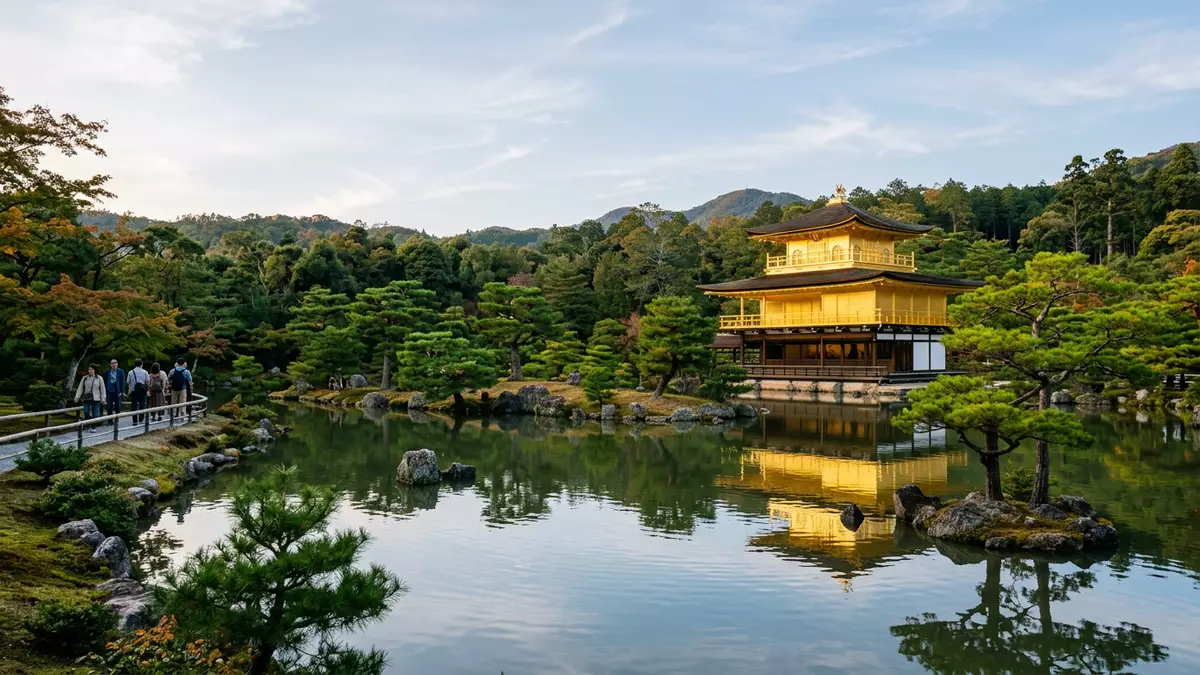
Kinkaku-ji in Kyoto, formally known as Rokuon-ji, is a Zen Buddhist temple where a golden pavilion rises above a reflecting pond and landscaped grounds, bringing architecture, water and garden into a single composition that visitors trace on foot.
The Golden Pavilion and its mirrored setting
The centrepiece of Kinkaku-ji is the Golden Pavilion, a three-storey structure whose upper levels are covered in gold leaf and reflected in the pond at its base.Golden Pavilion The pavilion stands on the edge of the water, with its image falling across the surface alongside small islands, stones and carefully placed trees that form part of the temple garden.pond-side setting The play between the gilded walls, the timber structure beneath and the muted colours of the garden makes the building appear different as visitors move around the shoreline.
The pavilion’s three levels follow distinct architectural traditions drawn from successive periods of Japanese history. The ground floor is associated with shinden-zukuri, a style linked to aristocratic residences of the Heian period, and opens towards the pond with wide bays and verandas.Heian-period residence style Above it, the second floor uses elements of buke-zukuri, a style connected with samurai houses, while the third floor draws on karay?, a Chinese-influenced temple style that appears in Zen architecture.three different styles Only the upper floors are clad in gold leaf, so the base reads more clearly as timber, supporting the brighter volumes above and giving the facade a layered character.
From shogun’s villa to Zen Buddhist temple
Kinkaku-ji’s story reaches back to the late thirteenth and fourteenth centuries and the politics of medieval Japan. The site began as a villa associated with the Saionji family in the early thirteenth century, before passing into the hands of Ashikaga Yoshimitsu, the third shogun of the Ashikaga shogunate, in 1397.Ashikaga Yoshimitsu in 1397 Yoshimitsu developed the grounds as his retirement residence, placing the pavilion by the water and arranging the garden as a setting for both contemplation and display.
Following Yoshimitsu’s death in 1408, the complex became a Rinzai Zen Buddhist temple under the name Rokuon-ji, linking it to the Shokoku-ji branch of the Rinzai school.Rinzai Zen Buddhist temple The temple’s status later came to be recognised formally: it is part of the group of Historic Monuments of Ancient Kyoto that were inscribed on the UNESCO World Heritage List in 1994 and is recorded in Japan as a National Special Historic Site and Special Place of Scenic Beauty.Historic Monuments of Ancient Kyoto The present pavilion is a reconstruction from the mid-twentieth century, completed in 1955 after an earlier building on the site was destroyed by fire, and continues the same three-level form, gold cladding and lakeside placement.reconstruction completed in 1955
Gardens, paths and details around the pond
The experience of Kinkaku-ji extends beyond the pavilion itself into the surrounding stroll garden, which visitors follow on a set route. Paths wind through trees and past viewpoints where the pavilion appears between branches or across the water from different angles, letting its reflection combine with the outlines of pines, stones and small promontories within the pond.stroll garden route Further into the grounds, smaller buildings such as a teahouse and former priest’s quarters stand among the planting, giving a sense of how the temple complex functions as more than a single structure.teahouse and garden structures
The pond, known as Ky?ko-chi or Mirror Pond, is irregular in outline and includes islands associated with classical Chinese and Japanese gardening symbolism.Mirror Pond Stone lanterns, bridges and carefully pruned trees are placed so that individual features are picked out against the water as visitors progress around the circuit. The combination of garden elements with the gilded architecture makes Kinkaku-ji read as a compact summary of several centuries of design in Japan, set on the edge of Kyoto’s northern hills.
Visiting Kinkaku-ji: what travellers from Western Europe should know
- Kinkaku-ji stands in the Kita ward of northern Kyoto, with the temple entrance reached from city bus routes that stop at Kinkakuji-michi and other nearby stops.
- The visit follows a fixed walking route on prepared paths that loop around the pond and through the garden, including gentle gradients and some steps.
- The surrounding district includes other temples of the Shokoku-ji network and residential streets, so Kinkaku-ji can be combined with further temple visits in northern Kyoto.
- The official language is Japanese and the currency is the yen.
- Entry requirements depend on your nationality; UK travellers can check the FCDO travel advice at gov.uk/foreign-travel-advice, Irish travellers the Department of Foreign Affairs at ireland.ie.
Searching for Kinkaku-ji on social platforms
These links open searches for Kinkaku-ji on each platform.
Frequently asked questions about Kinkaku-ji
Where is Kinkaku-ji located?
Kinkaku-ji is a Zen Buddhist temple in the Kita ward of Kyoto, in the northern part of the city, set against foothills and reached by city buses.
What should visitors expect during a visit?
Visitors walk along a one-way route through the grounds, viewing the Golden Pavilion from several angles around the pond and passing garden features, smaller buildings and a teahouse.
What makes Kinkaku-ji distinctive among Kyoto’s temples?
The combination of a pavilion with upper floors covered in gold leaf, the Mirror Pond and a garden route that reveals three historical architectural styles gives Kinkaku-ji a character closely associated with Kyoto.