
Kinkaku-ji and its golden reflection in Kyoto
Published on 09/16/2026 at 07:42 | Editorial responsibility: Rafael Müller, Editor-in-Chief AD HOC NEWS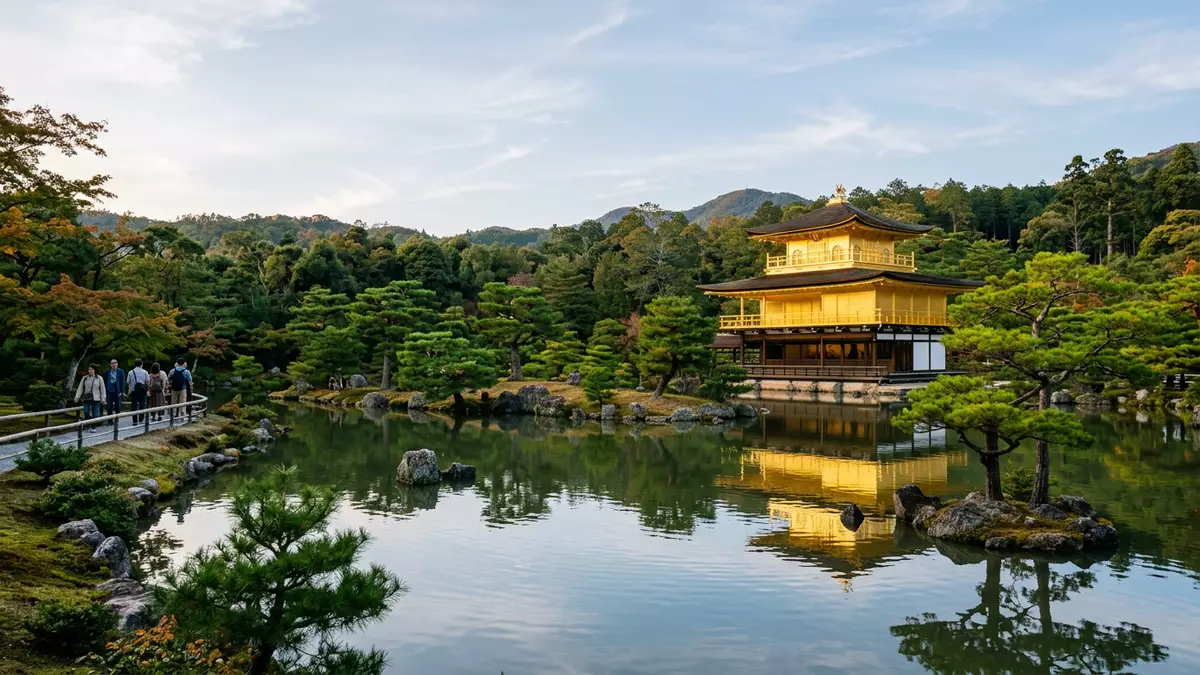
Kinkaku-ji in Kyoto, officially known as Rokuon-ji, centres on a Golden Pavilion that rises beside a reflective pond, binding Zen architecture and landscape into one composed scene from the late fourteenth century.
The Temple of the Golden Pavilion and its setting
Kinkaku-ji is a Zen Buddhist temple of the Rinzai school in Kyoto, with the popular name derived from its Golden Pavilion that dominates the temple grounds.Zen Buddhist temple The temple stands in Kinkakuji-cho in Kita-ku, in the north-western part of Kyoto, a district historically associated with hilly terrain and villa estates.Kinkakuji-cho in Kita-ku The pavilion itself is positioned at the edge of a garden pond, arranged so that its gilded surfaces and tiered roofs are reflected in the water, a view that has become one of Japan’s most recognisable temple images.
The temple belongs to the Shokoku-ji branch of the Rinzai sect, linking it to a wider network of Zen institutions in Kyoto that shaped religious and artistic life in the medieval period.Shokoku-ji branch of the Rinzai sect The official name Rokuon-ji, meaning “Deer Garden Temple”, reflects its status within this network, while the name Kinkaku-ji, “Temple of the Golden Pavilion”, foregrounds the structure that visitors most immediately encounter.officially named Rokuon-ji In 1994 Kinkaku-ji was included among the Historic Monuments of Ancient Kyoto on the UNESCO World Heritage list, a recognition that formalised its cultural and historical significance at international level.Historic Monuments of Ancient Kyoto
Ashikaga Yoshimitsu’s villa and its transformation
The origins of Kinkaku-ji lie in the late Muromachi period, when the shogun Ashikaga Yoshimitsu established a villa on the site in 1397.built in 1397 Yoshimitsu’s residence combined aristocratic domestic architecture with religious symbolism, reflecting the close ties between warrior rule and cultured display in the late fourteenth century. After Yoshimitsu’s death in 1408 the villa was converted into a temple, becoming Rokuon-ji and adopting the structure and rituals of a Rinzai Zen institution.converted into a Zen temple after his death in 1408 This shift from private villa to temple fixed Kinkaku-ji’s dual identity: a place of religious practice embedded in a setting shaped by courtly taste.
The pavilion that gives Kinkaku-ji its name has not survived unchanged from Yoshimitsu’s time. The original structure was destroyed by fire in 1950 and rebuilt in the mid-1950s, following its historical form and position beside the pond.destroyed by fire in 1950 and rebuilt The present pavilion therefore stands as a reconstruction that honours the medieval design while using twentieth-century craftsmanship to restore the gilded surfaces and timber frame. In 1987 the gold leaf on the upper storeys was renewed, sharpening the contrast between the pavilion and the surrounding garden and hills.gold leaf renewed in 1987
Architecture, gold leaf and garden composition
The Golden Pavilion at Kinkaku-ji is a three-storey timber structure that combines distinct Japanese architectural styles from different periods in one building.three distinct Japanese architectural styles The ground floor follows the shinden-zukuri style associated with the Heian period, a palace layout with open bays and a close relationship to the surrounding garden.shinden-zukuri style of the Heian period The middle floor draws on buke-zukuri, the style of warrior residences, while the upper floor reflects elements of Zen temple architecture. Together these levels stack courtly, military and religious forms into one vertical composition.
The upper storeys are covered in gold leaf on lacquer, giving the pavilion its striking appearance and catching light in different ways across the day.top two floors covered in gold leaf A phoenix figure crowns the roof, a motif associated with auspicious power and imperial imagery.phoenix ornament on the roof Below, the pavilion is ringed by balconies and walkways, projecting over the pond so that the building and its reflection form a near-continuous image. The surrounding garden uses stones, small islands and carefully placed trees to frame this view, an arrangement that reflects established principles of Japanese strolling gardens.
Visiting Kinkaku-ji: what travellers from Western Europe should know
- Kinkaku-ji stands in the north-west of Kyoto in Kinkakuji-cho, Kita-ku. It is reached from central Kyoto by city buses that stop at Kinkakuji-michi, followed by a short walk through a built-up district.
- The temple grounds follow a fixed path that leads around the pond and through garden areas. Surfaces are mainly compacted earth and stone, with some sections on gentle slopes and several staircases linking different levels.
- Beyond the main viewing points around the Golden Pavilion, the route passes smaller halls and tea-house structures. These are set among trees and stone arrangements that give a sense of a layered temple complex rather than a single building.
- The official language is Japanese and the currency is the yen. Entry requirements depend on your nationality; UK travellers can check the FCDO travel advice at gov.uk/foreign-travel-advice, Irish travellers the Department of Foreign Affairs at ireland.ie.
Searching for Kinkaku-ji on social platforms
These links open searches for Kinkaku-ji on each platform.
Frequently asked questions about Kinkaku-ji
Where is Kinkaku-ji located within Kyoto?
Kinkaku-ji is in Kinkakuji-cho in Kita-ku, the north-western part of Kyoto, set among modest urban streets at the foot of low hills.
What should visitors expect on a visit to Kinkaku-ji?
Visitors follow a set route through the temple grounds, with key viewpoints of the Golden Pavilion across the pond and further garden and hall areas beyond.
What makes Kinkaku-ji distinctive among Kyoto temples?
The combination of a three-storey pavilion covered in gold leaf, its reflection in the pond and the blend of Heian palace and Zen architectural styles gives Kinkaku-ji a particular character.


