
Kinkaku-ji and its golden reflection in Kyoto
Published on 08/19/2026 at 17:51 | Editorial responsibility: Rafael Müller, Editor-in-Chief AD HOC NEWS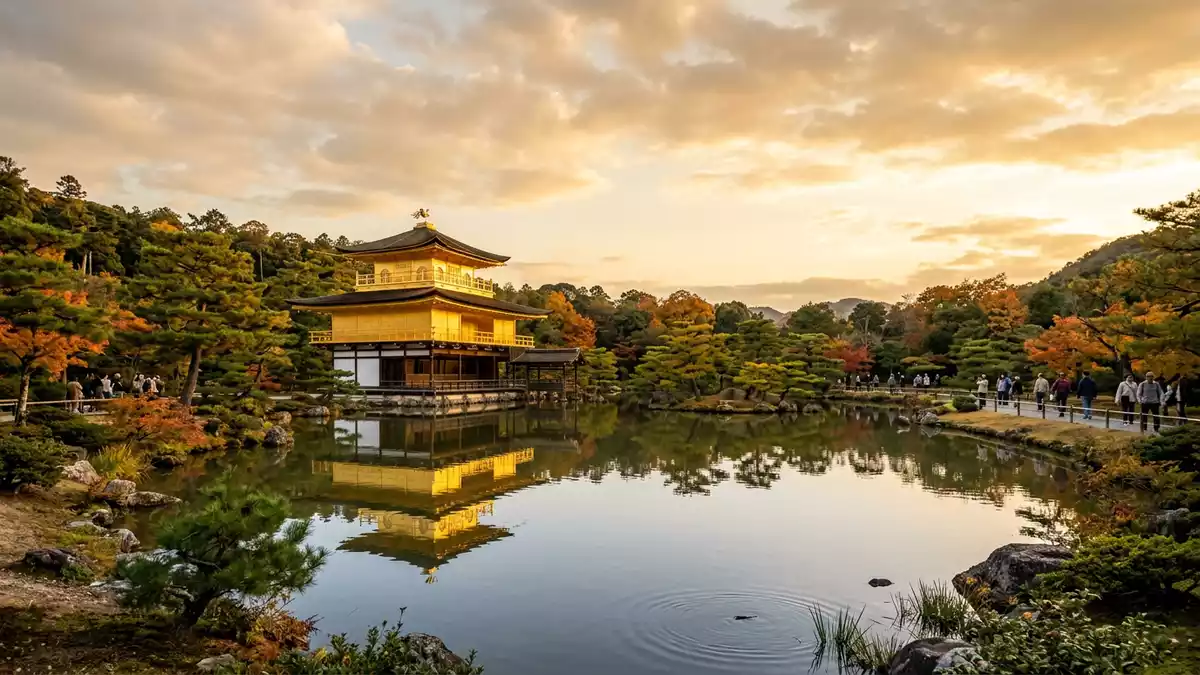
Kinkaku-ji, the “Temple of the Golden Pavilion”, brings together gilded architecture, reflective water and carefully framed greenery in the northern part of Kyoto. The pavilion’s golden upper storeys, mirrored in the surrounding pond, sit within the precincts of Rokuon-ji, a Rinzai Zen Buddhist temple whose origins reach back to the late fourteenth century.
A golden pavilion beside the mirror pond
The focus at Kinkaku-ji is a three-storey pavilion that rises beside a broad garden pond, its upper levels covered in gold leaf that catches the light against the dark timber beneath. The building’s popular name, Golden Pavilion, refers to this gilding, which distinguishes it from the other halls and structures within the Rokuon-ji precinct. The pavilion stands on the edge of Ky?ko-chi, often translated as Mirror Pond, whose islands and inlets are arranged to hold the reflection of the structure and the surrounding trees.Golden Pavilion beside Ky?ko-chi The scene that visitors recognise from photographs is therefore not only the building itself, but also its reflection framed by water, stone and planting.
The official name of the temple complex is Rokuon-ji, sometimes rendered as “Deer Garden Temple”, and Kinkaku-ji is one of its branch sites in the Rinzai Zen tradition linked to Shokoku-ji.Rokuon-ji as a Rinzai Zen temple The pavilion that draws visitors began as part of a villa and garden estate, later incorporated into the religious complex and given the role of housing sacred relics of the Buddha. Its three levels show distinct architectural styles associated with courtly residences, warrior dwellings and Zen worship spaces, expressed vertically in one structure beside the pond.Three architectural styles in one pavilion
From shogunal villa to Zen temple complex
The site that became Kinkaku-ji was first developed as a mountain villa in the Kitayama district of Kyoto, and entered the history of Japan’s military rulers when Ashikaga Yoshimitsu, the third shogun of the Ashikaga shogunate, acquired it in the late fourteenth century.Ashikaga Yoshimitsu’s retirement villa Around 1397, Yoshimitsu began building his retirement estate here, including the pavilion by the pond, combining residence and garden in the hills north-west of central Kyoto. After his death in 1408 the pavilion and grounds were converted into a Zen Buddhist temple complex, with the name Rokuon-ji taken from his Buddhist name, and the function shifting from private retreat to religious site.
Kinkaku-ji forms part of a wider group of sites known collectively as the Historic Monuments of Ancient Kyoto, which were inscribed on the UNESCO World Heritage List in the 1990s.Historic Monuments of Ancient Kyoto Within Japan, the temple is recognised as a National Special Historic Site and a Special Place of Scenic Beauty, formal statuses that reflect both its role in Muromachi-period history and the designed landscape around the pond. While much of the wider complex has seen damage and reconstruction over the centuries, the present Golden Pavilion, rebuilt in the mid-twentieth century, continues to express the layered styles and gilded surfaces that define the site’s appearance.
Gardens, paths and viewing points around the pavilion
A visit to Kinkaku-ji unfolds along a fixed route that follows garden paths around Ky?ko-chi and through the wooded grounds, presenting the pavilion and pond from a succession of angles. On the first stretch, the path runs opposite the Golden Pavilion, with clear viewpoints where the building rises across the water and its reflection meets the shapes of stone lanterns, low islands and clipped shrubs. Further along, the route gains elevation slightly, giving oblique views where the pavilion appears partly screened by pine branches and other trees.
Beyond the pond, the grounds contain smaller garden features, stone basins, lanterns and subsidiary halls that belong to the Rokuon-ji temple complex, set among slopes and planting characteristic of Kyoto’s northern hills.Kinkaku-ji temple grounds in Kita-ku The composition ties the Golden Pavilion to its landscape, with the structure rising at the water’s edge and paths leading visitors through viewpoints that alternately reveal and partially conceal it. The sense of progression through garden and temple buildings, and the repeated pairing of gilded architecture with water and stone, make the circuit as much about the setting as about the pavilion itself.
Visiting Kinkaku-ji: what travellers from Western Europe should know
- Kinkaku-ji stands in Kinkakuji-ch? in Kita-ku, in the north-western part of Kyoto, and is reached from Kyoto Station and the city centre by local buses that stop near the temple precincts.
- The temple grounds are arranged as a circuit on firm paths around the pond, with gentle gradients and several flights of outdoor steps linking different viewing levels and garden areas.
- Kinkaku-ji lies within a built-up district backed by low hills, and the approach from the nearest bus stops involves a short walk along urban streets before reaching the gate and inner gardens.
- The official language is Japanese and the currency is the yen.
- Entry requirements depend on your nationality; UK travellers can check the FCDO travel advice at gov.uk/foreign-travel-advice, Irish travellers the Department of Foreign Affairs at ireland.ie.
Searching for Kinkaku-ji on social platforms
These links open searches for Kinkaku-ji on each platform.
Frequently asked questions about Kinkaku-ji
Where is Kinkaku-ji located within Kyoto?
Kinkaku-ji stands in Kinkakuji-ch? in Kita-ku, the northern ward of Kyoto, in the Kitayama district at the edge of the city’s low hills.
What can visitors expect when walking through Kinkaku-ji?
Visitors follow a set route on garden paths around the pond, viewing the Golden Pavilion and its reflection from several points, then passing smaller temple buildings and landscaped features.
What makes Kinkaku-ji distinctive among Kyoto’s temples?
Kinkaku-ji is distinguished by its gilded three-storey pavilion beside Ky?ko-chi, combining courtly, warrior and Zen architectural styles and reflecting in a carefully composed pond and garden.


