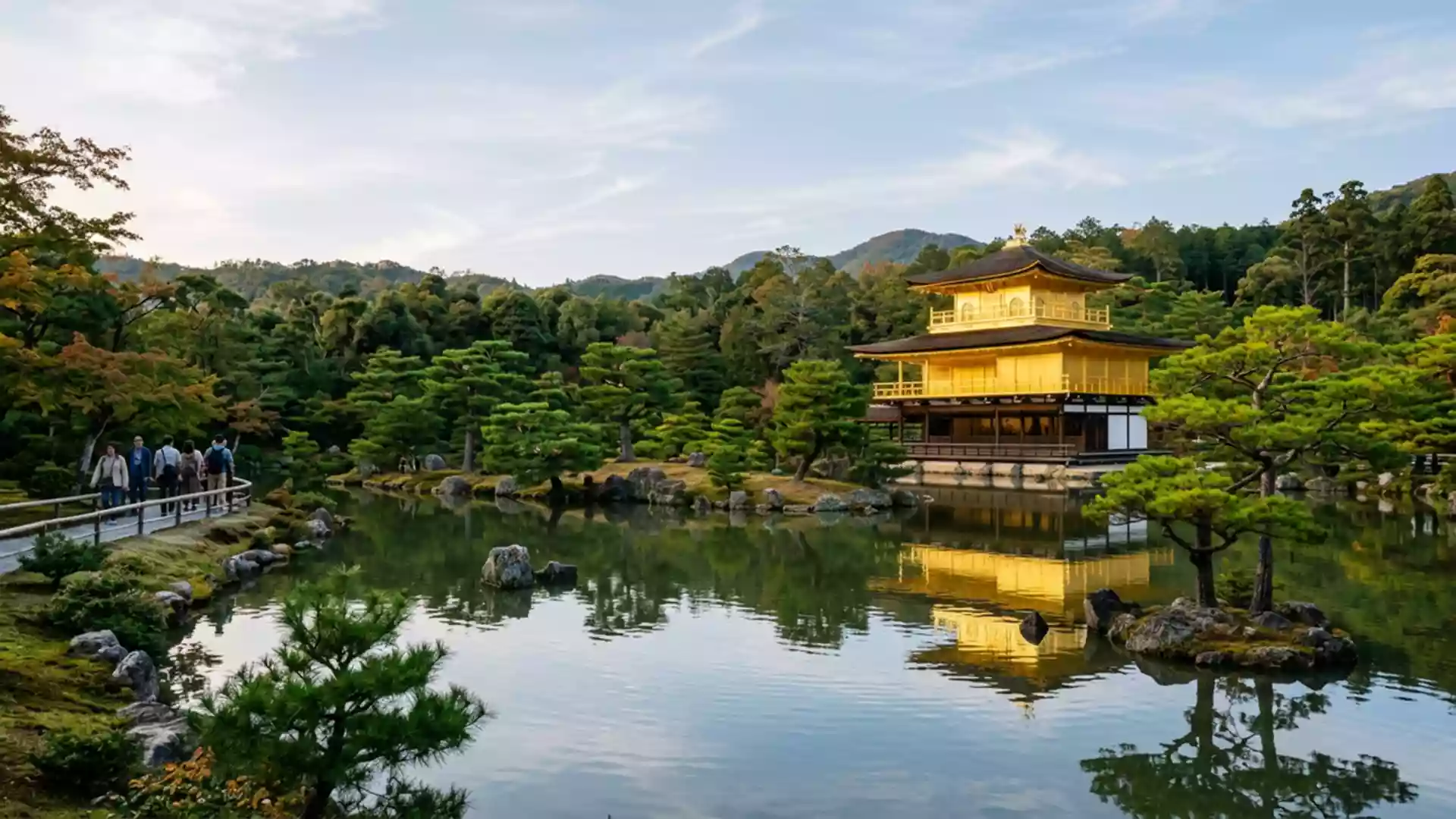
Kinkaku-ji and its golden pavilion reflected in water
Published on 09/11/2026 at 17:56 | Editorial responsibility: Rafael Müller, Editor-in-Chief AD HOC NEWS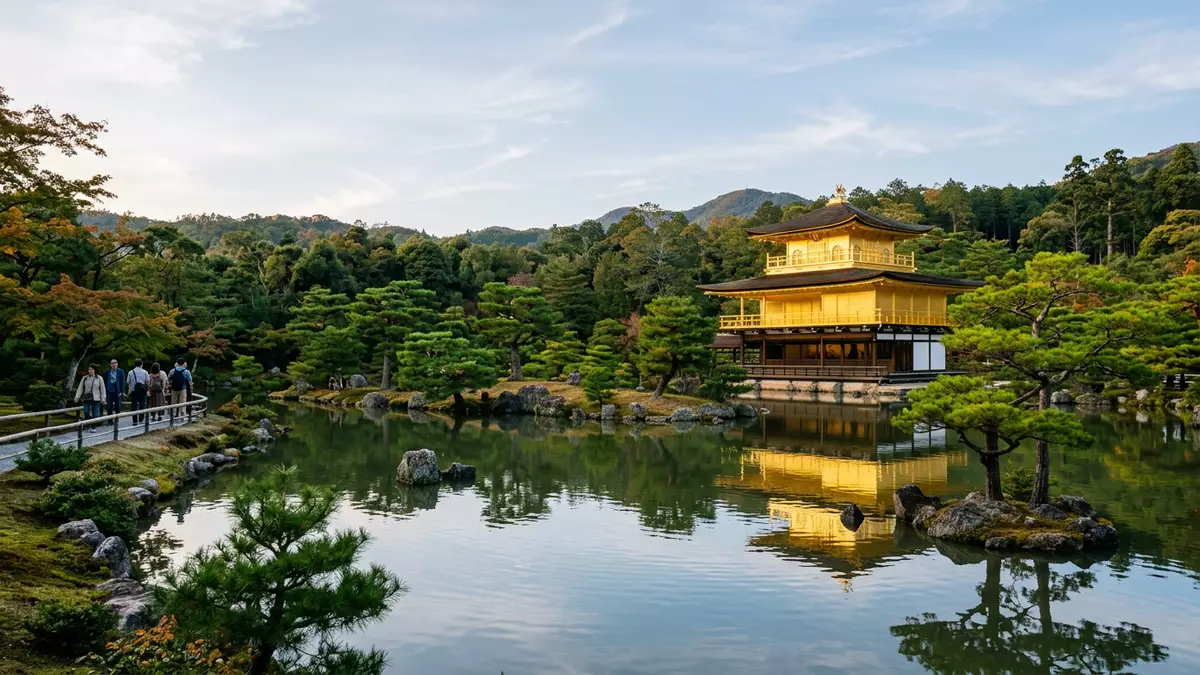
Kinkaku-ji in Kyoto brings together architecture, water and greenery around a single golden pavilion whose surfaces catch the light above a landscaped pond. The temple complex belongs to the Rinzai Zen tradition and is formally known as Rokuon-ji, a name that points to its origin as a garden retreat before it became a place of worship.
The Golden Pavilion in its Muromachi-period setting
The structure widely associated with Kinkaku-ji is a three-storey pavilion known as Kinkaku, standing at the edge of a pond within a garden in Kyoto’s Kitayama district.Kinkakuji Temple in Kyoto It forms part of a temple that was first built in 1397 as the retirement residence of the shogun Ashikaga Yoshimitsu, during the Muromachi period when Kyoto served as the political centre of Japan.founded in 1397 by Ashikaga Yoshimitsu After Yoshimitsu’s death in the early fifteenth century the residence was converted into a Zen Buddhist temple and given the formal name Rokuon-ji, while the popular name Kinkaku-ji derives from the Golden Pavilion itself.
The pavilion’s three levels combine different historical building styles stacked above one another, a characteristic feature of Muromachi-period design that balances courtly, warrior and religious architecture.masterful exemplar of architecture in the Muromachi period The first storey, known as Hossui-in or “Chamber of Dharma Waters”, follows the shinden-zukuri pattern associated with Heian-period palaces, with a relatively open plan beside the pond. Above it sits a second level referred to as Cho’on-do, designed in the buke-zukuri style that recalls the residences of samurai families, while the top floor adopts the forms of Chinese-style Zen temples and carries the name Kukkyo-cho. Linking these levels is a timber structure whose upper parts are finished with lacquer and gold leaf, bringing a uniform surface to a composition that otherwise reflects distinct architectural traditions.
Gold leaf, phoenix and water: materials and motifs
The Golden Pavilion is defined visually by the precious metal that covers its upper storeys, with pure gold leaf applied over lacquered surfaces on the second and third levels.top two floors are completely covered in gold leaf The roof above them is laid with thin planks of sawara cypress, creating a textured surface that contrasts with the smooth gilded walls below.roof is shingled with countless planks of thin sawara cypress At the ridge stands a statue of a phoenix, a motif associated with auspiciousness in Chinese-influenced art, which crowns the building and marks its silhouette against the sky.
The pavilion is set beside a pond known as Kyoko-chi, and its gilded surfaces are reflected in the water, tying the architecture directly into the garden composition.emphasized the natural landscape as opposed to the building itself Stones, small islands and carefully placed trees shape the view across the water towards the pavilion, a layout that corresponds with Muromachi interest in integrating built forms into a larger landscape. Around the pond the grounds include paths and viewpoints from which the building can be seen from different angles, each presenting another relationship between gold leaf, timber and planting. The combination of materials and reflections is one of the temple’s most recognisable features, and it is reinforced by the way the golden surfaces rise above a darker ground level.
From shogun’s villa to World Heritage temple
Kinkaku-ji began as Kitayama-dono, a villa conceived as a retirement retreat for Ashikaga Yoshimitsu, and only later took on the full character of a temple complex.retirement residence of the shogun Ashikaga Yoshimitsu The conversion into a Rinzai Zen temple followed his death in 1408 and gave the site an institutional religious role while maintaining much of its original garden layout. Over the centuries the complex experienced damage during conflict, including the ?nin War of the late fifteenth century, and later through an arson attack in 1950 that destroyed the Golden Pavilion itself.destroyed by arson and rebuilt in 1955 The pavilion standing beside the pond today is a reconstruction completed in 1955, based closely on the historical design, including the three blended storeys and the phoenix on the roof.
The wider temple belongs to the Shokoku-ji branch of the Rinzai Zen sect and forms part of the group of sites known as the Historic Monuments of Ancient Kyoto, which were inscribed on the UNESCO World Heritage List in 1994.Historic Monuments of Ancient Kyoto Within Japan the temple is recognised as a National Special Historic Site and a Special Place of Scenic Beauty, designations that reflect both its historical significance and the visual quality of its garden setting.National Special Historic Site and Special Place of Scenic Beauty These formal titles sit alongside its everyday identity as Kinkaku-ji, a name taken from the Golden Pavilion and widely used for the entire complex.
Visiting Kinkaku-ji: what travellers from Western Europe should know
- Kinkaku-ji stands in Kinkakuji-ch? in Kita-ku, in the north-western part of Kyoto, and local city buses stop at Kinkakuji-michi near the temple entrance.
- Paths around the pond are on level ground but include sections of compacted earth and stone; the route through the garden involves walking on foot without seating for extended stretches.
- The official language is Japanese and the currency is the yen.
- Entry requirements depend on your nationality; UK travellers can check the FCDO travel advice at gov.uk/foreign-travel-advice, Irish travellers the Department of Foreign Affairs at ireland.ie.
Searching for Kinkaku-ji on social platforms
These links open searches for Kinkaku-ji on each platform.
Frequently asked questions about Kinkaku-ji
Where is Kinkaku-ji located in Kyoto?
Kinkaku-ji stands in Kinkakuji-ch? in Kita-ku, the north-western district of Kyoto, in the hilly Kitayama area above the city’s central plain.
What can visitors expect when walking through Kinkaku-ji?
Visitors follow a one-way path around a pond and through landscaped grounds, seeing the Golden Pavilion from changing angles as it reflects in the water and rises above planted banks.
What makes Kinkaku-ji distinctive among Kyoto’s temples?
Kinkaku-ji is distinguished by its three-storey Golden Pavilion with mixed architectural styles, gilded upper levels, phoenix-topped roof and its setting beside a reflective pond within a Muromachi-period garden.