
Kilimanjaro and the volcanic summit above Moshi
Published on 09/24/2026 at 01:20 | Editorial responsibility: Rafael Müller, Editor-in-Chief AD HOC NEWS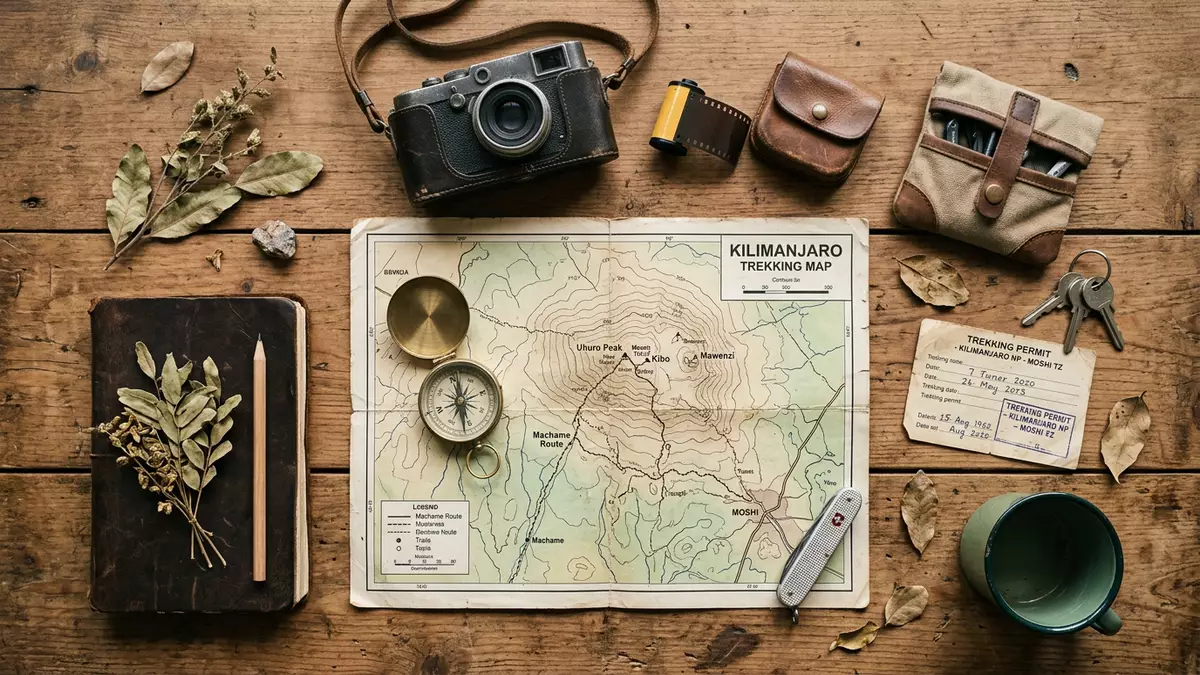
Kilimanjaro rises above Moshi as a broad volcanic massif, its summit reaching 5,895 m (19,341 ft) above sea level. The mountain’s visible drama lies in the change of landscape: cultivated lower slopes, forest, open alpine ground and the high summit of Kibo occupy one ascent.
Kilimanjaro’s three volcanic cones
Kilimanjaro is formed by Kibo, Mawenzi and Shira, three volcanic cones within one massif. Kibo holds Uhuru Peak, the highest point in Africa, while Mawenzi forms a sharply eroded eastern summit with ridges and pinnacles.
Shira lies to the west as a broad high plateau associated with an older volcanic cone. The massif rises about 4,877 m (16,000 ft) above the surrounding plains, giving the mountain a distinct profile above northern Tanzania. Its summit is part of Kilimanjaro National Park, which covers the mountain and its surrounding natural zones.
From cultivated slopes to alpine ground
The lower mountain is linked with the agricultural landscape around Moshi. Chaga communities cultivate bananas, coffee and other crops on the southern and eastern slopes, where streams descend from the mountain’s higher zones.
Above the cultivated belt, the landscape changes into montane forest, heath and high moorland. The upper slopes contain volcanic rock, sparse vegetation and wide views across the plains. At the summit, Kibo’s crater and the remaining ice fields form a stark high-altitude environment.
Kilimanjaro’s geological identity is that of a giant stratovolcano. Major volcanic activity belongs to the Pleistocene, while the mountain’s three cones preserve different stages of volcanic formation. Mawenzi reaches 5,149 m (16,893 ft), creating a rugged counterpoint to Kibo’s summit dome.
Uhuru Peak above Moshi
Moshi lies at the southern foot of Kilimanjaro and functions as a base for journeys onto the mountain. The town’s position gives the climb a clear geographical beginning, with roads and cultivated land leading towards the forested lower slopes.
The mountain became known in European records after German missionaries saw it in 1848. Hans Meyer, Ludwig Purtscheller and their local guides reached Kibo’s summit in 1889. The climb belongs to the late nineteenth-century history of European exploration in East Africa, while the mountain remains inseparable from the communities living around its base.
The summit landscape is divided between Kibo’s crater area and Uhuru Peak. At 5,895 m (19,341 ft), Uhuru Peak is the highest point in Africa, a fact also recorded in the UNESCO description of Kilimanjaro. The mountain’s scale is visible in the long succession of ecological zones below it.
Visiting Kilimanjaro: what travellers from Western Europe should know
- Kilimanjaro stands in north-eastern Tanzania, south-west of the Kenyan border and north-east of Moshi. Moshi is the principal town associated with access to the mountain.
- The ascent crosses major changes in altitude, from cultivated foothills and forest to open highland terrain and the summit of Kibo. The final environment is above 5,000 m (16,404 ft).
- Routes use named gates and mountain camps rather than a single road to the summit. Marangu, Machame, Lemosho, Rongai, Umbwe and Shira are established route names.
- The official language is Swahili and the currency is the Tanzanian shilling.
- Entry requirements depend on your nationality; UK travellers can check the FCDO travel advice at gov.uk/foreign-travel-advice, Irish travellers the Department of Foreign Affairs at ireland.ie.
- Conditions on the mountain change with the seasons; the local cable-car operators and alpine clubs provide information.
Searching for Kilimanjaro on social platforms
These links open searches for Kilimanjaro on each platform.
Frequently asked questions about Kilimanjaro
Where is Kilimanjaro?
Kilimanjaro is in north-eastern Tanzania, near the town of Moshi. The mountain rises above the plains close to the Kenyan border.
What does a visit involve?
A visit involves an organised mountain journey across several ecological zones. The terrain changes from cultivated slopes and forest to high volcanic ground and a summit above 5,000 m.
What makes Kilimanjaro distinctive?
Kilimanjaro combines Africa’s highest summit with a three-cone volcanic massif. Kibo, Mawenzi and Shira create a mountain landscape that changes markedly from its base to Uhuru Peak.


