
Kilimanjaro: Africa’s free?standing giant above Moshi
Published on 09/08/2026 at 16:33 | Editorial responsibility: Rafael Müller, Editor-in-Chief AD HOC NEWS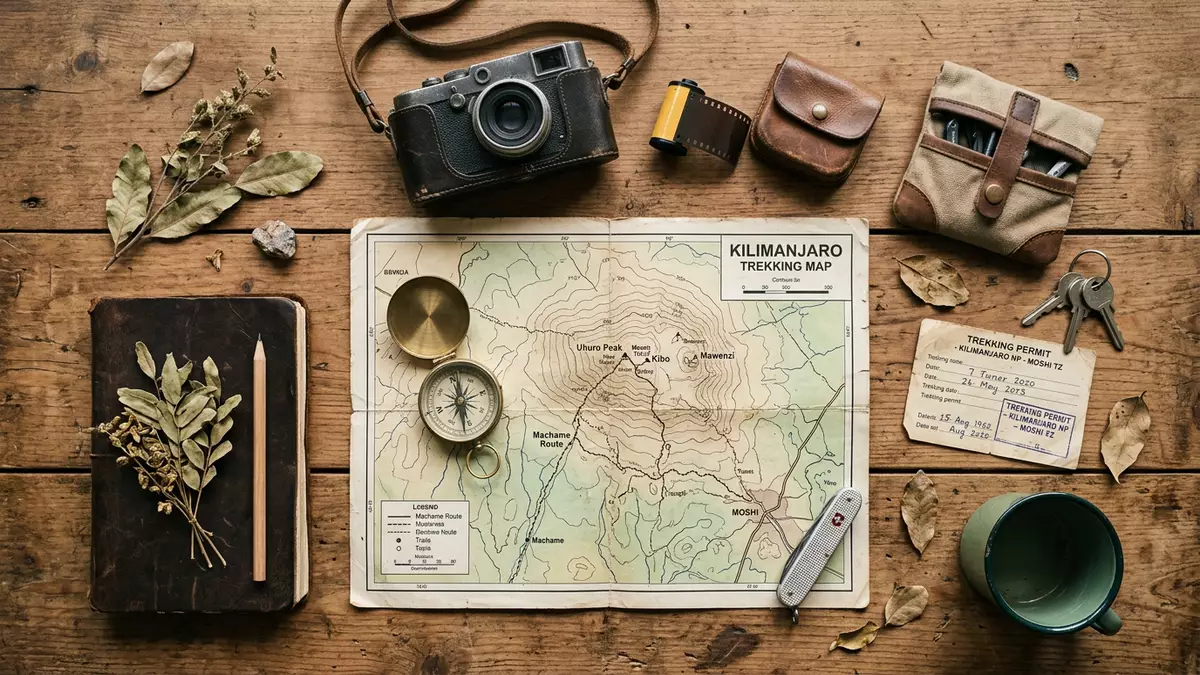
Kilimanjaro rises above the town of Moshi in northern Tanzania as a vast volcanic massif whose summit, Uhuru Peak on the Kibo cone, reaches about 5,895 m (19,341 ft) above sea level.Uhuru Peak on Kibo More than a single peak, it is a broad, ice?tipped mountain standing far above the surrounding plains.
A stratovolcano made of three volcanic cones
Geologically, Kilimanjaro is a stratovolcano built along the southern sector of the East African Rift, formed by eruptions over hundreds of thousands of years.East African Rift setting The massif consists of three principal volcanic cones aligned roughly west to east: Shira, Kibo and Mawenzi.Shira, Kibo and Mawenzi Shira, to the west, is the oldest cone and has been eroded into a high plateau of ancient lava flows. Mawenzi, to the east, forms jagged ridges and pinnacles of deeply eroded volcanic rock. Between them rises Kibo, the youngest cone, whose broad upper slopes lead to the crater rim and the summit area.
The mountain’s internal structure reflects repeated eruptions that built overlapping lava and ash layers. Kilimanjaro’s cones developed during the Pleistocene, with Shira erupting first and Kibo continuing activity long after the earlier structures began to erode.Pleistocene volcanic development Kibo retains a summit caldera several kilometres across, where geothermal vents and fumaroles testify to residual heat deep beneath the surface.summit caldera and fumaroles
Height, isolation and the snows near the equator
Kilimanjaro is widely recognised as the highest mountain in Africa and among the world’s most prominent peaks, reaching 5,895 m (19,341 ft) above sea level.highest point in Africa Its bulk rises roughly 4,900 m (16,100 ft) above the plateau base, forming a free?standing mountain that is not part of any continuous range.free?standing elevation From east to west the volcanic edifice extends for about 80 km (50 miles), dominating views across northern Tanzania.
The mountain stands close to 3° south of the equator yet retains a snow?capped summit, creating a marked contrast between tropical lowlands and high?altitude ice.equatorial position and summit Vegetation zones and terrain change markedly with height: cultivated foothills give way to montane forest, then heather and moorland, and finally alpine desert with loose volcanic scree near the crater rim.vegetation belts and summit area At the very top, ice fields and glaciers cling to the upper slopes around the crater.
Kilimanjaro National Park and Moshi at the mountain’s foot
The mountain and its surrounding forests form Kilimanjaro National Park, which protects the volcanic massif and high?altitude ecosystems.Kilimanjaro National Park The park boundary encloses the upper slopes and summit plateau, while coffee farms and settlements occupy many of the lower foothills. Kilimanjaro’s slopes shed water into rivers that drain towards the plains of northern Tanzania, supporting agriculture and local communities.
Moshi lies at the southern foot of Kilimanjaro and serves as a principal town in the region, with streets and markets set against the backdrop of the mountain’s bulk on clear days.Moshi at the southern foot Roads from Moshi lead towards park entrances and trailheads on the southern and eastern flanks, where approaches climb through forest belts before reaching higher, more open terrain.
Visiting Kilimanjaro: what travellers from Western Europe should know
- Kilimanjaro rises in northern Tanzania near the border with Kenya, with Moshi at its southern foot and regional road links leading from the town towards park gates.
- The ascent routes cross steep volcanic slopes with extended sections on uneven ground and loose scree at higher elevations, demanding steady footing over sustained gradients.
- The official language is Swahili and the currency is the Tanzanian shilling.
- Entry requirements depend on your nationality; UK travellers can check the FCDO travel advice at gov.uk/foreign-travel-advice, Irish travellers the Department of Foreign Affairs at ireland.ie.
Searching for Kilimanjaro on social platforms
These links open searches for Kilimanjaro on each platform.Frequently asked questions about Kilimanjaro
Where is Kilimanjaro?
Kilimanjaro is a volcanic massif in northeastern Tanzania, near the border with Kenya, rising above Moshi and forming part of the East African Rift region.
What should travellers expect on a visit?
Travellers encounter a high volcanic mountain with distinct vegetation belts, steep slopes of lava and ash, and thin air at elevations exceeding 5,000 m (16,404 ft).
What makes Kilimanjaro distinctive among mountains?
Its status as Africa’s highest peak, its free?standing form rising thousands of metres above surrounding plains, and its equatorial snows give Kilimanjaro a distinctive character.


