
Kilimanjaro above Moshi: Africa’s highest free?standing peak
Published on 08/16/2026 at 14:31 | Editorial responsibility: Rafael Müller, Editor-in-Chief AD HOC NEWS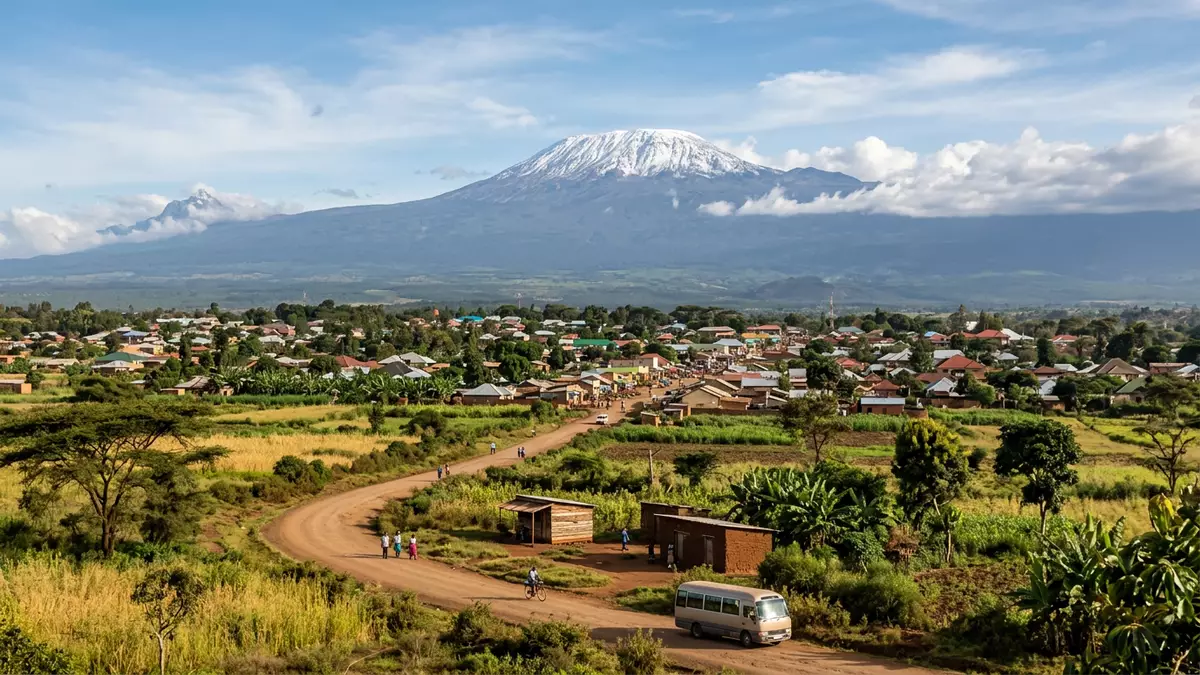
Seen from Moshi on the southern slopes, Kilimanjaro dominates northern Tanzania as a broad volcanic massif crowned with ice, rising far above the plains and coffee fields that surround it. It is the highest mountain in Africa, with its summit at 5,895 m (19,341 ft) above sea level on the cone known as Uhuru Peak on Kibo in the Kilimanjaro range.
A stratovolcano of three distinct summits
Kilimanjaro is a large dormant stratovolcano composed of three separate volcanic cones that together form its broad outline above the Kilimanjaro Region. The central and highest cone is Kibo, whose summit at 5,895 m (19,341 ft) above sea level makes Kilimanjaro the highest single free-standing mountain above sea level on the African continent.Kibo’s elevation The eastern cone, Mawenzi, reaches 5,149 m (16,893 ft), while the western Shira ridge rises to 4,005 m (13,140 ft), giving the mountain a stepped skyline when viewed from different directions.Mawenzi and Shira heights
The mountain stands as a free-standing block above its surrounding plateau, with a prominence of around 4,900 m (16,100 ft) from its base to its summit, which makes its height over local terrain as striking as its altitude above sea level.Free-standing prominence Its flanks carry successive belts of vegetation and volcanic deposits, recording long phases of eruptive activity from the different cones that built the massif.
Moshi and the southern foot of Kilimanjaro
On its southern side, Kilimanjaro rises directly above the town of Moshi, which serves as the regional capital for the Kilimanjaro Region in north-eastern Tanzania.Moshi as regional capital Moshi lies on the lower slopes of the mountain and has developed as a market town among fertile soils fed by runoff from the volcanic massif, with coffee and other crops grown in the surrounding countryside.Town on lower slopes
The town is sometimes described as a gateway to Kilimanjaro because routes and approaches towards the mountain radiate from Moshi and nearby settlements. Roads from Moshi lead north towards the mountain’s southern trailheads and give access to the national park around the volcano. The relationship between town and mountain is close in physical terms: streets and neighbourhoods in Moshi hold open views towards the summit cones, and the outline of Kibo can be seen above the town on clear days.
Established ascent routes on the mountain
Kilimanjaro’s modern trekking geography is structured around named paths that climb through different aspects of the massif, each starting at a specific gate or trailhead on its flanks. There are seven official trekking routes used for ascents and descents: Marangu, Machame, Umbwe, Rongai, Shira, Lemosho and the Northern Circuit, along with the Mweka descent path and Marangu used for descent by some parties.Seven trekking routesNamed ascent paths
These routes start at elevations that lie within or just above the mountain’s forest belt, between roughly 1,600 m and just over 3,400 m above sea level, and then climb through moorland and alpine zones towards the crater rim on Kibo.Trailhead altitudes For example, the Machame route begins at Machame Gate at about 1,640 m (5,380 ft), while the Marangu route begins at Marangu Gate at around 1,843 m (6,047 ft), both of them reached from the southern side of the mountain not far from Moshi.Machame and Marangu gates
Visiting Kilimanjaro: what travellers from Western Europe should know
- Kilimanjaro rises in northern Tanzania above the town of Moshi in the Kilimanjaro Region; Moshi lies on the mountain’s southern slopes and is reached by road from Arusha and other centres.
- The mountain is high and extensive, with approaches to the southern trailheads involving travel on roads that climb from the plains to gates such as Machame and Marangu at mid-altitude.
- The terrain on the volcano includes forest, moorland and high-altitude rocky slopes; paths climb steadily and may involve long sections of walking on uneven ground and loose volcanic material.
- The official language is Swahili and the currency is the Tanzanian shilling.
- Entry requirements depend on your nationality; UK travellers can check the FCDO travel advice at gov.uk/foreign-travel-advice, Irish travellers the Department of Foreign Affairs at ireland.ie.
Searching for Kilimanjaro on social platforms
These links open searches for Kilimanjaro on each platform.Frequently asked questions about Kilimanjaro
Where is Kilimanjaro in relation to Moshi?
Kilimanjaro rises directly above Moshi in north-eastern Tanzania; the town sits on the mountain’s southern slopes in the Kilimanjaro Region.
What kind of landscape surrounds the mountain?
The mountain stands above a plateau with agricultural land and market towns, including Moshi, and its flanks carry belts of forest, moorland and rocky high-altitude terrain.
What makes Kilimanjaro distinctive among African mountains?
Kilimanjaro is the highest mountain in Africa and a free-standing stratovolcano with three main cones, Kibo, Mawenzi and Shira, rather than a single ridge in a larger range.


