
Kilimanjaro above Moshi: Africa’s great free?standing volcano
Published on 08/28/2026 at 11:41 | Editorial responsibility: Rafael Müller, Editor-in-Chief AD HOC NEWS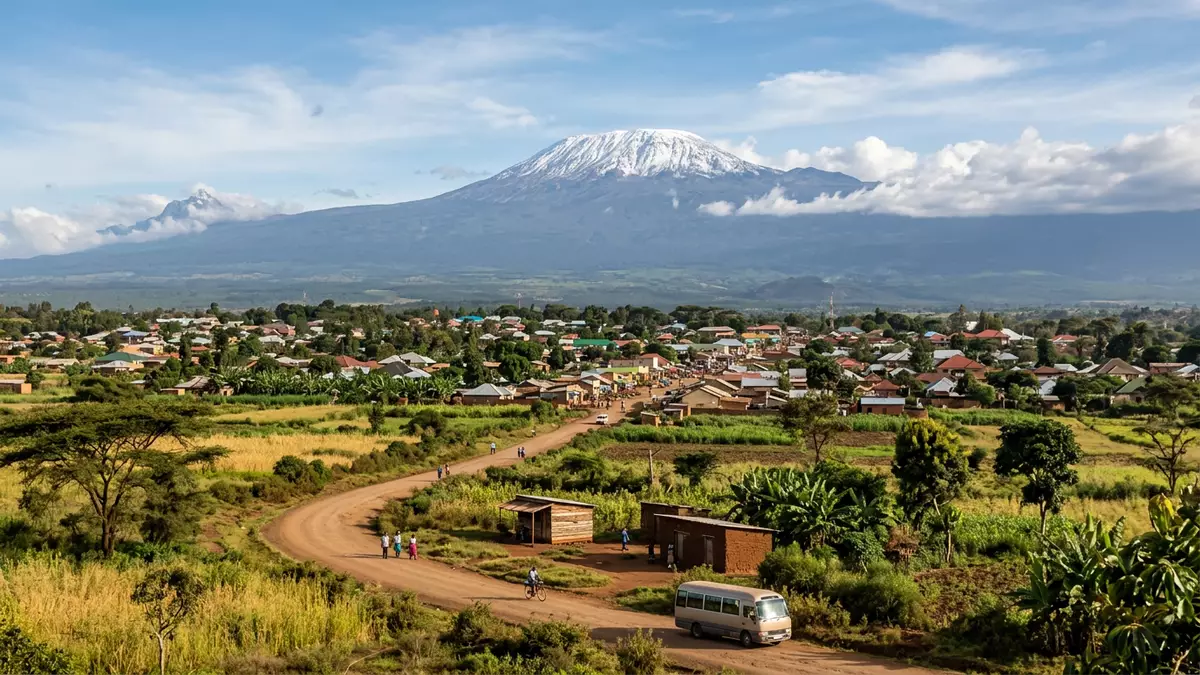
Kilimanjaro towers above Moshi in north?eastern Tanzania as a vast free?standing volcanic massif, climbing through clear ecological bands towards a snowy summit high over the plains.
The volcanic mountain at the heart of Kilimanjaro National Park
Mount Kilimanjaro is a dormant volcanic mountain in Tanzania, rising to 5,895 m (19,341 ft) above sea level and forming the highest point on the African continent.Mount Kilimanjaro The massif stands alone above surrounding lowlands rather than as part of a continuous ridge, which gives the mountain a distinctive free?standing profile visible from Moshi and across the Kilimanjaro Region.Kilimanjaro is the highest point in Africa
The mountain and its upper slopes form Kilimanjaro National Park, a protected area that covers tens of thousands of hectares around the volcanic bulk.Kilimanjaro National Park The park was established in 1973 and later inscribed on the UNESCO World Heritage List in 1987, recognising its volcanic landforms, forest belts and the dramatic snow?capped summit zone.World Heritage status
Layers of climate and vegetation from foothills to summit
Approached from Moshi, Kilimanjaro rises in clear layers: cultivated lower slopes, montane forest, heath and moorland, and finally the high alpine desert and volcanic summit areas.Kilimanjaro rises above Moshi in clear layers The montane forest belt encircles much of the mountain and provides habitat for a range of mammals, including species that are listed as endangered within the wider East African region.mountain forest and mammals
Higher up, vegetation gives way to bare volcanic rock, old lava flows and glaciers scattered across the summit crater area. At 5,895 m (19,341 ft), the highest point on the mountain is known as Uhuru Peak and sits on the Kibo cone, the central and highest of Kilimanjaro’s volcanic summits.Uhuru Peak on Kibo From the plains, the upper reaches form a pale, snow?covered cap above darker forest and heath, giving the mountain a layered appearance that changes with light and weather.
Moshi and the mountain’s north?eastern Tanzania setting
Kilimanjaro stands in north?eastern Tanzania, several hundred kilometres south of the equator and close to the border with Kenya.location in Tanzania Moshi lies on the southern side of the mountain and functions as a base town for the wider Kilimanjaro region, with the peak dominating its northern skyline on clear days.Moshi as a base for Kilimanjaro
The national park occupies the upper part of the massif and adjoining forests, stretching from the montane belt into the summit zone around Uhuru Peak.extent of the national park The surrounding plains link Kilimanjaro visually to the broader landscapes of northern Tanzania and the nearby Rift Valley, while Kilimanjaro International Airport and regional roads provide access towards Moshi and the park boundary.Kilimanjaro International Airport
Visiting Kilimanjaro: what travellers from Western Europe should know
- Kilimanjaro rises in north?eastern Tanzania, with Moshi on its southern side and Kilimanjaro International Airport serving the wider region.
- The mountain involves substantial altitude gain from foot of the massif to summit zone, and paths on the upper slopes cross rough volcanic terrain.
- The official language is Swahili and the currency is the Tanzanian shilling.
- Entry requirements depend on your nationality; UK travellers can check the FCDO travel advice at gov.uk/foreign-travel-advice, Irish travellers the Department of Foreign Affairs at ireland.ie.
Searching for Kilimanjaro on social platforms
These links open searches for Kilimanjaro on each platform.
Frequently asked questions about Kilimanjaro
Where is Kilimanjaro in relation to Moshi?
Kilimanjaro stands in north?eastern Tanzania, close to the border with Kenya, with the town of Moshi on its southern side and using the mountain as a landmark.
What kind of landscape can visitors expect on the mountain?
The mountain rises through cultivated foothills, belts of montane forest and heath into bare volcanic rock, glaciers and a high summit crater centred on Uhuru Peak.
What makes Kilimanjaro distinctive among African mountains?
Kilimanjaro forms a single free?standing volcanic massif reaching 5,895 m (19,341 ft), recognised as Africa’s highest mountain and protected as a UNESCO World Heritage natural site.


