
Kilimanjaro above Moshi: Africa’s free?standing giant
Published on 09/02/2026 at 06:50 | Editorial responsibility: Rafael Müller, Editor-in-Chief AD HOC NEWS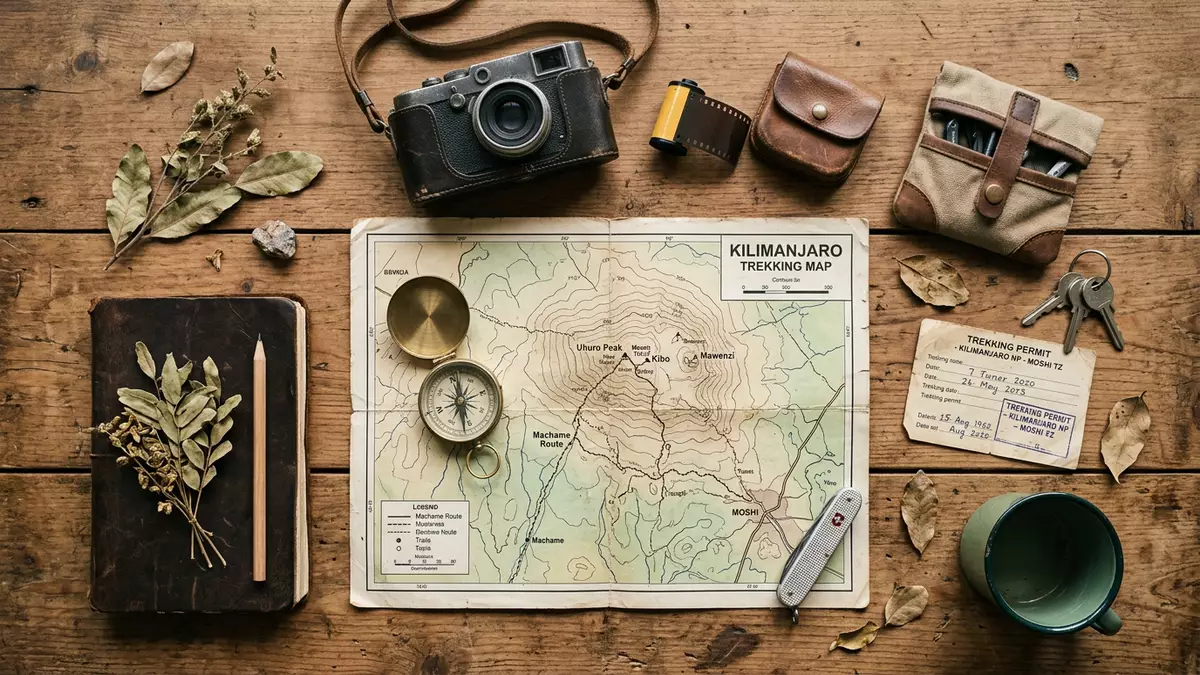
Kilimanjaro rises above the town of Moshi in northern Tanzania as Africa’s highest mountain and a vast volcanic massif that dominates the surrounding plains. The mountain reaches an official summit elevation of 5,895 m (19,341 ft) at Uhuru Peak on the crater rim of the Kibo cone, giving it a scale that shapes the entire region’s horizon.Africa’s tallest mountain
A volcanic massif with three distinct cones
Kilimanjaro is a volcanic massif rather than a single sharp peak, and its bulk stands in stark contrast to the relatively gentle landscape around Moshi. The mountain is a dormant stratovolcano composed of three main cones: Kibo, Mawenzi and Shira, each forming its own summit area and skyline.three cones Kibo Mawenzi Shira Kibo, positioned centrally, carries the mountain’s highest point at Uhuru Peak, while Mawenzi presents a jagged profile to the east and Shira forms a broad, eroded plateau on the western side.
The volcano sits in northern Tanzania close to the border with Kenya, its base rising out of the East African plains rather than from a larger mountain range.volcanic massif in northeastern Tanzania Kilimanjaro National Park protects the upper slopes and summit area, while farmland, coffee plantations and settlements occupy the lower foothills. The contrast between cultivated land and volcanic uplands is visible on any clear approach towards Moshi.
Summit height, first ascent and protected status
Uhuru Peak on Kibo’s crater rim is recognised as the highest point in Africa, with an official elevation of 5,895 m (19,341 ft) above sea level that has become the standard reference in maps and park documentation.Elevation 5,895 m at Uhuru Peak The mountain’s prominence over its plateau base underscores its status as the tallest free?standing mountain on Earth, rising dramatically from the surrounding terrain.tallest free-standing mountain
The Kibo summit was reached in 1889 by the German geographer Hans Meyer and the Austrian mountaineer Ludwig Purtscheller, whose expedition established a documented route to the crater rim.Kibo summit reached in 1889 Kilimanjaro later gained formal protection as a national park and was inscribed as a UNESCO World Heritage Site in the late twentieth century, recognising both its ecological diversity and its geological significance.World Heritage 1987 Moshi, at the southern foot of the massif, serves as a base town for ascents and connects the mountain to the wider transport networks of northern Tanzania.Moshi at the southern foot
Landscapes and ascent routes above Moshi
A journey from Moshi towards Kilimanjaro begins in cultivated foothills, where coffee and other crops grow in the fertile volcanic soils, and gradually moves into woodland and montane forest on the lower slopes.Moshi in Kilimanjaro region Higher up, the vegetation opens into heathland and moorland with scattered shrubs and rock outcrops, before giving way to an alpine desert of bare lava and ash near the summit region. Above this, ice fields and seasonal snow patches surround the crater rim, providing a striking view of white ice above equatorial plains.
Several well?established ascent routes approach the summit from different sides of the mountain, crossing these ecological zones in stages. Among the named paths are the Marangu, Machame, Lemosho, Shira, Rongai, Umbwe and Northern Circuit routes, each climbing through forest bands and open high slopes on their way towards Kibo.seven official routes Most organised climbs use Moshi or nearby villages such as Marangu as logistical bases, reflecting the town’s role as a practical gateway to Kilimanjaro.Moshi base town
Visiting Kilimanjaro: what travellers from Western Europe should know
- Kilimanjaro rises in northern Tanzania near the border with Kenya, and Moshi at its southern foot functions as the main town linked to the mountain.
- Approaches from Moshi towards the national park move from cultivated foothills into forested slopes before reaching higher, more exposed volcanic terrain.
- The official language is Swahili alongside widespread use of English, and the national currency is the Tanzanian shilling.
- Entry requirements depend on your nationality; UK travellers can check the FCDO travel advice at gov.uk/foreign-travel-advice, Irish travellers the Department of Foreign Affairs at ireland.ie.
Searching for Kilimanjaro on social platforms
These links open searches for Kilimanjaro on each platform.
Frequently asked questions about Kilimanjaro
Where is Kilimanjaro in relation to Moshi?
Kilimanjaro rises immediately north of Moshi in northern Tanzania, with the town situated at the mountain’s southern foot as a base for ascents.Location near Moshi
What kind of landscape should visitors expect on Kilimanjaro?
Visitors encounter cultivated foothills, forested lower slopes, open heath and moorland, high alpine desert of lava and ash, and ice around the summit crater.
What makes Kilimanjaro distinctive among African mountains?
Kilimanjaro is Africa’s highest peak and the tallest free?standing mountain on Earth, a stratovolcano with three major cones rising sharply above surrounding plains.highest mountain in Africa


